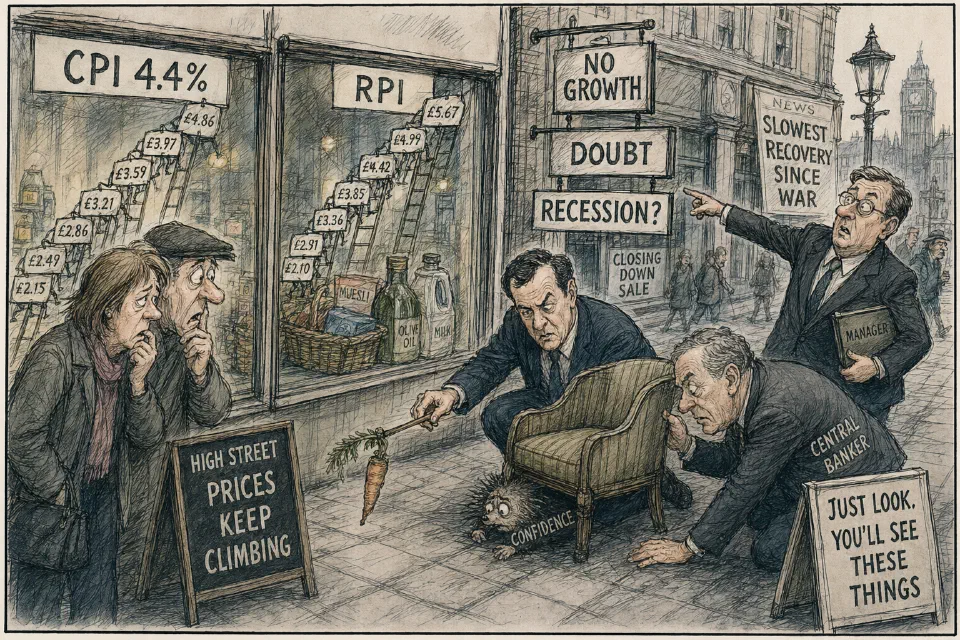
This country’s consumers are frightened by the outlook for our economy.
They have no faith in the various authorities’ competence to stimulate growth. In fact, they doubt the will and skill to prevent the UK from slipping back into a recession. GfK NOP says that people’s confidence fell for the third consecutive month in August. The biggest downward driver was negative sentiment over the general economic sentiment. The Consumer Price Index (CPI) has returned to 4.4% and the Retail Price Index (RPI) is still at 5%. Inflation is twice the Bank of England’s target. The Governor must have a standard letter of apology. Martin Wolf is Chief Economist at the Financial Times and has concluded that ‘This is no normal recession’. The economies throughout Europe and the US urgently need a serious agenda for growth. Productivity-boosting actions, cutting barriers to trade and more determination on removing excessive regulation are essential everywhere. Faster pace on development and renewal of infrastructure and remodelling of public services are no brainers.
The CBI’s president is right, ‘Recent difficulties in the recovery have made the case for economic reforms more pressing, not less ……….’
Employees (and volunteers) regard a destabilised department or project as a threat to their career or reputations.
Sometimes, they grow weary of the uncertainty and decide to seek their futures elsewhere. Typically, they are more willing than usual to consider opportunities by other firms. Talented people are often the first to go. Good swimmers are the most likely to jump ship. This can drain a workplace of its highly skilled people at a time they are needed more than ever. Shrewd managers move quickly to re-establish the commitment of their disaffected, but valued, staff. They do this with the same intensity devoted to finding an outsider. The managers romance them and tell them they are important to success. It’s a high risk stance to assume that key players will remain in place just because they have not announced publicly they intend to leave.
MBO, PERT, ZBB, theory X and theory Y, DCF, managerial grid, transactional analysis, matrix management, one-minute managing,
QCs, TQM, Excellence, BPR, NLP and so on. Why are managers still attracted to the quick fix? This, in the face of forty years’ experience with fixes and knowledge that fads move in predictable cycles. The size and scope of a fad industry has prompted many researchers to attempt an explanation for the fascination. Peter Drucker thought the love of patent medicines was neither new nor exclusively managerial, but endemic: ‘It’s an old habit. We love panaceas, the quick fix that can solve everything from bad breath to cancer’.
Employees know at first hand the complexities of an organisation. The simple solutions embodied in fixes are typically seen by them as little more than bandaids for what may be systemic illnesses. Moreover, they have to live with the consequences of applying one sticking plaster after another. When they lose faith in the acumen and actions of managers, no fad or fix can remedy the situation. Fads easily become myths. These myths distort reality, promote automatic means and ends, and kill imagination. None of these words of caution should be interpreted as trying to stop experiments.
I reckon procrastination causes five working weeks’ lost time each year for every employee.
Reasons? Inability or unwillingness to take decisions; lack of effective communications; confused or conflicting instructions resulting in double-work.
By gum
New Yorkers were nearly twice as likely to die from a horse accident in 1900 (1 out of every 17,000 people), than they were from a car accident in 2007 (1 out of every 30,000). Superfreakonomics by Steven D Levitt and Stephen J Dubner (Penguin).