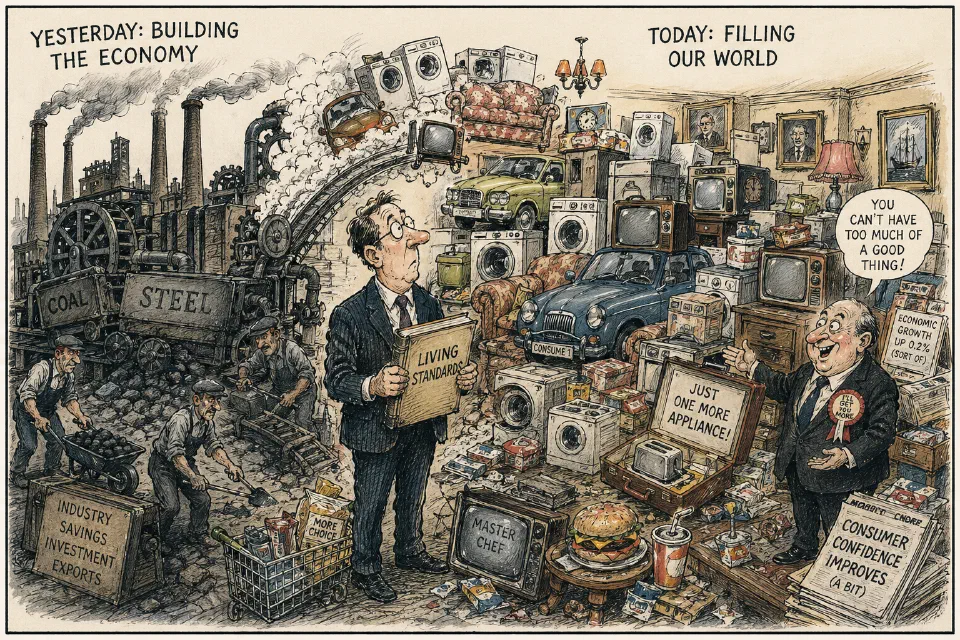
Oil, coal, steel, machines in big workplaces was the economy of our earlier years.
It was successful, if not overly efficient, at making things and moving them around. In two generations, the UK moved from an economy based upon human muscle to one driven mostly by machines. By the 1980s, there were more washing machines than households, more settees than people to sit on them, more cars than drivers, more televisions than pairs of eyes and more burgers than we could eat. Living standards rose rapidly. Additional things suggested higher status and wealth. That is how economists measured the situation. We expected more the next year. Governments and business relied upon the upward shift in consumption of most items. Then we discovered personal credit in big lumps. This is not the same as money earned. Wages and other income are a form of wealth. Debt is a claim on money we have not earned. Debt has to be paid back. Years pass by, then we find ourselves – particularly governments and individuals – in trouble. Thanks to Bill Bonner for the prompts.
Your scribe had dinner recently with a couple of Australians.
They were delighted with purchases in this country. The Australian dollar has risen by 60% against the pound in the last five years. Our prices look low. The US dollar is up 21%, the New Zealand dollar 43%, the Singapore dollar 59%, the Japanese yen 87%, and the Thai baht 42%, And, wait for it ….. , the euro 23%. All of this is good for tourism and should assist exporters. The clutch of figures explains a lot about our inflation. Costs of all our imports – food, energy, clothing, shoes and so on - increase as sterling falls. This inflation accounts for much of our economic weakness.
The end of economic growth for at least several years
is being considered as a possibility. Dejected economists have searched unsuccessfully for an explanation of the continuing crisis. The International Monetary Fund (IMF) has predicted flaky growth for the ‘advanced’ economies. The Organisation for Economic Co-operation and Development (OECD) gives warnings, too. You will have observed that the Office for Budget Responsibility (OBR) quietly extends the date on which austerity will come to an end (2018 right now). The biggest political/economic problems faced by the UK are an ageing population, unemployment and debt (public and private). If the ‘steady state’ economy becomes a reality and policy, the Conservative and Labour Parties will have to reassess their approaches to promises and aspirations.
Change has to be the natural habitat of managers.
Multinational corporations are those businesses which have subsidiaries in two or more countries. In 1970, more than half of the world’s 7,000 multinationals had their headquarters in America or the UK. Today, there are 79,000 companies of this kind, more than eleven times as many as in 1970. Only 2,418, or 3.1% are based in the United States. 56,448 (71.5%) are centred in other developed countries; for example, Canada, Germany, Japan, Italy and the UK. 20,586 (26.1%) are located in developing countries; Brazil, PR China, Columbia, India and South Africa. With enabling technologies and cheaper travel we live in a different and smaller world. Mobile investment is an increasingly important and common method of conducting global business.
Are large institutions incapable of holding themselves to account?
Banks, parliament, churches, press, police and now the BBC seem to have ignored the simple notion of our trust in them. Each group’s first reaction to accusations was denial. This was followed by attempts to downplay their misbehaviour. MPs had the cheek to insist that even the most extravagant claims for expenses were ‘within the rules’. The lesson to be learned is that openness and transparency are the most effective safeguards against abuses of power. How do we get there?
That’s correct.
‘The conventional view serves to protect us from the painful job of thinking.’ J K Galbraith, quoted in The Week and Associated Press
He knows, you know.
‘I’ve learnt one thing – people who know the least anyways seem to know it the loudest.’ Andy Capp (cartoonist), quoted in The Buffalo News.