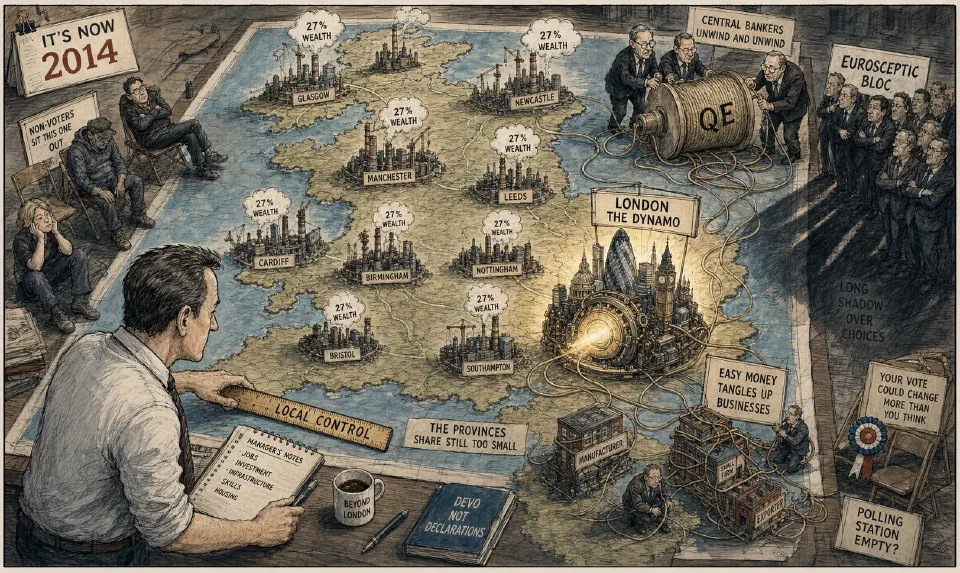
Between them, eight urban areas (cities) – Birmingham, Bristol, Leeds, Liverpool, Manchester, Newcastle, Nottingham and Sheffield – produce 27% of England’s wealth.
Everyone knows London is a dynamo. In the decade to 2011, populations grew: London (12%), Birmingham (10%) and Manchester by a whopping 19%. There is a connection between the figures and an ability to attract jobs, talent and investment. Expect a shift towards additional local control over finances and policies.
The politics of rejection and resentment will be a destabilising factor in 2014.
Plunging turnout of voters at elections is an affliction of mature democracies. In the general election of 2010, around 16 million electors did not vote. The proportion was lower among 18-to-24 year olds. In a recent survey (YouGov) only 7% of non-voters agreed with the statement: ‘Most MPs are basically honest’. It is likely after the forthcoming elections to the European Parliament there will be a large ‘Eurosceptic bloc’. They might be able to frighten the mainstream parties into nationalist policies. This would not be healthy for the private sector.
There will be a beginning of the end for quantitative easing (QE).
The sums of money are remarkable. £375 billion by the Bank of England and $85 billion a month by America’s Federal Reserve Bank, with a total of $3 trillion. And the European Central Bank has been active. There is no guarantee that the process of unwinding will be a smooth one.
The world will see a new cold war.
Three years after the Arab Spring, the Middle East is divided along a new faultline. And, at least for now, President Obama appears to be on better terms with Iran’s president than he is with Israel’s Prime Minister. Iran on one side, Saudi Arabia on the other. Israel and Pakistan look towards Saudi. The jostling for influence is slipping through Libya to Tunisia. Ironically (remember the war?), Iraq is inclined towards Iran. The effects are seen in Syria, where support from within Iran and Saudi Arabia goes to rival groups.
The latest recession and its consequences have differed from previous experience
Employment has been higher than expectations after the biggest fall in output since WW2. Productivity has reduced significantly. This is not unusual during a downturn. At September 2013, average weekly earnings (excluding bonuses) were about 8% lower than in March 2008. This drop is unprecedented in the post-war period. One set of explanations points to competition in the labour market and its impact on employers and employees. The population of working age has increased, not due simply to immigration and participation among the over-50s, has gone up. Welfare to Work policies have stepped-up attachment to employment. Thus, more employers were able to amend pay and working conditions that preserved jobs.
The other group of reasons for lower pay and conditions concentrates on how the economic situation might have change businesses’ decisions in ways that lowered productivity. Investment has fallen sharply. Firms, especially smaller ones with few physical assets, have found capital impossible to obtain at affordable rates. Of course, the poor outlook for sales and the general air of uncertainty have made companies of all sizes cautious on investment. Low interest rates have enabled some poor performers to remain trading by paying interest on debt, but not reducing the principal.
There is a crucial part for Government to play in overcoming these complications. It is almost impossible to know which options work. These observations were prompted by Mark Beatson, Chartered Institute of Personnel and Development.
Leadership?
Many (most?) people are administered at a workplace, not led. They are treated as ‘human resources’. Even the Government and universities provide modules and money on the subject. How do you spot a leader? They come in all ages, shapes, sizes and conditions. Some are dreadful organisers, others are not overly bright. The true leader’s group consistently turns in superior performances somehow. Lao-tzu was about right, ‘As for the best leaders, the people do not notice their existence. The next best, the people honour and praise. The next, the people fear; and the next, the people hate … . When the best leader’s work is done, the people say ‘We did it ourselves!’’
Just random thoughts.
‘Worry is the interest paid on trouble before it is due.’ *‘The public and private sectors are distinguished by the former to live after death.’ ‘One of the great puzzles in life is how a fool and his money got together in the first place’. ‘Luck is when preparation meets opportunity.’ *
A thought from John Maynard Keynes
in his Treatise on Money. It is enterprise which builds and improves the world’s possessions … . If enterprise is afoot, wealth accumulates whatever may be happening to thrift: and if enterprise is asleep, wealth decays whatever thrift may be doing.