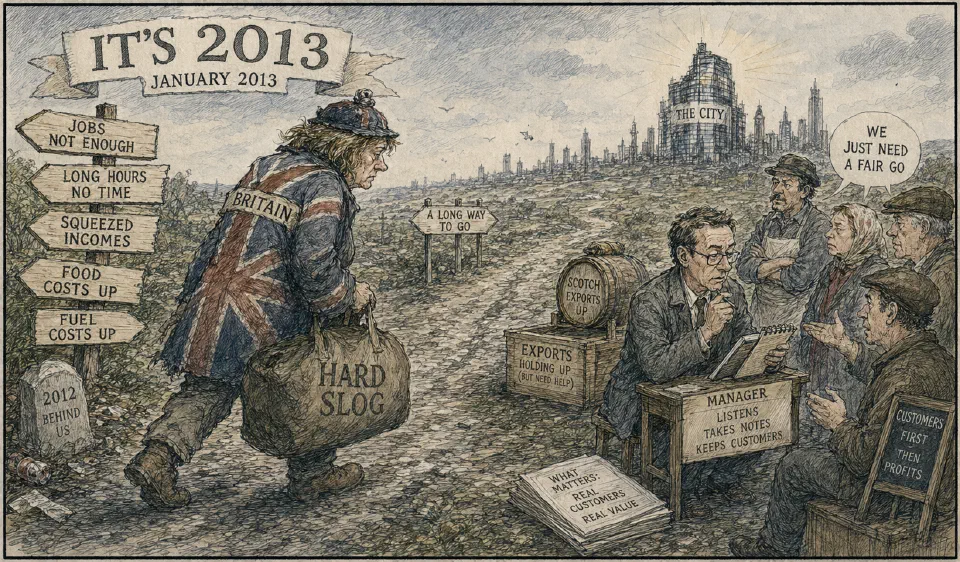
Most of us in the UK must brace ourselves for another hard slog this year.
That is what we are paid to do as managers. Reliable information suggests there will be fewer jobs, longer working hours and a continuing pressure on incomes. The Chartered Institute of Personnel and Development (CIPD) says that although employment will still rise, the net increase will be less than a fifth of the figure recorded for 2012. The Times (28 December) has pointed to an important statistic. Workers in the Scotch whisky industry take home a smallish fraction of the pay received by their counterparts in the City of London. However, contribution per person to the British economy is greater. The overall impact of these businesses on the economy is £4.2 billion, including £1.3 billion across the supply chain. It employs or supports 36,000 jobs. There is evidence here that the UK’s private sector is getting better at exports. Our marketing skills and cost structures are becoming more competitive.
Three warning shots.
A survey by the Bank of England on personal expenditure revealed that 35% of people spent less over the past year because of concern about debts. The response from about 6,000 households showed that one in ten adults increased working hours or took on a new job. Nearly 5% received financial help from relatives. The Bank said low income families have suffered the biggest squeeze on their cash, with 63% reporting that available income has fallen, compared to 48% in the wealthier bracket.
A study by R3 (insolvency practitioners) concluded that rising costs of food and fuel, rather than payments on mortgages or credit cards, are the main reasons why respondents struggle to make ends meet. The analysis found that almost half of Britain’s grown-ups (47%) struggle in getting to payday. 67% of this group blamed rising food prices and 58% attributed the situation to increased charges for fuel.
A review by Adzuna revealed that the growth in ownership of smartphone apps, tablets and online shopping has contributed to a boost for IT-based jobs, with more than one million specialist vacancies advertised in the sector. The second-highest hiring field in the UK was healthcare – mainly the National Health Service – with just over 700,000 posts, followed by engineering, finance and retail. Adzuna reckoned that Hull has been the most difficult place to find a job. In 2012, Aberdeen, Guildford and Cambridge have all had strong opportunities. Thanks to Idox.
Think long-term with customers. Instant friendships can disappear quickly.
Be thoughtful. Personal touches show you see them as more than just customers. You are interested in them, not in the budget only. Give extra advice for nothing. They might feel they owe you a favour as a result. Listen, listen, listen. They will give important clues on hopes and fears. Help to make them heroes. If you can remove some stress and let them take credit inside their businesses, they will be keen to work with you. Keep them informed about your work. They hate surprises. If anything goes wrong, they must be the first to know. Lead opinion. Challenge constructively and privately when you believe a customer is in danger of making a mistake. Good advisers tell you when you are going wrong. Keep your ear cocked for whispers of change. It will enable you to give good counsel. Make introductions. Introduce customers to people who matter in their worlds. They will feel part of an inner circle. Stay in touch during the fallow periods. Fair weather advisers vanish like dew in the morning. You will be remembered and trusted when the good times return. Nothing beats doing a good job. That is, nothing. With thanks to Octavius Black, the Mind Gym.
Are they ready for additional action?
Your scribe has served over the last thirty years on the boards of several ‘businesses’ in the third sector – charities, higher education, a public corporation, a social enterprise and a workers’ co-operative. There has been a wide range of sizes. All of them have had honourable objectives and loyal managers.
The government has declared its intention to encourage the formation of ‘mutuals’ to own and manage activities delivered currently by the public sector. However, there are huge differences between these institutions and commercial companies. A major one is the disciplines for measurement of success. There are many key performance indicators for conventional businesses : net profit, return on investment, price of shares, capital gains, dividends, price/earnings ratio, market share, value added. And more. These are the kind of tools with which managers run their firms and tell them if they are doing well or badly. Without them, guesswork is all-embracing.
‘Not-for-profits’ suffer from a lack of reliable measures/standards which show whether the outfit is discharging its obligations effectively. How do benefactors know if the charity to which they give is efficient? How can trustees judge if the managers are doing a competent job as custodians of resources? There is much work to be done. Otherwise, the government will lose a lot of tax payers’ money and inherit some sticky problems. There have been a few rumblings already.
That’s correct.
‘All great things are simple, and many can be expressed in single words: freedom, justice, honour, duty, mercy, hope.’ Winston Churchill.