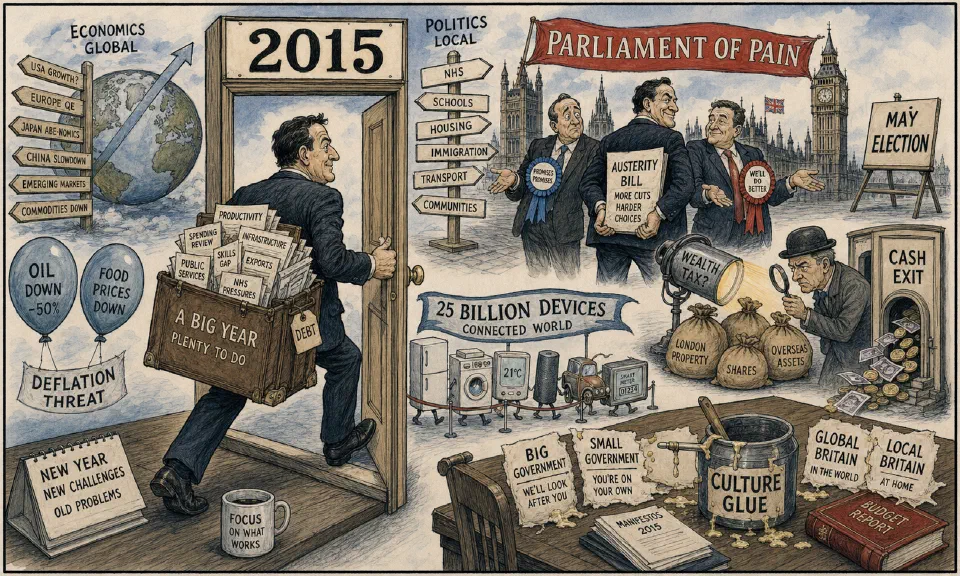
Issues for managers
include:
-
handling disillusionment. Expect an extension of austerity after the general election in May
-
dealing with politics going local as economics move more global
-
balancing the impact of falling costs. There are losers and prospects of deflation in some countries
-
responding to the inevitable increases in taxation of assets/wealth. They are more difficult to hide
-
alleged decline in social mobility. This topic will attract political intervention
-
discovery of unusual friends for the UK in Eastern Europe and the Middle East
-
the ‘internet’ of things. Cisco estimates that 25 billion devices will be connected by the end of this year. Up from 12.5 billion in 2010
-
the end of cash. UK Payments Council expects 2015 will be the year when payments by cash will become fewer than half of transactions.
Parliament of pain in May.
None of the main political parties denies the certainty of sustained austerity. All tell us about the ‘tough choices’ ahead. Indeed, Chancellor George Osborne in his Autumn Statement sought to convert economic failure into political success. He asserted that only the Conservatives can be trusted to complete removal of the deficit. Labour has popped up with the slogan, ‘Big reform, not big spending.’ The Liberal Democrats split the difference by pledging to reduce the deficit faster than the opposition, but in a fairer way than the Tories. George Eaton has pointed out that, ‘Here the truth telling largely ends.’ No party is prepared to itemise the next dose of financial severity. There are short populist statements. Labour and the Conservatives respectively target the wealthy and welfare. But seeking to raise more from these sources is the politics of easy choices, not hard ones. The Institute for Fiscal Studies (IFS) suggests that £12 billion of additional consolidation will be needed simply to maintain cuts in departmental spending at their present delayed level. Senior politicians have not come close to revealing plans for bridging this gap. Is there an unstated conspiracy of silence? The reality of Britain’s fiscal situation is being hidden.
The business of government has been modified.
Managing an economy is no longer about ownership/control, but to assure the conditions for flourishing businesses. Companies rely on the absence of despotism, not on democracy. Oligarchy in one form or another has become a fashionable answer. Real opposition has withered on the vine throughout Europe. There are some signs of disenchantment. We can expect a continuing fall in the quality of public debate. Consensus is all the rage.
Culture.
We talk a lot about culture and blame it for many managerial ills and some successes. But nobody tells us the meaning of this word or situation. So here goes. Broadly speaking culture is the adhesive that binds people to their employer and guides their actions when hard and fast rules are ambiguous, insufficient or absent. When it does not work, the company/institution has got a problem. Opinions and behaviour get ingrained in every group/level – from structure of pay, methods of promotion and how people are recognised. Employees are likely to do what they think their managers approve. You can declare values and encourage particular behaviour, but if there is not a constant link between the two, failure will come your way. You are not walking the walk. Success is not immediate. Consistency with a desirable culture can be uncomfortable. The result of shortcomings is rarely criminality or malfeasance. Incompetence and confusion can be just as damaging.
Good idea.
‘First learn the meaning of what you say, then speak.’ Epictetus (50 – 120 AD), Greek philosopher.
That’s experience.
‘Management by objectives works if you know the objectives. Ninety per cent of the time you don’t.’ Peter Drucker, American commentator on management.