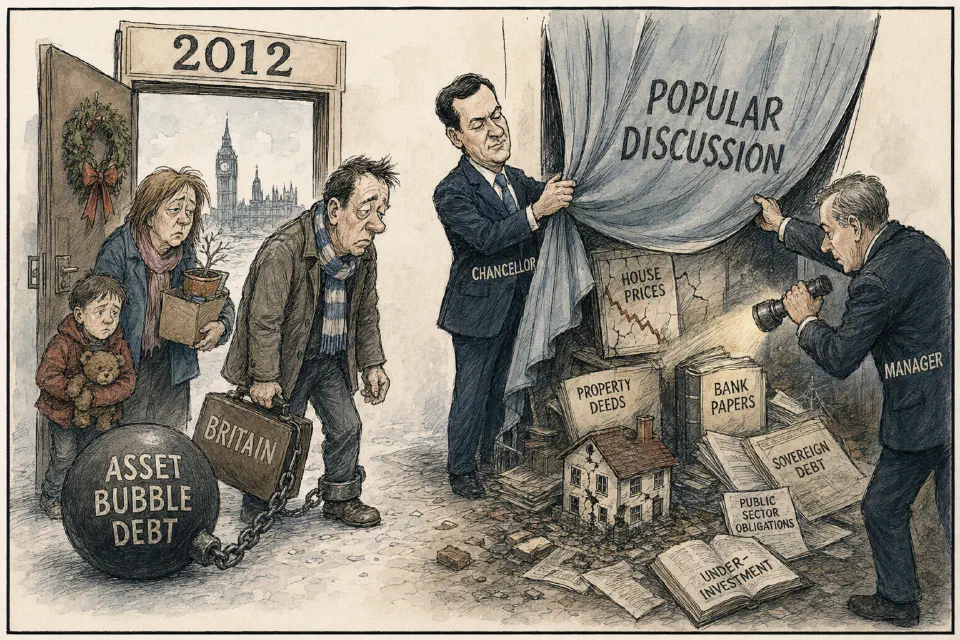
Omission of uncomfortable realities
from discussions of politics and the economy are a weakness of popular methods for informing us. For example, the present domestic problems have more to do with a price bubble on assets. Business households and banks find themselves with properties that are no longer worth the price paid for them. However, the consequential debts are still outstanding. Defensive personal and corporate behaviour is an automatic response and include reducing expenditure to lower liabilities. Collectively, these actions are devastating. They eliminate demand from the economy, weaken growth and cause shifts towards more downturns. The double-dip, maybe? Bear in mind that latest estimates on plans relating to public expenditure might achieve only half of the government’s target to bring down debt by the end of this parliament. Managers must continue their pursuit of higher productivity – as an obsession.
Is the scrutiny of the ‘Big Four’ overdue?
They – Deloitte, Ernst and Young, KPMG and PwC – dominate the market for audits. Only one member of the FTSE 100 index has its books reviewed by a firm outside the quartet. Only 2.30% of these top companies have made a switch within the group. This explains the Office of Fair Trading’s decision to refer the profession to the Competition Commission. Why stop here? The magic circle of lawyers Allen and Overy, Clifford Chance, Freshfields, Linklaters and Slaughter and May, occupy lofty positions also. This story started in The Independent.
Nicolo Machiavelli (1469-1527) has many statements and traits attributed to him.
Most managers have not taken the trouble to read ‘The Prince’ by this Florentine diplomat. It is an omission. For example, Machiavelli says, ‘It is unnecessary for a prince to have all the good qualities I have enumerated, but it is very necessary to appear to have them.’ And on managing change, the recent imperative, ‘There is nothing more difficult to take in hand, more perilous to conduct, or more uncertain in its success, than to take the lead in the introduction of a new orders of things.’
In his book,
‘Global Strategies’ (Harvard Business School Press) Percy Barnevik, formerly of ABB, writes, ‘It is often easy to be dazzled by flashy concepts and slick managerial jargon. The much-touted international matrix organisation, for example, can be a disaster or triumph, depending on how the model is implemented, how individuals understand their roles and relationships within the organisation, how procedures are specified, how managers can contain overhead costs. As the English say: the devil is in the detail.’ He reckoned the common thread through successful businesses is their leaders’ ability to combine and vary, depending on the issue: vision, leadership, communication and execution.
Producers of goods and services have devoted themselves to consistency and avoiding errors.
Many still have a lot to do. But the next stage of managerial excellence is on the horizon. Customisation and speedy innovation will be the order of each day. Concepts such as zero defects and just-in-time will be regarded as the essential last throes of dominance by producers. They are no longer enough for competitive advantage. They will be taken as automatic. In the new economy, a customer can shop anywhere in the global village. Best in the world has to be a credo for all businesses, irrespective of size.
There’s a surprise
‘Thirty-eight percent of British office workers would rather see a colleague made redundant than take a cut in salary.’ Daily Telegraph, 4 October 2011.
Have an untroubled Christmas, happy New Year and a prosperous 2012.