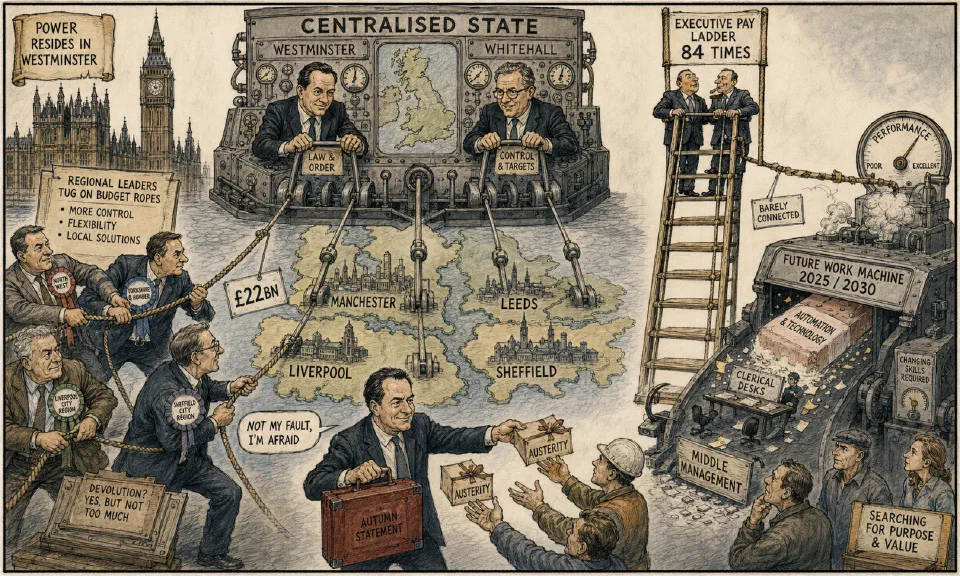
Power to the English regions?
Politicians of all shapes and sizes have embarked upon a long, complicated and dangerous journey. Britain is still one of the most centralised states in the world and has been run by a Whitehall-based civil service since the mid-1800s – and still is. Bear in mind that talking about devolution is not the same as doing it. So far, caution has reigned. To obtain the full benefits of decentralisation, parliamentary politicians must have more faith in local authorities. Central government has to take substantial action if electors are to notice changes. Sir Richard Leese, leader of Manchester City Council has welcomed the Chancellor’s proposal but says he wants more; the transfer of all £22 billion of government expenditure in the area covered by the Greater Manchester Combined Authority. A shift of this scale would challenge all the controlling activities and reflexes of Westminster and Whitehall. There will be mistakes, bumps and misuses along the road which will test commitments to the plans and expectations. Nonetheless, outlines of additional proposals for Leeds, Liverpool and Sheffield, with more in the queue, might be astute moves by government. We know austerity will continue after next year’s general election. Only half of planned cuts in expenditure have been implemented by the Cabinet and public borrowing continues to increase. Handing budgets to municipalities spreads the blame for cuts and helps to make sure that spending reflects local needs. The dual rise of UK Independence Party (UKIP) and the Scottish nationalists emphasises the decline of faith in Westminster.
Pay of executives and results.
The alleged misbehaviour of bankers has made sure there has been analysis of their activities and performances. The European Consumer Staples team at RBC Capital Markets found, ‘a minimal correlation between remuneration and long-term share price performance’. Another study said, ‘ … attempts to link pay of Britain’s leading company executives to their company’s performance are not working’. The consensus of research into the subject is clear and is receiving attention from Management Today and Banker’s Umbrella. Executive pay has little to do with a business’s results. The figures are startling. Of the companies in the Fortune 500 (USA) in 1955, only 13% remain. The trend in increased pay for executives has not brought corporate longevity, business growth or increased shareholder value. Despite all the evidence, there remains an almost common belief that corporate executives are leaders who create and build value. Is this a myth? Is it possible executives are administrators, not leaders? The real job is to sustain the business and control risk. These are important duties but the incumbents are not risk-takers. On average, they are paid eighty-four times the salary of an average worker. There is an acceptance that when you take risks and they pay-off you deserve the related and substantial rewards. However, the real situation is likely to create a lengthy sense of unfairness.
Jobs will disappear.
CBRE, a major consultancy firm and China-based Genesis, say their research shows that 50% of today’s occupations will not exist by 2025. This includes processing of all kinds, work relating to customers and middle management. The report titled ‘Fast Forward 2030: The Future of Work and the Workplace’ suggests that advances in technology and artificial intelligence will help to transform organisations and the jobs people do. Peter Andrew of CBRE Asia Pacific concludes there will be ‘new opportunities for companies to create value and enhance employees’ performance through innovative workplace strategies and designs. Many of these opportunities have already arrived and by seizing them early, smart employers can gain a competitive advantage’. The findings are reinforced by research from Oxford University and Deloitte. It indicates that 35% of existing jobs in the UK – including office and administrative support; sales and services; transportation and construction – are at risk of being replaced by robotics. The ability to attract and retain top talent will be the commercial edge in 2030. Employees now seek purpose, meaning and authentic values in their tasks.
Wisdom.
‘Tact is the ability to tell someone to go to hell in such a way that s/he looks forward to the trip.’ Winston Churchill, 1874-1965.
Me too.
‘I read the newspaper avidly. It is my one form of continuous fiction.’ Aneurin Bevan, 1877-1960. British statesman. MP from 1929. Minister of Health, 1945-51.