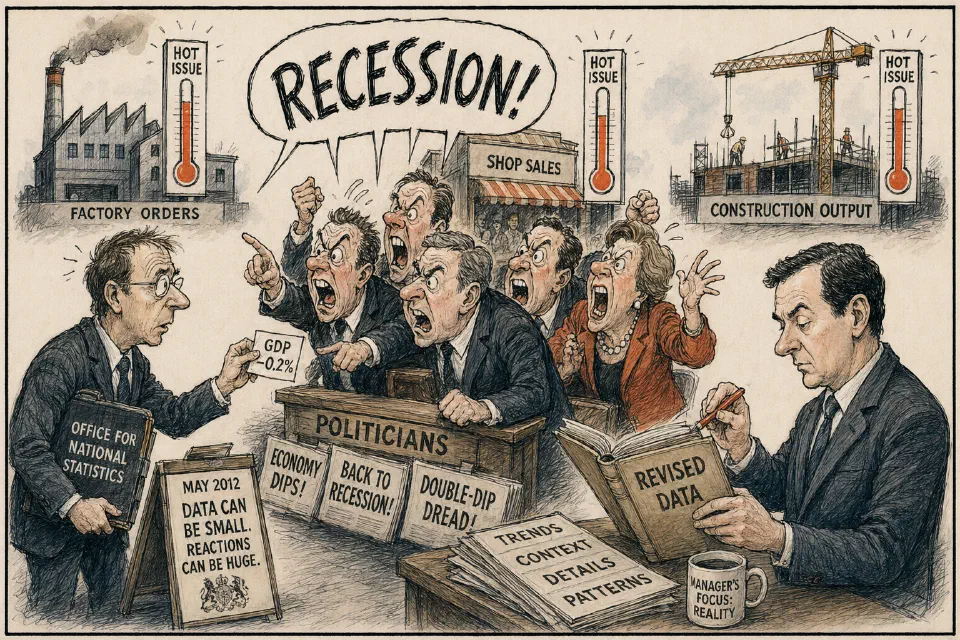
The economy unexpectedly shrank by 0.2% in the first quarter of 2012.
This was the second successive period of contraction, fulfilling the technical definition of a recession. This is politically significant, but does not mean a lot in a deeper economic context. Gavyn Davies observed on FT.com that first estimates for gross domestic product are notoriously unreliable. They are based on only 40% of the data collected eventually by the Office of National Statistics (ONS). Revision upwards is common. Also, a dramatic slide in the volatile figures for construction was a major factor, but is especially prone to correction. The minutes of a recent committee of the Bank of England assume the economy is in a bit better shape. And the trends from the respected Chartered Institute of Purchasing and Supply indicated better results than those shown by ONS.
Even so, the overall situation and outlook give no room for satisfaction. Manufacturing is stagnant. The services sector hardly grew and can expect pressure downwards because of higher cuts by the public sector. Inflation is giving greater difficulties than expectations. This does not bring confidence for personal expenditure. Indeed, the last five years have seen the deepest downturns and weakest recovery for 100 years. France’s new president, Francois Hollande, seems likely to press for a fiscal compact underpinned by growth-oriented measures. There will be sympathetic ears in at least Greece, Holland, Ireland, Portugal and Spain. However, the president of the European Union has warned, ‘some people are creating the illusion that pro-growth policy is easy’. The ‘traditional Keynesian remedy of turning on the government taps is simply not available’. The changes have to be structural reform, these take time and pain. Germany might be unwilling to release any more money to alleviate others’ debts. As Capital Economics says, we must win back the ‘vast amounts of competitiveness’ we have lost if we are to improve our prospects for growth.
Away days, strategy discussions and brainstorming sessions
I receive invitations to attend these serious explorations. Of course, this is good for my self esteem. However, my mind is moving towards the conclusion that such gatherings are mostly a waste of time. Social media and other internet-based approaches emphasise the proposition that assembling crowds is an effective way to devise new ideas. The reality is that few of us have our best visions in a group. Concentration needs privacy and reflection. So-called teams are dominated often by those members with the loudest voices. They do not necessarily bring insights to the party. Profound suggestions tend to be crushed by consensus. Obvious and apparently safe choices always shift us towards the comfortable middle. I doubt that many innovative breakthroughs happen in meetings. Rather, they are produced by individuals with special talents - often introverts - working on their own. Sadly, assemblies of all kinds have become a substitute for handling proper demands from making decisions. Implementation is a different kettle of fish.
Formal watching of social trends is now a component in the toolkit of managers
But which ones? A large number can confuse businesses and lead to wasted money. Here are some key points: social factors will become important in operating and commercial systems. Designers of such processes will have to adopt a people-centred approach. These issues should have constant scrutiny
-
directors/senior managers as group would be wise to review systems and working practices to reveal legal, ethical and social vulnerabilities
-
the connected society (Internet and so forth) affords opportunities for products and services. But it also presents threats. Think about analysing both
-
discern and exploit the outcomes from every possible source and relationship in offerings
-
explore the prospects for capitalising on the effects of networks and the social media to solve managerial predicaments in new ways
-
privacy is a way of life and a strategic decision, not a technical one. Who has personal responsibility?
Wisdom?
One of your scribe’s respected friends suggested recently that the pursuit of knowledge has caused a loss of wisdom. She reckons this valued quality means behaviour that takes account of what is known and what ‘does most good’ – ethical and social considerations. Maybe those of us who try to manage businesses have lost or ignored these insights? They are often omitted from discussions about leadership. Yet experience points constantly to their importance.
About right.
‘Meetings are indispensable when you don’t want to do anything.’ J K Galbraith, an American economist, quoted in the Financial Times.