Continental Europe.
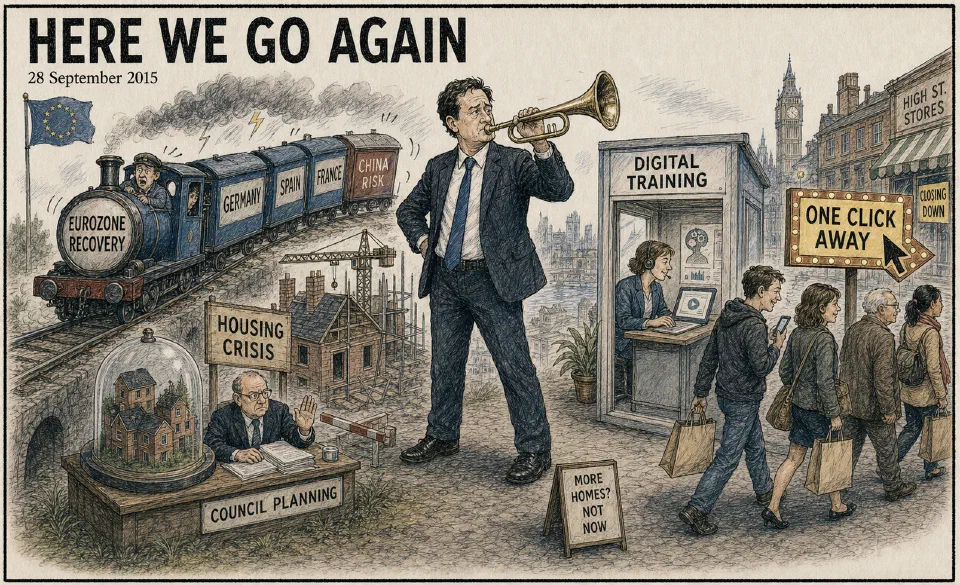
For a change, there has been some good news from the eurozone in recent weeks. Services and manufacturing have been at their highest performances for four years. Spain’s economy went up by 1%, with stagnation in France. Germany achieved exports at €103.4 billion in July, a new record. Life will become difficult for the eurozone if China suffers a slowdown. Germany accounts for nearly half of the European Union’s exports to China. She is driver of eurozone and accounts for about 30% of the territory’s GDP. Capital Economics points out that many of its exports create demand for products from other eurozone countries. The president of the European Central Bank might have to reintroduce quantitative easing (‘printing of money’) if growth goes down and inflation stays weak. Mind you, that would be good news for European equities.
A crisis for housing.
Yes, there is one and it is a good example of what happens where our kind of democracy wobbles.
Everyone says s/he supports the building of affordable homes. Most of them do not want such initiatives to be taken where they live. Green fields and Green Belts near cities are untouchable. Governments are faced with the danger of losing votes and stimulating protests in those parts of the country where people most want to live and work. They have avoided the issues year-in and year-out. One after the other. Of course, the changing demography of Britain is a large part of the problem. Not only more people, but older ones and many living alone. Immigration is a factor, but only a small one. The difficulties cannot be solved without central government. This is the one institution which can set the balance between national needs and local planning. Or construct railways and roads so that people can easily live in one place and work elsewhere.
Disconnect.
Between programmes for learning and development of employees. This is one conclusion of a survey by The Cegos Group. It covered 600 directors of human resources and 2,500 employees in Britain, France, Germany, Italy and Spain. 84% of the directors said training is becoming increasingly digitised. They use e-learning modules, virtual classrooms and web conferences. Massive Online Open Courses (MOOCs), Small Private Online Courses (SPOCs) and Corporate Online Open Courses (COOCs) have a growing importance. Of those asked, 62% across the five countries said computerisation was one method for reducing costs. There is not a reduction in satisfactory results. Of course, individual learning and group-based training remain the largest, if diminishing choice.
Society is changing.
We have less time and additional people in work – for longer hours. As customers, we have more products available to us, extra information and a baffling range of accesses to it and means to make purchases. We can shop at all hours, do banking on the move, research for a new car on the internet and book travel through television. Relationships with loyal buyers are recognised increasingly as the only reliable source of competitive advantage and primary component of corporate survival and long-term profitability. The better we know our customers, the better we serve them and the longer we benefit from their loyalty. Tomorrow’s winners are listening to their customers at every opportunity to understand their needs and wants, create personalised messages and offers, and react with them on their terms – wherever, whenever and however they choose. It’s ‘hear today or gone tomorrow’. If we don’t listen to customers we will lose them to someone who does. After all, our competitors are just a click away.
A real danger.
‘Business has only two functions – marketing and innovation. The modern corporation is a political institution; its purpose is the creation of legitimate power in the industrial sphere.’ Peter Drucker; academic/economist, author of successful books on management, professor of social sciences at the Claremont Graduate School in California from 1972.
And it works.
‘The only way to convert the heathen is to travel into the jungle.’ Lane Kirkland; an American trade unionist in 1980, on working with capitalists.