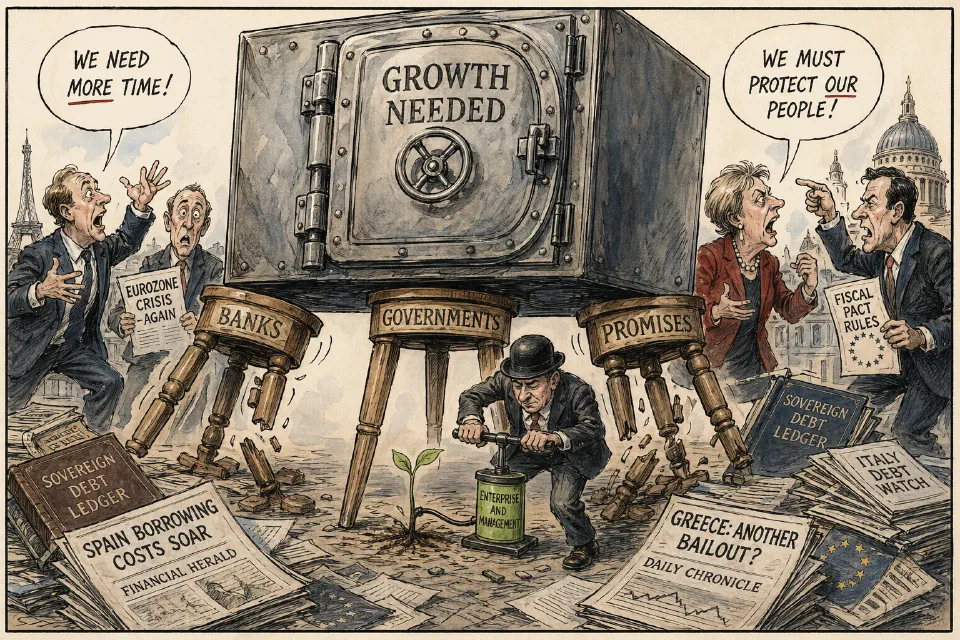
Without economic growth, most of the world’s major banks will go bust.
And every government in the developed world is likely to default on its debts and promises. Moreover, the world we have known will fall apart. The only way out of the problems of sovereign debts in Europe is growth. Everybody assumed that growth would continue – even if it is interrupted every now and again by a recession. Previous recessions since the 1940s have been a relatively quick and painless pause. They have not been major changes of direction. Things are different now. My thanks to Bill Bonner for the stimulation.
Companies’ directors have a ‘distorted’ view of their success and reputation
compared to the self-image of less senior managers in their organisations. This is the conclusion of new research by Roffey Park. Twice as many board-level executives as line managers felt that redundancies had been managed well in their businesses. Sixty-two per cent of directors thought that their firm was ‘very supportive’ of learning and development. Only fifty per cent of managers had the same view. Almost ninety per cent of directors thought their leadership was good or excellent, compared to seventy per cent of managers. Seventy-nine per cent of members of boards said they were well respected, only fifty per cent of managers came to the same conclusion. On every issue, woman managers were less positive about their seniors than male counterparts. For the second year running, Roffey Park’s findings suggest that board directors are out of touch with the concerns and issues facing managers at all levels. I will look in the mirror more closely.
Smart managers are reconsidering value for customers in a post-digital economy.
They are finding that it is now less about the quality of a product or service – performance is taken for granted. Increasingly, customers are favouring the suppliers who can best answer such questions as:
- delivery: are you reliable?
- total cost of procurement and ownership: how much will I pay – in time and aggravation – to do business with you?
- information: what can you tell me about my customers?
- business-based expertise: which of my internal processes can you make more effective?
- brand: what promise does your product or name imply?
There is emphasis on new value for customers, shareholders, employees and the community.
Gary Hamel, the corporate strategist and author, sprays important ideas all over the place.
Intangible assets such as innovation, organisational culture and strategic capabilities now account for as much as 85 per cent of market capitalisation for many firms in the United States, he calculates. The future is about differentiation; size is no longer a defining issue. ‘Capture new wealth by being novel and ask yourself if the voice of imagination is as loud as the noise of experience.’ Market share is dead, asserts Hamel. If companies want to increase their proportion of wealth; they will have to ‘reboot’ and rethink plans more quickly. He suggests three types of capital – intellectual, structural and financial. A lot of businesses are threatened by their traditional ways of doing things.
Blimey
‘The majority of property in the City of London is now owned by foreign institutions (fifty-two per cent).’ The Financial Times, 21 November 2011.