Interest rates.
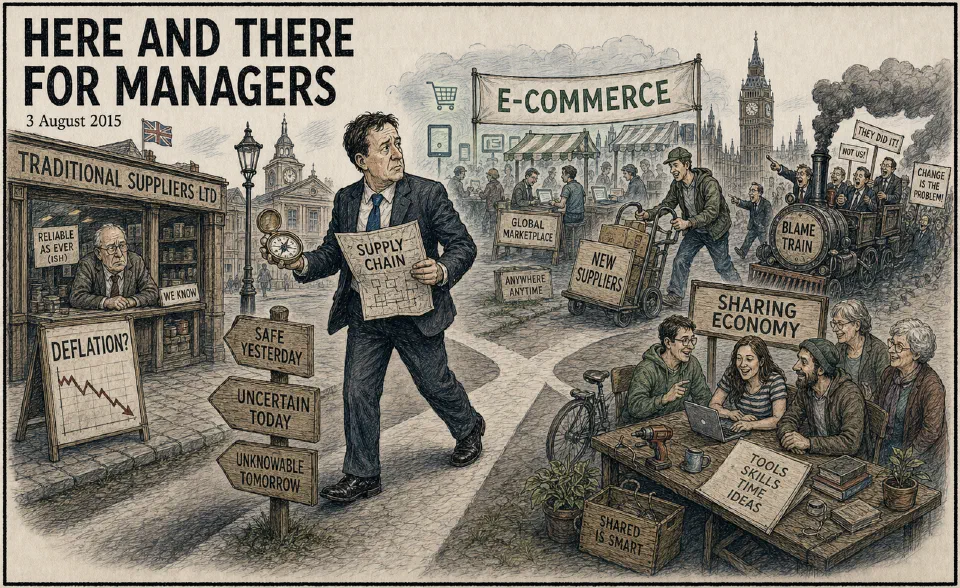
Katie Allen noted in The Guardian that Britain might experience another dip into deflation. The price of oil has slipped again recently and the strong pound will avoid inflationary pressures. There is no sign of stagnation. Real increase in wages is around 3% a year, good news for retailers. Surveys of employment remain consistent with an increase in the number of jobs. Well- informed economists are confident the Bank of England will not go for dearer money until February 2016.
New habitat.
The world of electronic commerce is an uncertain one. There are no fixed rules and boundaries. Managers face journeys into the unknown. It is clear they will have to cope with enormous upheavals if they are to reap any benefits from e-commerce. The challenge is to put into place the ‘right’ strategy, supported by agile supply chains capable of satisfying new demands from customers. Many existing businesses will fail. When the mists of uncertainty become clearer, only those companies committed to learning the many painful lessons from trading in the digital era will retain their prospects for a profitable future. The special hurdle is to obtain a place alongside the teeming mass of new suppliers untrammelled by a traditional organisation.
Quick summary of impact.
Information technology (IT) has delivered three big changes. First, it has reduced the need for work. Second, it has become possible to provide an abundance of goods and services which disrupt sectors founded on scarcity. Third, it encourages collaborative production, outside the dictates of markets. Just think, Wikipedia is produced by unpaid volunteers and has abolished the sales of encyclopaedias. Almost unnoticed, major parts of economic life are on the same route. The so-called ‘sharing economy’ may well replace what we know as capitalism.
Persistence will be a major factor.
Members of elected governments in the western world will be having sleepless nights. There is evidence of a widespread and popular discontentment with conventional stances and their advocates. Upstart candidates and parties seem to be challenging political establishments all over the place. The anti-austerity party, Syriza, dominates Greece and Podemos, its counterpart in Spain, has made gains. Bernie Sanders, a declared socialist prospect for the presidency in America, is drawing record crowds. Donald Trump is making an impact in his campaign for the Republican party’s nomination. He relies on the toxic rhetoric of ultra-nationalism. There have been worrying shifts in Denmark, Finland, France, Germany and the Netherlands. In the UK, Jeremy Corbyn MP continues to shock by outpolling his three centrist rivals for leadership of the Labour Party. The United Kingdom Independence Party (UKIP) delivered a few frights in the recent general election. Peter Bloom (Open University) points out that despite political differences, these movements reveal dissatisfactions with ‘respectable’ offerings and proposals. They are challenges to the comfortable political class and their beliefs. The ‘blame train’ is gathering speed. Sporadic attacks will not deal with the many issues.
Sounds correct.
‘If you can’t explain it to a six-year-old, you don’t understand it yourself.’ Albert Einstein. 1879 – 1955. German theoretical physicist.
And then it’s too late.
‘Inside every old person is a young person wondering what happened.’ Sir Terry Pratchett. 1948 – 2015. English author of fantasy novels. Best known for his forty volumes of the Discworld series.