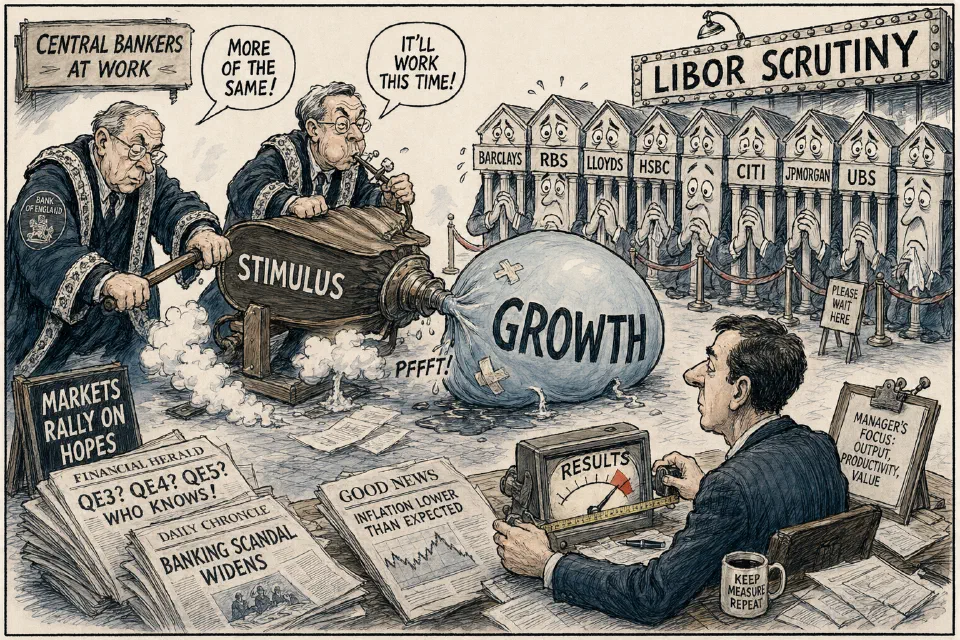
Central bankers have had five years of experiencing failure.
They still tell us they can ‘stimulate’ economies and make them grow. The evidence is not good. We want to believe them. Investors reckon their shares will rise beyond the sporadic spike. Economists think gross domestic product will go up more quickly. The consumers look forward to spending more than they earn. But, but, the Financial Times points out that seven of the world’s largest banks face new scrutiny over LIBOR by a powerful state prosecutor in the United States. Eric Schneiderman, New York’s attorney-general, has sent subpoenas to them. This is the latest probe into banks’ setting of the London Interbank Offered Rate. Mr Schneiderman is said to have political ambitions and has the power to investigate anyone doing business in New York. Anthony Browne has just started as Chief Executive of the British Bankers’ Association. Influential voices seem to have advised him to take the opportunity to lead by example and work with banks for real action in reforming their practices. Sir Philip Hampton, chairman of RBS, said in Management Today, ‘Banks have a rock bottom reputation; understandably so.’
Maybe banking is losing its appeal to both potential employees and borrowers? The good news is the formation of new lenders. Also, there are small signals that this country’s economy is clawing its way out of recession. Consistency will take several years. Opportunities for profitable sales are still available to the adaptable, fast-moving businesses. Technological innovation is the key.
Getting a bigger share of customers’ expenditure is receiving serious attention at last.
There has to be a disciplined approach to discovery. This emphasises crucial questions:
- what drives this customer’s performance?
- what is this customer’s strategy?
- what major issues face this customer?
- how can you and this customer combine goals?
- what is the top-to-top relationship with this customer?
We want it now, says the crowd. So this country treats politics as we do the cash machine or the supermarket’s aisle.
Demand is sudden and intense. Satisfaction must be swift. A lunatic with firearms kills schoolchildren : there is a blanket ban on weapons. Pit-bulls savage youngsters : dangerous dogs are outlawed. In a rapidly unstoical world, the stupid person is the one who can neither satisfy nor even articulate her/his immediate need. The politician starts to speak like a commercial, and those who do not deliver are pilloried publicly before being sacrificed. The National Health Service has not understood the basic issue. Much of this world has come from the bottom up. We demand more and punish those who do not give it. Politics looks set to be increasingly consumer-driven.
There are several species of fine feathered executive friends
If you organise a shoot, we know of experienced beaters for the safari through thickpile carpets. Good targets are:
- The Blue Shirted Parrot gives people a job to do, then perches nearby and squawks
- The Sparrow Hawk swoops down unexpectedly from a great height
- The Red Feathered Thrush thrives in a nest of red tape
- The Credit Swallow well-known for presenting others’ ideas as her/his own
- The Lesser White Crested Cuckoo habitually lays a task in another nest
- The Office Wader paddles around in the shallows stirring up the mud, but without commitment to anything
- The Rear Bird sits all day and shows no inclination to see what is going on outside
- The Bright-Tied Songster has views on every subject; the less s/he knows the louder s/he sings
- The Well Shod Raven is dignified and more concerned with keeping up appearances than actually doing something
- The Willow Warbler flutters around the upper branches all day, but refuses to come down to the ground
- The Domestic Budgie lives in a private world.
Interesting opinion.
‘Life itself is a universally sexually transmitted disease.’ Professor Petr Skrabamek, quoted in The Week.