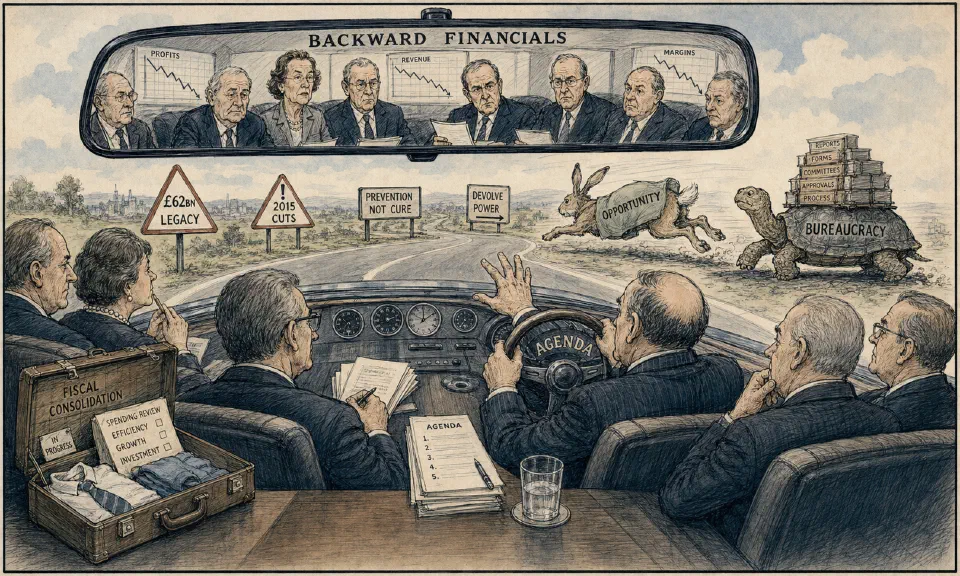
Legacy for new government in 2015?
Back in 2010, UK’s chancellor of the exchequer set out plans for ‘fiscal consolidation’. Only around 55% will have been completed before the general election, leaving another £62 billion of spending cuts and/or increases in taxation. Neither of the two main political parties has given electors an indication of how it will deal with this issue. Both the Coalition and Labour appear to assume that highly paid people and property-owners are reliable sources of income. The top 1% of earners pay 25-30% of all income tax. Will this curve break? In 1990/91, a middle group made an average of £908 in net contribution to the chancellor. In 2012/13 it was minus £3,999. There is general agreement for change in public services, with concentration on prevention rather than cure. This means devolving power from Whitehall and reviving the civic activities of personal responsibilities and reciprocity. The natural conservatism and opposition of institutions brings major difficulties. Will they get in the way?
Boards and directors.
‘Most board packs are heavily weighted towards backward-looking financials and information. But you wouldn’t drive a car looking only in the rear view mirror.’ That was the observation by Jennifer Sundberg, founder of Board Intelligence. She adds, ‘The board has two roles: steering and supervision. The trouble is that the supervisory part often fills the available time and then some’. The board of directors has its roots in the emergence of limited liability companies in the mid-1800s, a highly controversial notion. There was concern that the ability to ‘walk away’ from debts would lead to a collapse in public probity. Backers demanded more influence and independent representation in return for risking their capital. Sounds familiar!? When things go wrong these days, it is rarely the case that the board made a bad decision. The seeds of disaster are in discussions that did not happen. The agenda and priorities are a pivotal task of a chairman.
Crack the principle.
Many managers do not realise that if they concede/secure a principle, everything else on that issue is up for grabs. Your scribe recalls that the American Automobile Workers made a claim to employers of one dollar a year for those employees who had forty years’ service. It was given. The union then returned, ‘Now you have accepted responsibility for your employees during retirement, you will agree that they cannot live on a dollar a year, won’t you?’ Geddit?
And now to speed.
Competitive edge is talked about everywhere. There are few mentions of speed. Businesses must ‘travel light’ and cover ground more quickly. They have to erase operational boundaries, so that work flows seamlessly and swiftly. There is an imperative to dump excess baggage, abandon bureaucratic practices and reduce the time it takes to get things done. We live in an impatient world, with fierce opposition and fleeting opportunities. But organisations cannot be fast if their employees go slowly. Acceleration in all activities brings advantages, even if it means living with some loose ends. Effective managers in this context emphasise action. Quality remains crucial, but must come promptly. Sacrificing speed is a serious error. Relying solely on incremental step-by-step improvements is a big mistake.
An important source!
‘The avoidance of taxes is the only intellectual pursuit that carries any reward.’ John Maynard Keynes
It’s where you sit.
‘If it’s them, we feel we should know about it – that’s transparency. But if it’s us, we feel we should have the right to stop them finding out about it – that’s privacy.’ David Aaronovitch in The Times