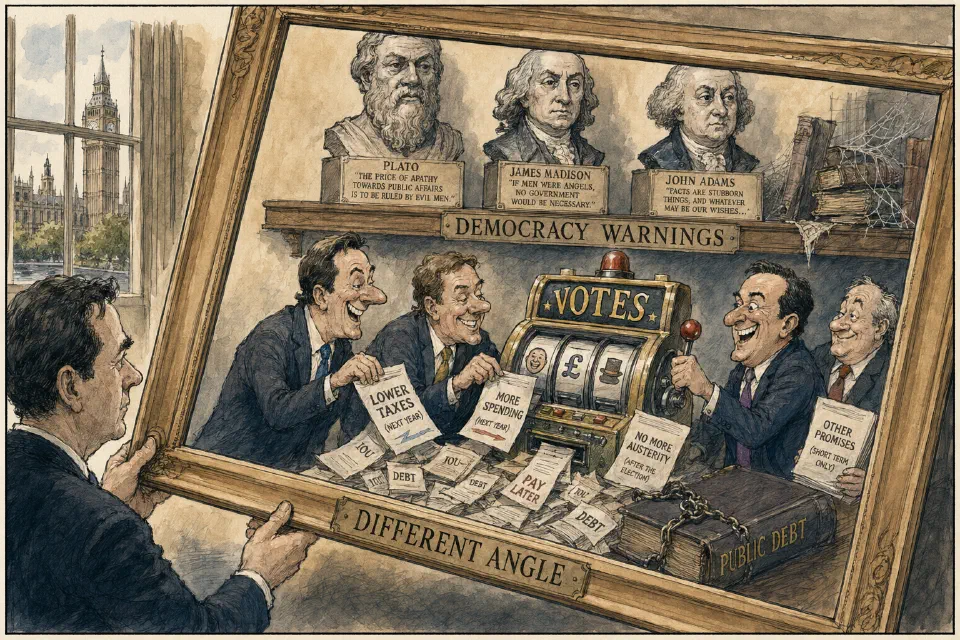
Plato warned that democratic leaders would ‘ … rob the rich, keep as much of the proceeds as they can for themselves and distribute the rest to the people’.
Democracy was a dirty word among political philosophers for many years. James Madison, one of America’s founding fathers, was concerned that democracy would bring ‘a rage for paper money, for an abolition of debts, for an equal division of property and for any other improper wicked projects’. John Adams, the country’s second president, worried that rule by ordinary people would lead to heavy taxes on the rich in the name of equality.
The Economist Intelligence Unit has pointed out that almost half the world’s population now lives in a democracy of one sort or another. It is easy to forget that this is a new approach to government for most nations. Moreover, it is clear that democracy has its faults but other systems have not proved more prudent. Dictatorships appear to feel the need to bribe their citizens and spend large sums on police and the military to maintain their power. These shifts towards democracy grant huge patronage to a growing number of political leaders in the form of contracts, jobs, social benefits and tax breaks. Maybe this country ought to remove fiscal policies out of the hands of elected politicians. We have taken this action on monetary policy. Greece, Iceland, Ireland, Italy, Portugal and Spain have discovered the harsh truth that democracies cannot make foreign lenders extend credit.
Management audits are debated hotly by the private sector’s friends and critics.
They fit the urge to intervene in the affairs of managers by using several instruments. The proponents usually argue for a searching enquiry into basic managerial qualities: a management’s morale and integrity; its creativity; its social values and its human empathy. The opponents insist the only thing that counts is performance and this is judged by the bottom line. Both are wrong. There is a need to appraise managers. Directors of publicly-quoted companies have an obligation to assess those with pivotal responsibilities. But it is true also that only performance can be evaluated with any hope of objectivity and consistency. Yet the ‘bottom line’ will not do the job either. It reveals a lot about the business and possibly less about managers.
A company’s position now may well be a commentary on former incumbents. Of course, today’s executives are not passive custodians of the past. They can only modify the decisions they inherit. In fact, this is one of their most important and difficult tasks. However, managers have a duty to make the future, with leadtimes becoming even longer and sometimes ranging beyond ten years. ‘Performance in management’ means doing a good job in preparing for the certainty of turbulent times head.
The relevance of the nation-state is in doubt.
Does this country have baggage? The controls of global financial flows are beyond the powers of governments. The purveyors of news and entertainment have become supranational, especially those who work through television. There is anarchy in the transfers of information across our planet, open to the whims of a new elite. We face a different reality. The idea of ‘greatness’ is an anachronism, at least in the sense that the 1939-45 war established in Whitehall’s mind a dangerous notion that Britain is a cut above the continentals. We should close the scrapbook, replace the album of photographs and refold the faded letters. Then the whole caboodle can be returned to the attic of folk memories, where it belongs.
The great human drama is seen usually in social and political terms.
Science and technology are regarded as stage props. This is the wrong way round. Profound social changes have been caused primarily by our increased understanding of how the natural world works. Other adjustments follow in its wake, often in ways which were neither intended nor predicted. Science is the playwright and stage manager in the story of the last century. Whatever the image of science, Britain still attracts students. Unfortunately, we are less good at making use of those skills. The number of 20 to 24 year old graduates in science is over 14 per thousand, second only to France (15.7) in Europe. This is well ahead of Germany (8.6). Japan, the US and South Korea also produce proportionately fewer graduates in science than this country.
The order shifts significantly for engineers, with Britain behind Japan and South Korea but just ahead of America. HOWEVER , the situation is serious if we examine how many of the graduates in science and engineering get jobs related to their studies – in university or industry. The percentage is highest in the US. Britain trails behind France, Germany and Japan. Makes you think.
About right
‘Rudeness is the weak man’s imitation of strength.’ Eric Hoffer, quoted in The Times and The Week (29 September 2012).