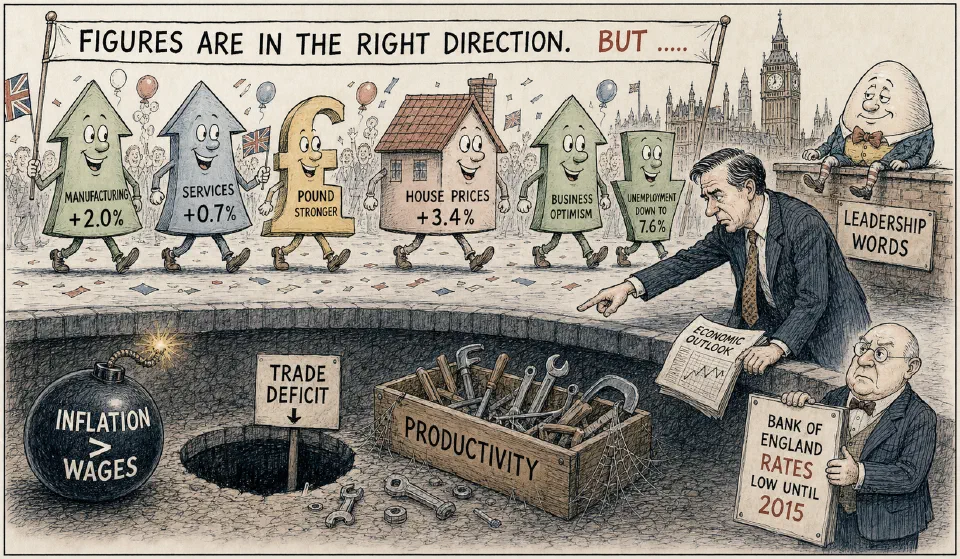
The UK’s economic performance is getting better.
Results of manufacturers and services are rising. The pound is buoyant. Businesses feel optimistic. Of course, house prices are going up. Unemployment is on a downwards trend. Does all this mean a sustained recovery? Well, only if we are careful. A usual story of boom and bust is possible.
Richard Jeffrey (Cazenove) and John Stepek (Moneyweek) have noted: ‘The reason that the UK’s recession was so deep was that household sector had previously got itself into dire financial straits – encouraged, it may be added, by a protracted period of below normal interest rates’. The Bank of England is taking great pains to tell us that interest rates will be held for the foreseeable future. It means until after the general election in 2015. And the flagship policy on housing is not intended to make house prices more affordable. The plan is to use taxpayer-backed funds to assist people in borrowing enough money to buy houses at inflated values. Inflation climbing faster than wages remains a timebomb awaiting detonation. The trade deficit is still bad news. We do not hear enough about productivity.
Six Is for the future.
Alan Webber in the Harvard Business Review reckoned there are three drivers for change. They are globalisation, technology and people, which should be seen as a series of crosscuts on a business. He suggests six ‘I’s for success:
Inspiration
A company has to stand for something beyond its products and services.
Innovation
A passion for the new is essential. Not one huge thrust but a sustained flow of small, incremental innovations.
Implementation
Front runners excel also at hammering home that last nail which gets the product out of the door.
Information
The organisation has to be ‘rewired’ so that employees get much of the information previously restricted to managers.
Incentives
Rewards have to match today’s objectives. Most incentives are obsolete and geared to yesterday’s aims.
Integrity
Inside, this helps to weld all activities together. Outside, it brings good people into the business.
A story with a sting in its tale.
This is a story about four people named Everybody, Somebody, Anybody and Nobody. There was an important job to be done and Everybody was sure that Somebody would do it. Anybody could have done it, but Nobody did. Somebody got angry about that, because it was Everybody’s job. Everybody thought Anybody would do it, but Nobody realised that Everybody wouldn’t do it. It ended up that Everybody blamed Somebody when Nobody did what Anybody could have done!
Leading words for scrambled egg-heads.
Have you noticed the assertion? ‘Leadership’ is the essential ingredient for organisational success. And it is a seductive word, with a multitude of interpretations. Relax and consult Humpty Dumpty, that old-time manager who falls off the walls of jumbled concepts. Every business school should have Alice Through the Looking Glass as a basic text. ‘When I use a word’ , Humpty Dumpty said in a rather scornful tone, ‘it means just what I choose it to mean – neither more nor less’. ‘The question is’, said Alice, ‘whether you can make words mean different things’. ‘The question is’, said Humpty Dumpty, ‘which is to be master – that’s all.’ Makes you think! Humpty Dumpty has so many worthy successors.
Sounds about right.
‘A government bureau is the nearest thing to eternal life we will ever see on this Earth.’ President Ronald Reagan, quoted on Human Events.com
Just a thought.
‘Better keep your mouth shut and be thought a fool, than open it and remove all doubt.’ Dennis Thatcher