Crisis.
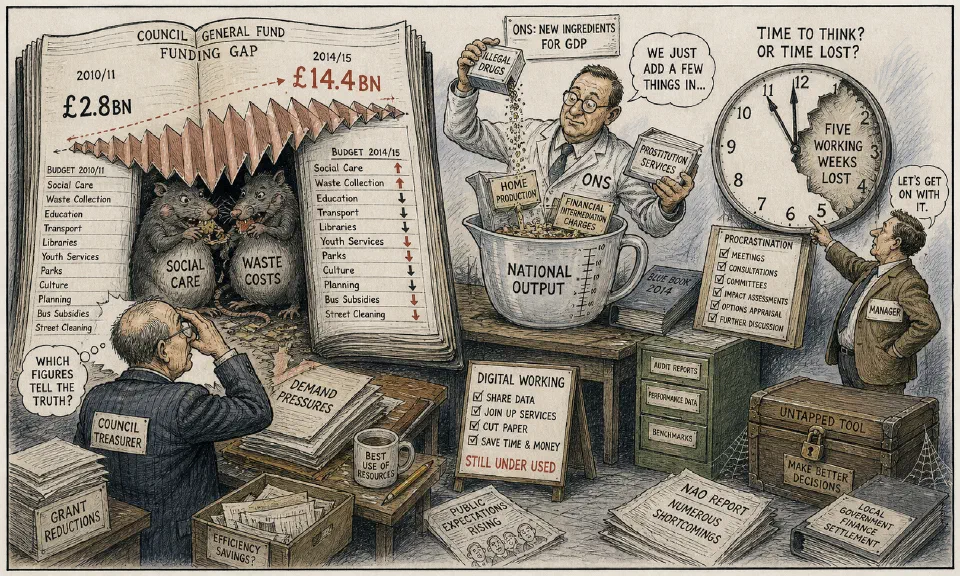
English local government is facing a financial predicament according to the Local Government Association. It estimates there is a funding gap that starts at about £2.8bn in 2013/14 and exceeds £14.4bn by 2019/20. Social care and waste/recycling absorb an increasing proportion of monies available to councils. Cash for other services is expected to drop by 46% at 2019/20, from £26.6bn in 2010/11. Greater use of technology and digital information has the potential to reduce costs, increase efficiencies and deliver improved outcomes. Also, they would stimulate innovation, enable new ways of working and assist the reshaping of relationships between citizens, communities and councils. John Thornton points out in Public Finance that the UK has one of the world’s strongest internet economies. Maybe it would be wise for local government to invest collectively in more research and pilot schemes to understand better the opportunities offered by digital working, the internet and evolving technologies?
‘We are all in this together.’
This was the declaration of Chancellor George Osborne. National statistics change quite often. However, The Office for National Statistics (ONS) has taken the boss of HM Treasury seriously. For the first time, it has started to measure the value to the UK’s economy (GDP) of sex work and drug dealing. This will bring us in line with most of the advanced countries. After all, transactions do take place. The boost will be £10bn for 2009. This is roughly the same contribution as farming and only slightly less than book and newspaper publishers added together. ONS has concluded there are in the order of 60,879 prostitutes earning an annual total of £5.3bn. Each has about twenty-five clients a week at an average price per visit of £67. The nation has 38,000 drug addicts spending a total of £4.4bn.
Lost time.
Your scribe reckons he has observed that procrastination causes five working weeks’ lost time each year for every employee. Reasons? Inability or unwillingness to take decisions. Lack of effective communications. Confused or conflicting instructions resulting in overlapping and/or repetition.
The five Cs.
Relationships go through five Cs: courtship, consummation, complacency, criticism and collapse. The managerial challenge is to sustain mutual enthusiasm over a long time.
Inside story.
‘Cabinet minutes should reflect the lies that were told at the time, not the lies people wish they had told after the time.’ Lord Norman Tebbit.
Objectives.
‘Mankind always sets itself only such problems as it can solve; since, looking at the matter more closely, it will always be found that the task itself arises only when the material conditions for its solution already exist or are at least in the process of formation.’ Karl Marx, 1818-83.