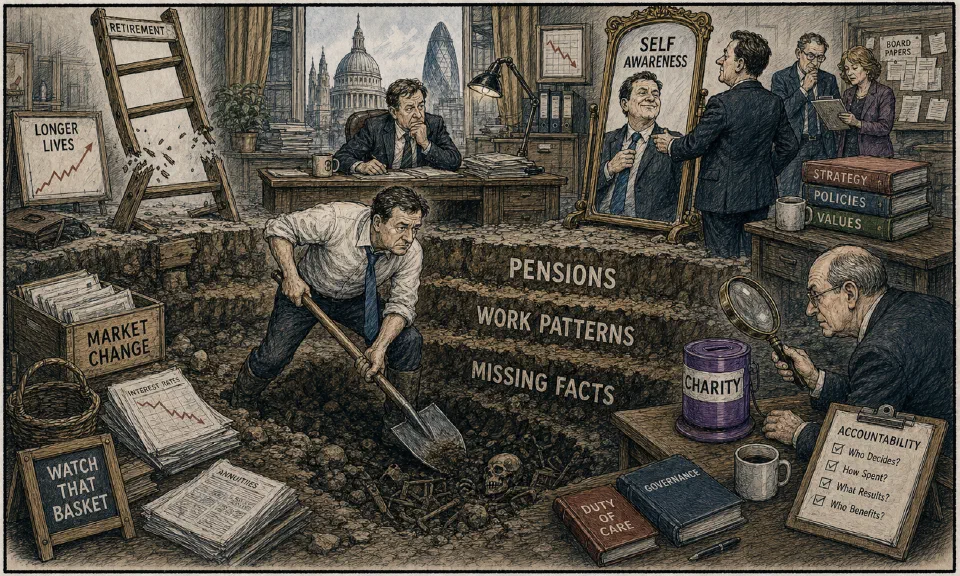
Differences and pensions.
Jane Parry (University of Southampton) has unpicked that in the UK we have never lived so long as we do now. Public Health England announced recently that life-expectancy has risen again. With baby boomers (born between 1946 and 1964) moving into retirement, the number of pensioners is exploding once more. We may be living longer, but many are not reaching old age in good health. Quality of life is a growing concern for institutions of all kinds, with three-quarters of us likely to reach the state pension with compromised health. Also, the age for payment edges upwards but early or forced retirement remains a norm for the majority. The option of working longer is not open to everyone. Shouts that we will have to carry on earning into our 70s fail to recognise how impossible this is for many. Policy-makers must review those outdated formats of retirement based upon the professional male notion of an upwardly moving career in a single workplace. The breadwinner model has almost gone, few families can live comfortably on a single income and women now enter the labour market at least as well-qualified as men. The country needs pension schemes that reflect these demographic changes and amended working patterns. The challenge is not so much how to keep the well-off saving, but how to open up the possibility of saving to those focused on surviving in the new approaches to work and employment.
Spotting poor managers.
Is as important as discovering talent. Alastair Dryburgh has considered the characteristics. Here are seven. (1) S/he has to be right always. (2) S/he distorts reality. Any error is someone else’s fault. (3) The really ineffective manager raises the jumping to conclusions into an art form. (4) S/he needs to stay in his/her comfort zone. Moves outside it are denounced. (5) These people are masters of the vicious circle. Do not bother with diagnosis. There are complaints and threats, which lead to paralysis. (6) They hate uncertainty. Most of us do. But the incompetent manager denies the possibility. Success demands that uncertainty is dealt with by the manager and those who report to her/him. Denial/cover-up explodes. (7) Outdated habits and assumptions are sustained by a lack of self-awareness. Let someone you trust hold a ‘mirror’ to you. Accept the discomfort. The results can be transformational.
Failure in the marketplace.
The biggest cause of marketers’ disappointments is lack of information. It is seldom that the facts are unavailable. Rather, for whatever reason, managers do not wish to find them. Indeed, missing facts not only contribute to a demise, they hide its imminence and sometimes its presence. Some managers tend to defend the marketing status quo with might and main. This is done even though the one unchanging factor with markets is that they change. Suggest a little research might not come amiss and one can be met with irrelevant appeals to long and arduous years of experience in the sector. These may be accompanied by grumpy observations about dubious assumptions being ‘obvious’. In short, with refusals to contemplate the painful process of thinking and acting anew.
Third sector under fire.
Everyone knows that charities, especially the big ones, are having a hard time. There has been a long list of accusations. Several come to mind quickly. The crash of Kids Company. Beat Bullying and the British Association of Adoption and Fostering. Chuggers – ‘charity muggers’ have had their activities cut back by more than a hundred local authorities. Merryn Somerset Webb has stressed how badly much of the £17 plus billion flows from HMRC (the taxpayer) to charities is used. Over 1,000 senior managers are paid six figure salaries. Eleven executives at a planned parenthood charity receive an average annual salary of £144,000. Of course, we can change rules and regulations and give sharper direction to the Charity Commission. But charities must remain independent from interference by government if they are to offer a proper alternative or addition to services provided by the public sector. They must also remain free to innovate. After all, charities gave us the first schools, libraries and hospitals. This should not distract them from regaining the trust of the UK’s citizens. To think the sector’s problems can be solved by becoming simply more like orthodox businesses is misleading. A recent report from Sir Stuart Etherington’s review of self-regulation recommended essential moves. Trustees are urged to take greater responsibility for their charities’ policies, actions and results. They have legal duties and obligations.
A bit of wisdom.
“Behold’, the fool saith, ‘Put not all your eggs in one basket’ – which is but a manner of saying, ‘Scatter your money and your attention’, but the wise man saith, ‘Put all your eggs in one basket – and watch that basket”. Mark Twain (1835-1910). American novelist.
Keep looking.
‘Visionary people are visionary partly because of the very great many things they don’t see.’ Berkeley Rice (1937-), in the New York Times Magazine (1968).