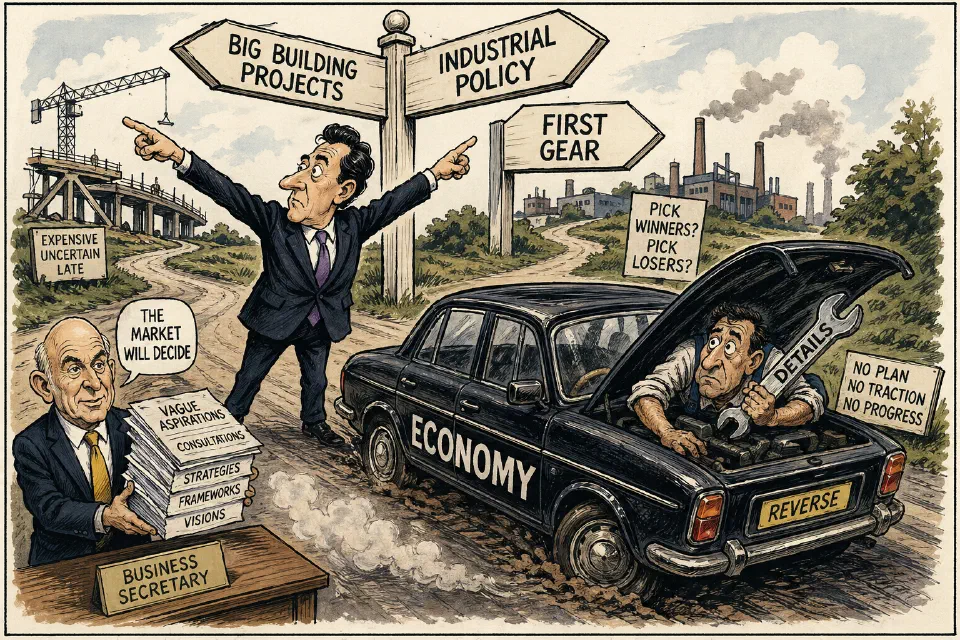
The economic downturn is into its fifth year.
There can be no surprises that the government grasps at politicians’ urgings for big building projects. Announcements sound good and create hope for kick-starting an economy stuck in first gear – sometimes reverse. Vince Cable, the secretary of state for business, innovation and skills, has decided that the UK needs an industrial policy. His recent speech in the House of Commons on this subject lacked particulars. He is right to point out that we are the only country in G8 without a national investment strategy and a serious regional investment plan.
Let’s be careful. The last time our economy was in serious trouble plenty of money was spent on technology and infrastructure. We created Concorde, then realised nobody wanted it. There was a huge campaign to electrify railways. We constructed the Channel Tunnel and watched it run into a financial crisis. In the 1970s, the citizen was saddled with incompetent state-directed monsters such as British Leyland. The state is not good at picking prospective winners and boosting entrepreneurial management. Hard-headed structural changes led to a revival in the 80s and 90s – for example, lower taxes, curbed inflation, privatised public monopolies and deregulation of whole industries. Consumers and businesses need confidence above everything else. Growth of Gross Domestic Product is a result of bringing two things together: an increased working population and higher productivity of resources. But … to capitalise on rising demand and expand the firm, shareholders usually need to invest in people and/or plant and machinery. Cashflow becomes an issue almost always.
The ubiquitous City is fascinated by managerial ‘stars’.
The number of burnt fingers rises each year. We are familiar with the hopes and excesses of football clubs and television studios in rewarding stars. Now the makers and marketers of things and services are getting the habit. Users of stars must understand how they operate, the effects they have on neighbours, and their lifestyles. They ought to be put in a place where their results can be assessed and refined safely. Make sure they understand the purpose and limits of their mission. Once launched, they move out of the orbit of co-operation. Stars have to have fuel. Most run on praise and recognition. They may well be loners, but this does not mean they enjoy loneliness. They insist on being consulted on changes of direction. In their infancy, stars are open to criticism from people they respect. But there is no guarantee they will adjust either their trajectory or velocity.
The ravages of unpredictability can be mitigated by communication. This can be a one-way process. The attention span of stars tends to be short. Explanations of what is happening in the galaxy back home are a waste of time. A hirer of stars has to deal with her/his gravitational pull – the effortless ability to suck in lesser bodies. Above all, remember that stars are short-lived. It is a symptom of stardom to deny this truth. Those who have stars must learn to notice the signals of stellar decline and then return them to mundane reality. Otherwise they degenerate into red dwarfs or implode into black holes.
The political philosophy of Niccolo Machiavelli (1469-1527), the Florentine diplomat, is of enduring relevance.
Most managers have not taken the trouble to read ‘The Prince’. It is an omission. For example, Machiavelli says, ‘It is unnecessary for a prince to have all the qualities I have enumerated, but it is very necessary to appear to have them’. And on managing change, the imperative right now, ‘There is nothing more difficult to take in hand, more perilous to conduct, or more uncertain in its success, than to take the lead in the introduction of a new order of things’.
Shifting decisions into action. Think Oscar:
- Outcome: what would you like to achieve in the longer-term?
- Situation: what is the current state of affairs? What is actually happening?
- Choices: what options do you have? What are the consequences of each choice?
- Actions: what will you do next? How will you do it? When will you do it? What will it cost?
- Review: what steps will you take to review your progress? When will you get together with your boss to consider results?
About right.
‘When the tide goes out, you see who’s been swimming naked.’ Warren Buffet.