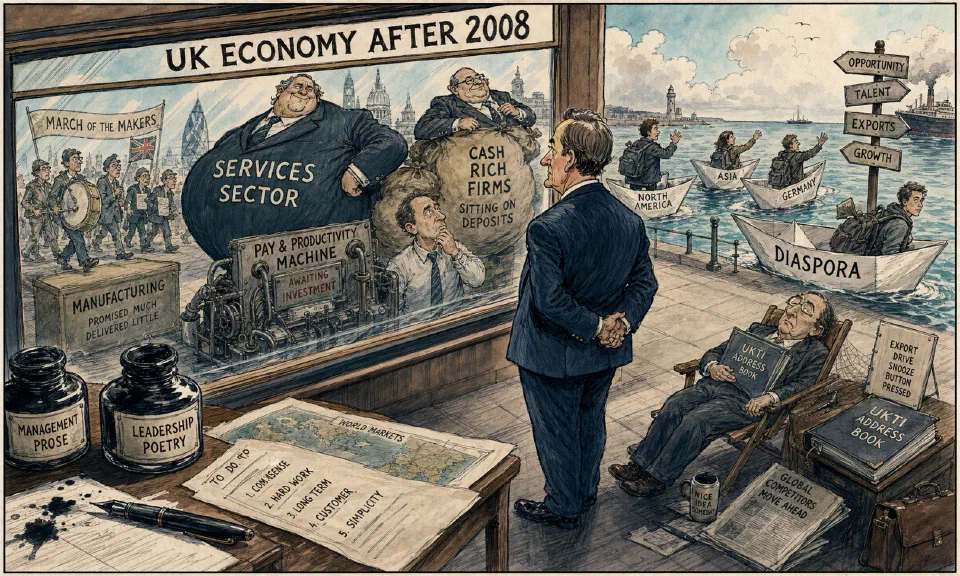
UK’s economy looks different from 2008.
It has, at last, exceeded the previous peak. The recovery has been slow. This country came up at the rear of G7. Only Italy’s GDP is smaller than six years ago. However, we have a different shape. Some industries have dwindled, others have mushroomed. Economic impact has shifted from workers to companies. Economists predicted a boom in exports. George Osborne, chancellor of the exchequer, looked forward to a ‘march of the makers’ as manufacturing businesses became more active. The prognosis that Britain would ‘rebalance’ away from its large services sector became an exciting talking point. It was wrong.
Yet businesses are flush with money. Michael Saunders of Citigroup has calculated that the ratio of businesses’ bank deposits to their debts rose to 77%, up from 48% in 2008. The rate of corporate liquidations was 0.56% earlier in 2014, the lowest for thirty years. The recession in the early 1990s put many firms out of business. The recent downturn damaged households’ finances more than companies’. The pattern will probably persist. The reshaped economy means the fate of the recovery is in the hands of those people running this country’s newly enriched firms. Investment is an upward trend, but still far below its heyday. Action on this need is the key to higher productivity and justification of higher pay.
Five millions British people live abroad.
This is an estimate from the World Bank and The Economist (9 August) and points to our government’s neglect of valuable contacts with the different type of emigrant. It is no longer ‘leathery retirees’ in the Mediterranean. Some ambitious graduates and technicians are moving to North America and Asia. The Office for National Statistics (ONS) says that since 2007/08, emigration is down by 19% overall but up by 8% among 15-24 year-olds. Of 193 of the United Nation’s member states, 110 have formal schemes to build links with citizens abroad. The UK is not one of them. PR China’s diaspora is reckoned by informed observers to be the most powerful economic force on the planet. If we do not want our talented globetrotters, others do. Germany encourages Britons actively to take apprenticeships there. Government from the Middle East tour our universities. There is some evidence that America and China (Hong Kong) are making direct approaches to small and growing hi-tech firms. Maybe UK Trade and Investment (UKTI) ought to take fast corrective action? There is plenty of experience in other countries: France, India, Italy and New Zealand, just for starters.
Warren Bennis died on 31 July, aged 89.
He invented leadership as a business idea. Central to his thinking was a distinction between managers and leaders. Managers are people who do things right, he argued that leaders do the right thing. Managers have their eyes on the bottom line. Leaders watch the horizon. Managers help you to get where you want to go. Leaders tell you what it is you want. The process of becoming a leader is similar, if not identical, to becoming a fully integrated human being. Mr Bennis emphasised that what constitutes good leadership changes over time and context. Leaders can no longer crack the whip and expect people to jump through hoops. They must become more like mentors and coaches than old-fashioned sergeant majors. One of Warren Bennis’s thirty books, ‘On Becoming a Leader’ (1989), included warnings about corporate corruption, extravagant executive awards and short-termism. Warren Bennis and Peter Drucker were the primary movers in making managers think about being more effective in what they try to do. Drucker said that management is the prose, leadership is the poetry. A business must have both.
Over-confidence.
Managers tend to make their biggest mistakes on issues and decisions they handled successfully in earlier years. In business, as elsewhere, acting cocky when things are going well is an unforgivable sin. As the Greek’s kept telling us, Hubris is followed inevitably by Nemesis.
What is this thing?
‘I have nothing against work, particularly when performed quietly and unobtrusively, by someone else.’ Writer, Barbara Ehrenreich, in Real Simple.
Wise planning:
‘Build your enemy a golden bridge to retreat across.’ Confucius, according to The Guardian.
And there are not many.
‘A friend is one who sees through you and still enjoys the view.’ Wilma Askinas, quoted in Forbes.com.