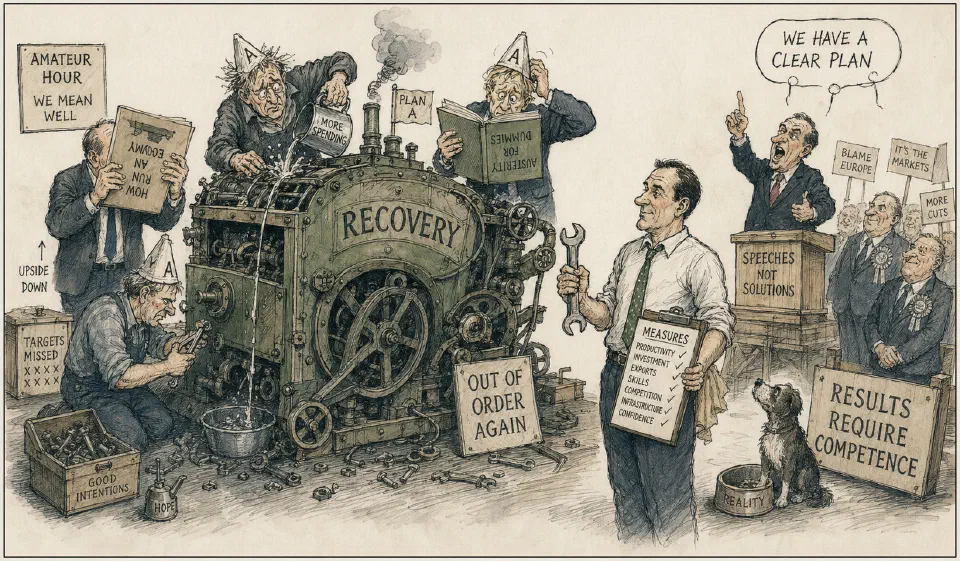
Chancellor George Osborne on a roller-coaster?
He once described austerity as a ‘project’. It’s beginning to look more like a permanent state of affairs. Despite having the usual good month for the public purse in January, expenditure continues to run higher than forecast, because of a strong growth in costs of both welfare benefits and delivery/administration of public services. Borrowing is moving towards being £7 billion higher than predictions in December. Some of the extra funds are due to Whitehall’s departments underspending by less than the assumptions. The low increase in tax receipts and large boosts in outgoings on welfare benefits will worry the Chancellor. If the trends remain, we can expect more than the large fiscal tightening.
The Office for Budget Responsibility (OBR) was Mr Osborne’s personal and new quango. Does he rue the day? It is staffed by top economists to make sure there are accurate indications of the future. This was a good idea. However, the pronouncements so far have often been wrong in both size and direction. These burdens do not help the Chancellor in his work and ambitions.
Britain has become a different country in ten years.
That is a reasonable interpretation of the recently published census. It revealed the largest growth in population since the survey begain two hundred years ago. Our professional politicians are trying to ignore several serious issues arising from this information. The old politics based upon class or religion are disintegrating quickly. How will the political parties organise their support? Immigration is a constant subject of public concern. There is a reluctance to admit this country needs a constant supply of trained young people. Can we balance the contradictions?
The consequential pressure on housing gets worse. Do we accept the aspiration of owning a home has ended? The problems are huge and demanding of an ageing population. There is a need for decisions by politicians. It is clear that productivity is falling. Where are the proposals for industries and services to compete in the modern world? Our elected representatives cannot put a pillow over their collective heads.
Intangible assets now account for as much as 85 per cent of market capitalisation for many firms.
They include innovation, organisational culture and strategic capabilities. This is the conclusion of Gary Hamel, who sprays important ideas all over the place. The future is about differentiation: size is no longer a defining issue. ‘Capture new wealth by being novel and ask yourself if the voice of imagination is as loud as the noise of experience.’ Market share is dead, asserts Hamel. If companies want to increase their proportion of wealth; they will have to ‘reboot’ and rethink plans more quickly. He suggests three types of capital – intellectual, structural and financial. A lot of businesses are threatened by their traditional ways of doing things.
Muddled manager?
Of course not. A preposterous suggestion. Well, just consider the new entrant to this managerial lark. What is s/he to think – ‘Look before you leap’: or ‘He who hesitates is lost’? Will the future belong to the dynamic, young, forceful, aggressive manager: or does it lie in co-operation and team spirit? How does ‘Too old at 40’ this week square with pensions for patriarchs the next? Why does one appraisal demand initiative: the next a statesman-like restraint? This company is focusing on fewer products: how can that one see salvation in diversity? Every proposition has another to deny it. The problem is in absolutes. We need learning managers not learned ones. That is, those who can deal with specific problems/opportunities, and do not repeat a comforting blanket of adages.
This says everything.
‘When state pensions were invented in 1908, the average time in retirement was expected to be three years.’ Robin Ellison, former chairman of the National Association of Pension Funds.