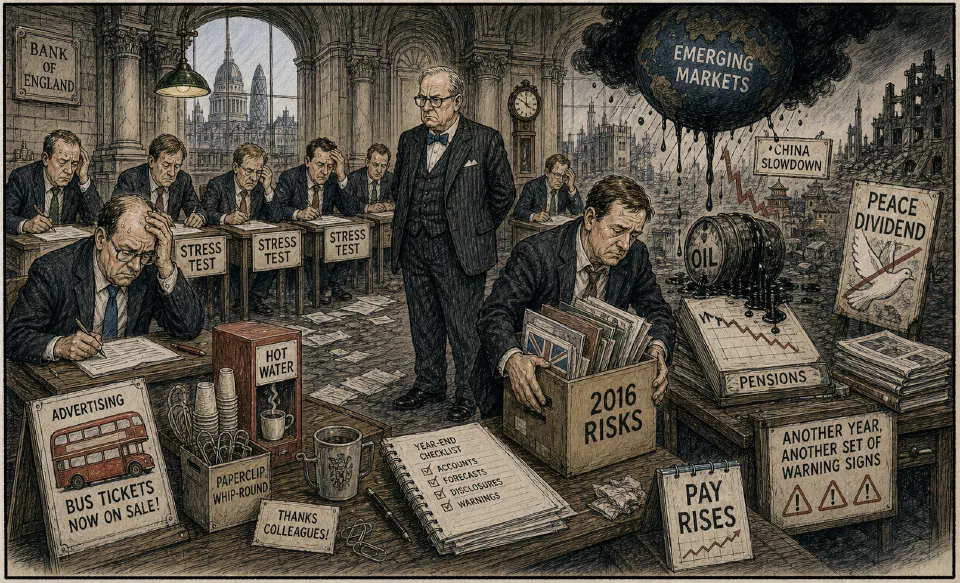
Pass the stress.
Britain’s seven biggest banks have passed the second round of annual stress tests. This new procedure is to establish their resilience in a sharp economic downturn. It was based on the possibility of a crisis in emergent markets. A fall in China’s growth to 1.7% rattled the cages of investors, sent oil below $40 a barrel and undermined developing countries over Europe. Mark Carney, the Bank of England’s Governor said the clearing banks were not more resilient than in 2008/09 and within sight of what the Bank’s Financial Policy Committee regard as adequate capital for the long-term. Running a bank used to be a job without pressure. Times have changed and will remain so.
Into 2016.
Morgan Housel of MotleyFool.com says professional market forecasts are often called dart-throwing chimps. He adds, ‘This might be an insult to chimps.’ But your scribe cannot resist the temptation. So here we go with two for 2016:
The peace dividend has gone.
The attacks in Paris on 13 November brought the so-called peace dividend to an end. Twenty-five years after an end to the cold war. Western governments became complacent.
The pay rise is on its way back.
After a longish period of stagnation, increases in wages and salaries in the UK are on their way back. Earnings have been declining for thirty years. It would be wise to expect rises to be faster than inflation.
Pensions.
Keep a watchful eye. Merryn Somerset Webb has opened an important box. Defined benefit pensions are usually those schemes that pay a percentage of final salary, and are linked to inflation. The Pensions Institute has indicated that many such schemes are ‘highly unlikely’ to meet fully their obligations. There are huge total deficits. The Institute says there is a need for radical action and wants pension schemes in trouble to be able to restrict benefits, even if the pensions are already in payment. Things have been going wrong for several years. For example, government removed the tax credit on dividends from investments. Employers took holidays from paying into funds when stock markets were buoyant. Life expectancy has increased much faster than forecasts. In desperate efforts to reduce risks, pension funds have switched from equities into bonds, where yield has collapsed and is now a major issue. There is not much we can do about this dilemma. Nonetheless, we can blame the unelected officials, mostly in central banks, running monetary policies.
Job creators.
The Confederation of British Industry (CBI) has started to unpack the figures on employment in the UK. The overall figures look good. The number of unemployed people declined by 110,000 in the three months to October. The rate fell to 5.2% and has now returned to the pre-2008 situation. Employment for 16 to 24 year olds went up to 73.9%, the highest since records began. The impacts were inconsistent. The three sectors creating jobs were: administrative and support services; agriculture, forestry and fishing; and construction.
Tell-tale signs of a downward spin:
The sales director starts entertaining customers at McDonald’s. This year’s advertising campaign is on the back of bus tickets. The water cooler has algae in it. The Red Cross takes over the staff canteen. The photocopier works. The finance director spends all day under the desk sucking his thumb. You find the managing director steaming stamps off envelopes. There is a whip-round whenever the paperclips run out. The drinks vending machine dispenses only hot water. Company cars are replaced by bus passes.
Dad and Mam.
‘Saving is a fine thing. Especially when your parents have done it for you.’ Winston Churchill, (1874 – 1965). British statesman and Nobel Prize winner.
About right.
‘All Governments like to interfere; it elevates their position to make out that they can cure the evils of mankind.’ Walter Bagehot, (1826 – 77). English economist and journalist.