Speed in the UK.
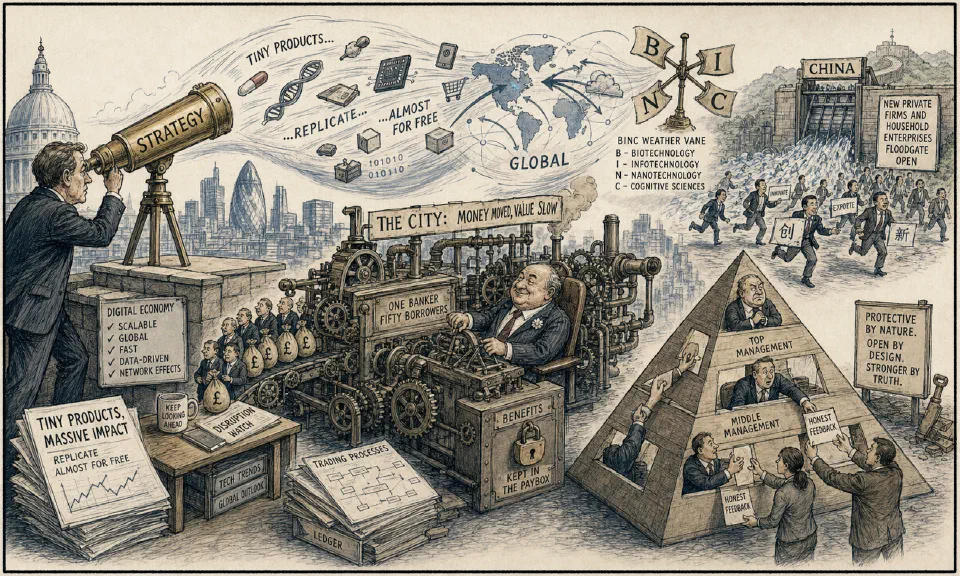
Changes are everywhere. Digital products and services account for an increasing part of our economy. Only the first unit requires capital and labour. Subsequent output is almost free of cost. These products are immediately global, and the best one takes all after effective marketing. Look at the dominance of Facebook, Google and Microsoft. Digitisation and automation remove more jobs than they create and drive demand for highly skilled people and competition for scarcer and middle and low-grade jobs. BINC is on our lips – biotech, infotech, nanotech and cognitive sciences.
Inefficiency in the City?
Our financial sector is supposed to move money to where it is needed for our economic health. London’s Square Mile is the world’s leading financial centre. It employs around 8% of the working population and produces 10% of the UK’s income. Anthony Hilton has pointed to Thomas Philippon’s work which established that it is no more efficient today than it was 120 years ago. By measuring the proportion of national income moved in any one year and the financial sector’s share of Gross Domestic Product (GDP), Phillipon found the ratio between these two figures has remained the same. It is as if one banker is still looking after fifty borrowers. This is astonishing, given the innovations over the past century. The only reasonable explanation is that the benefits of progress have been retained by those in the industry. Not only do we not get better service, major information from the US suggests the financial sector’s expansion has been accompanied by lower trends in economic growth. These observations will stimulate closer examination.
And more changes.
The PR China simplified the process for registering businesses in February 2014. According to the State Administrations for Industry and Commerce, there were 3.65 million new registrations in 2014, an increase of 46% on 2013. China had moved by 2012 from having an economy based upon the public sector. At that time, the country had 50 million active and registered private firms; 40 million of them were smaller ‘household enterprises’. Andrew Atherton (University of Lancaster) notes that this is a huge shift from 1978, the year reforms began, when only 140,000 registered private concerns generated less than 1% of economic activity. The private sector is at least three-quarters of China’s economy now. These businesses account for 90% of new jobs and are the major employer in many parts of the country. State-owned establishments have dropped from over 70% of total employment during 1990 to 26% in 2012. Phew!
Know thyself.
Research in America showed that eight out of ten subordinates have a better idea of a manager’s performance than their own boss. The survey questioned 1,100 employees in 70 firms, many of them in Fortune’s 500. None of this is new. Only protective pyramids in structures have prevented better access to informed comments. A manager has to earn the mandate. It’s not about popularity. Leaders make us feel different, not always better.
Maybe?
‘We become moral when we are unhappy.’ Marcel Proust (1871 – 1922); French novelist.
Strings and bows.
‘Most of us find it difficult to play second fiddle. If, on the other hand, all the second fiddles in an orchestra stopped playing, we would be well and truly sunk.’ Sir Georg Solti.