What’s different?
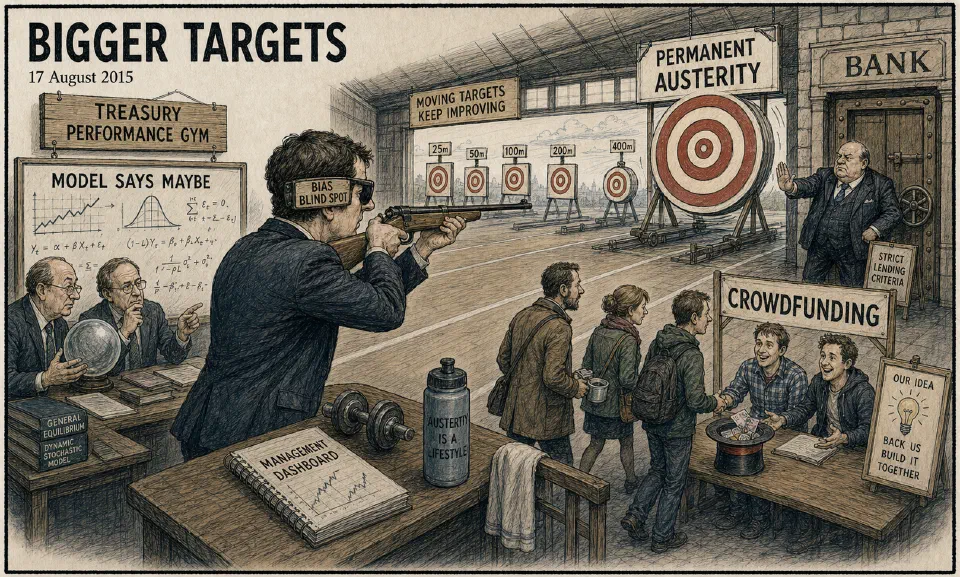
Austerity was presented initially as a crash diet to reduce financial extravagance. Prime Minster David Cameron and Chancellor George Osborne now speak of it as a permanent change in lifestyle. Osborne is reshaping the state. He wants to be fiscally conservative and economically liberal. Local councils will win the freedom to repeal the laws on Sunday trading, tenants of social housing whose earnings are above average will be charged a market rent; the government will no longer pay for free TV licences to the over-75s; the redistributive system of tax credits is being unravelled. Mr Osborne’s demeanour reflects his belief that, as with Margaret Thatcher’s privatisations, the Labour Party will only return to power by accepting the reforms as part of commonsense for the age.
Crystal balls.
Economists seem to rely upon abstract models that can be useless. Many observers say they ignore the real world, and are supported by outdated and unrealistic assumptions. They cannot handle instability, complexity and change. Such methods are unable to predict crises. Paul Mason (theguardian.com/commentaries) is confident there must be another way. In other fields – from neuroscience to fluid dynamics – supercomputers can simulate intricate systems. NASA, the American space agency, can tell us about climate of the entire earth over three days. The system incorporates nearly four billion data points and the calculation takes a day. Why is it impossible to have something similar for economics? The idea is not over-fanciful. Professor J Doyne Farmer of Oxford University advocates ‘agent-based modelling’, which goes some way towards it. The Bank of England has sponsored studies along similar lines. We ought to be able to gather and analyse information from every corner of the economy – including prostitution, drug deals, cybercrime and flight of capital. We could then avoid wasting tons of newsprint debating what will happen if Greece defaults on its debts, or the results of a programme of public housebuilding.
Will technology hit banks?
When small firms need cash to get off the ground and/or expand, they increasingly put their ideas on one of the crowd-funding sites. They will almost certainly find the financial support by this route. The costs are likely to be lower than fees from banks, venture capitalists and publicly-funded bodies. The terms and regulations can be less complex and less onerous too. Mainstream lenders have a lot of thinking to do. Matthew Lynn has pointed to estimates suggesting that. In the United States, more money will be raised soon for new companies from crowd-funding rather than traditional sources.
Everyone is biased.
Most people believe they are less biased than their counterparts. Researchers have concluded there is a ‘bias blind spot’. In a recent survey, only one person out of 661, thought s/he held more biases than others. This ‘blind spot’ has disadvantages. It prevents a person from accurately assessing her/his own abilities. This leads to the belief they are better than most at simple tasks but not so good with challenging ones. It also damages working relationships. Irene Scopelliti, of Cass Business School and leader of the study, says: ‘We think the ‘bias blind spot’ is a critical determinant of misunderstandings, mistrust and pessimism when attempting to reach agreements in interpersonal, political and professional relationships.’ Those with a bigger ‘bias blind spot’ are also more likely to ignore advice and might be less responsive to training.
Doers are not new, but still scarce.
‘It had long since come to my attention that people of accomplishment rarely sat back and let things happen to them. They went out and happened to things. Leonardo da Vinci, 1452-1519. Italian painter, sculptor, architect and engineer.
We know.
‘History is littered with wars which everybody knows would never happen.’ Enoch Powell. 1912-98. English politician and scholar.