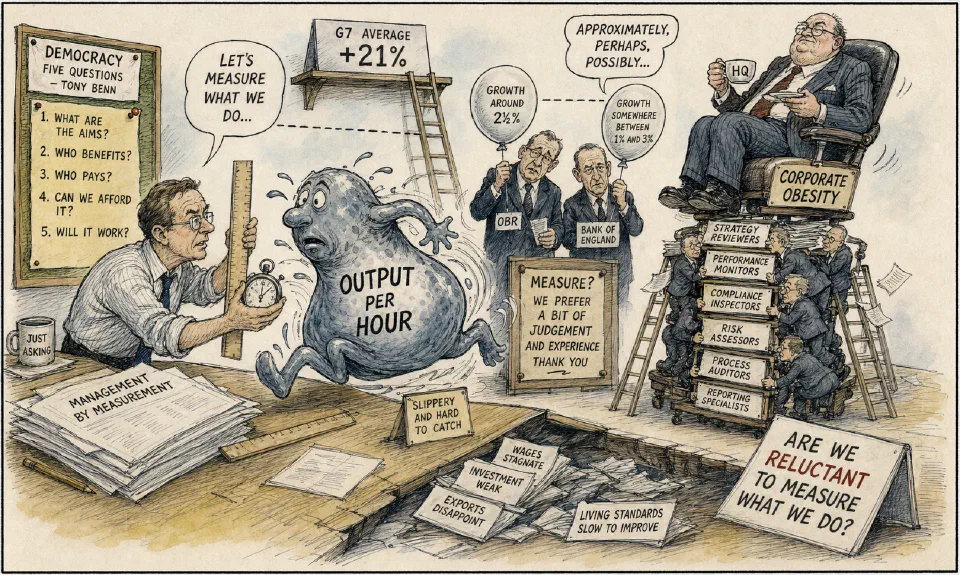
Productivity puzzle.
The economy is growing and the deficit (not debt) is coming down. Significantly, though, our official and independent watchdog, the Office for Budgetary Responsibility (OBR) concluded in December that the ‘surprising’ surge in growth of the past year is ‘cyclical ……… rather than indicating stronger underlying growth potential’. And the Bank of England’s decisions to maintain a low interest rate reminds us the economy is still in difficulties. The factor now standing in the way of the UK’s sustained better results is low productivity. It is 21% below the average for G7 (developed) countries as measured by output per hour. This is the widest gap for twenty years. In terms of output per worker, it is 25%. There are good reasons to suggest that part of the falls in productivity are because of temporary factors; for example, weak demand and turmoil in the financial sector. Inadequate fiscal policies and failures to address problems in banking properly have exacerbated the problems but will not hold back a sustained rebound indefinitely. The lack of investment (machines!) for each worker is a real hindrance for productivity. The fall in hours per employed person has not helped the situation, but has a smaller impact. Better measurement of pivotal ratios would allow managers to pursue relevant targets. The systems and technology are on the shelf.
Three researchers at the London School of Economics have done some excellent preliminary scrutiny. They are: John Van Reenen, Anna Valero and Joao Paulo Pessoa.
Corporate obesity.
Maybe the government ought to pay as much attention to this illness as it does to the difficulties of humans? Jeffrey Immelt, the chief executive of GE (America) said in his latest letter to shareholders, ‘We attempted to managed volatility through layers and reviewers. Like many companies, we were guilty of countering complexity with complexity – more inspectors, multiple reviewers’. The result was a ‘higher cost structure, an artificial sense of risk management and we were insulating our people from the heat of the market’. Mr Immelt has launched a programme of simplification, including lower overheads and a smaller head office. This is an important initiative. Also, a study by Sven Kunish at the University of St Gallen in Switzerland revealed the ease with which big organisations expand head offices. The challenges to corporate extravagance are moving into place. Many large organisations would benefit from a close look at their overheads. Zero-based budgeting insists that all expenditure must be justified from first principles each year. The approach is back on agendas. The Economist has noted encouraging trends. A rise in job satisfaction after action is one important outcome.
Pawns and playthings in Europe.
One aspect of integration in the European Union has been obscured by the post-Maastricht dramas. This is about the need to overcome difficulties between business philosophies and managerial cultures. There are radically divergent concepts of companies as entities and what their relationships should be with the state and individuals. The notion that companies are personalities in their own right and not pawns in a game played by a small group of powerful people remains just an idea in most continental countries. A corporate sector run by a few mighty industrialists is challenged in the Anglo-American axis. But it is still the norm in the rest of Europe.
The view that control itself is a valid strategic objective contradicts the Anglo-American belief that free markets are the best guarantee of an efficient allocation of resources. Herein lies the row about the ‘unlevel playing field’ on cross-border acquisitions.
Does the slowboat still leave on time?
The government of PR China has published its first guide to investing overseas. It concentrates on the basics of entry into the UK and describes twenty successful initiatives. The authors recommend that Chinese companies consider opportunities in the UK’s biosciences, digital sector, infrastructure, manufacturers and professional services.
Benn gem.
‘If one meets a powerful person, ask her/him five questions: ‘What power have you got? Where did you get it from? In whose interests do you exercise it? To whom are you accountable? How can we get rid of you? If you cannot get rid of the people who govern you, you do not live in a democratic system.’ Rt Hon Tony Benn, 1925 – 2014.
Not Karl.
‘Politics is the art of looking for trouble, finding it everywhere, diagnosing it incorrectly and applying the wrong remedies.’ Groucho Marx quoted in The Week.