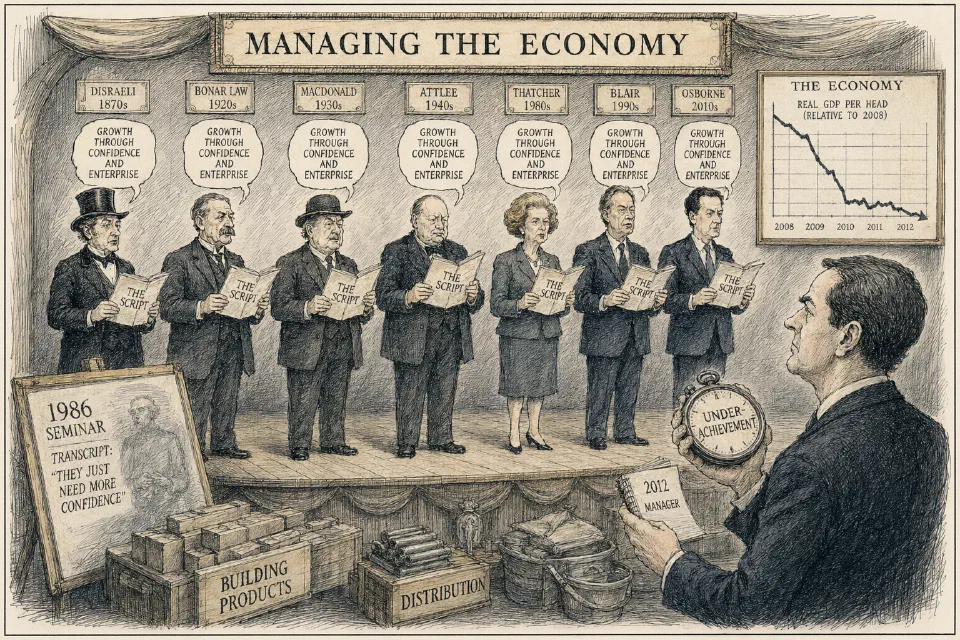
Are the many politicians at all stages of ‘managing’ our economy the real and consistent underachievers?
Michael Bateman, a long-standing friend of your scribe, was invited to a seminar in September 1986 (yes, 1986) for managing directors of major firms in the distribution of building products. The keynote speaker was Rt Hon John Smith MP, Leader of the Labour Party. The transcript of his speech shows that Mr Smith opened by saying ‘I identify two main issues, the first being very serious unemployment. The key question here is how do we reduce it? Secondly, there is evidence that our manufacturing sectors have been declining over a fairly long period of time. The second issue is how do we reverse that process?’ Here endeth the lesson in 1986. 2012?
The electorate’s increasing belief that Britain’s executives are not as exceptional as current pay and bonuses suggest has found political legs.
There is an ominous mood from left and right, with warning shots from David Cameron, Nick Clegg and Ed Miliband. There are signs that all political parties are following, rather than leading, public opinion. The image is a simple one. It includes a conclusion that directors and senior managers are not as internationally mobile as they claim. Another, smaller, group says that many are less talented than assumptions of the 80s and 90s. This is a country based on notions of open and fair competition and rewards based upon merit. Voters are starting to think our society is becoming less and less fair. This is a dangerous groundswell.
Ottmar Gissing talks unusual sense from the European Central Bank
‘The problem of ‘too big to fail’ is that it has made society – more precisely, the taxpayer – hostage to the survival of individual financial institutions… The taxpayers’ billions committed to rescue supposedly systemic institutions has dealt a big blow to confidence in the free market system… and has in turn become a threat to free societies.’
The idea of a war for talent could well be dangerous nonsense
asserted Jeffrey Pfeffer, professor of organisational behaviour at Stanford Business School. This is not a silly observation. One of Toyota’s firsts was recognising that people on assembly lines know something about putting motor vehicles together, regardless of formal qualifications and ability to talk smoothly. The ‘war for talent’ is a distraction from companies’ real tasks. W Edwards Deming pointed out long ago that the attributes of the system or framework in which a person works is more important than motivation or ability. He is right. We must relearn the lesson. The problem is in finding managers who can make things happen; there are not many around. But they are just as likely to be in your company as in somebody else’s. And, they have probably spent years brooding on how to make it better.
Warehouse of knowledge.
A ten-year-old may well have had more driving hours on computers than a person of fifty or more. AND, based on the rate at which knowledge is increasing, it can be speculated that by the time today’s child reaches fifty, 97% of everything known in the world at that time will have been learned since her/his birth.
The technology might be clever or potentially successful.
But can a company protect it by patents and block competitors? If not, the technology might soon become commoditised. Consider calculators, mobile ‘phones and personal computers. One day the same will happen to nanotechnology. The trick is to notice when the switch starts to happen. Watch out for disputes on patents and be sceptical of claims of uniqueness.
Bureaucrats?
‘They are not usually doers, they are not managers and they tend to get introverted.’ Sir John Cuckney, former chairman of 3i Group.