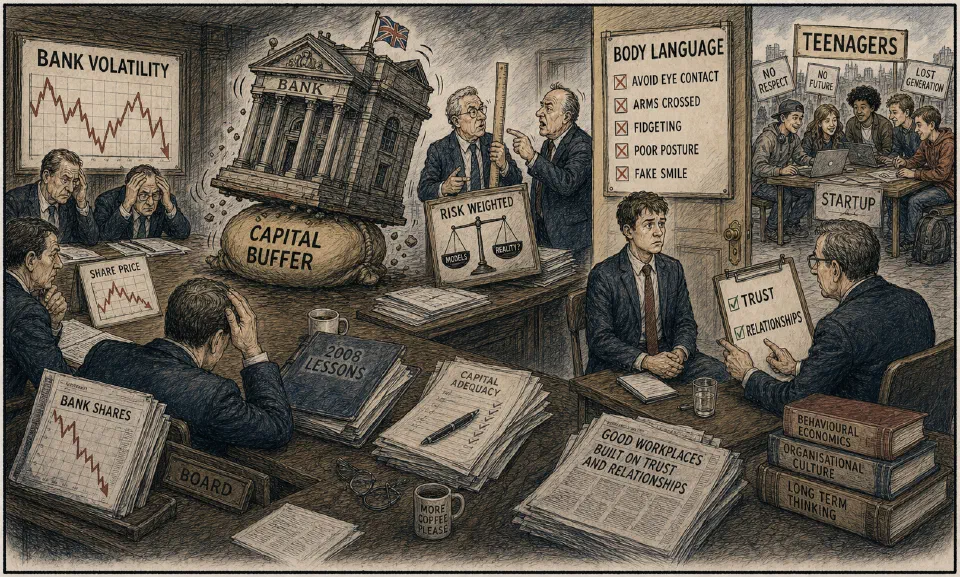
Volatility of banks.
The erratic prices of shares in major banks reminds us of the system’s fragility. Sir John Vickers chaired the Independent Commission on Banking (ICB). He says the crisis of 2008 taught us that banks were holding too little equity capital. The Financial Times has pointed out that eight years have gone by and the issue has not been resolved by the myriad of interested institutions. The Basel III regulatory framework obliges banks to have capital worth 8.5% of their risk-weighted assets (RWAs). This is a measure used by regulators to determine capital requirements. An additional buffer of 3%, applied to this country’s six biggest retail banks, would assist them to absorb major losses. But the Bank of England’s latest proposal recommends an additional cushion at 0.5%. This is a milder figure than suggested by the ICB in 2011 and less stringent than advice from some leading economists. Will the Bank of England reconsider its conclusion?
Interview or pitch.
Did you think it went OK and then suffered rejection? It is possible that you were let down by behaviour, rather than what you said. A survey of 2,500 professional recruiters by CareerBuilder in 2015 highlighted failings of body language: 67% did not make eye contact 39% ‘forgot’ to smile 33% played with something on the table 30% had bad posture 30% fidgeted too much on their seats 29% crossed their arms over their chests 27% fingered their hair or touched their faces 21% had a weak handshake 11% used too many hand gestures.
Back to basics.
Many commentators say there is a trade-off between being a ‘good’ employer and running a profitable business. However, there is a lot of evidence that the opposite is true. ‘A great place to work’ is a concrete concept, but such a place is not the upshot of crèches, subsidised meals or other perks. Instead, it stems from quality of relationships. The foundation for consistent success is trusting the people with whom you work, having pride in what you do and enjoying being with your colleagues.
Teenagers are not like we used to be!
The NextDraft emphasises this is correct. They smoke less than we did. They don’t get pregnant as often, and don’t do great quantities of meth. They do not binge drink regularly. They do not watch television as much. Are they likely to be too distracted by their mobile phones? Or are an advanced breed? Is it possible they are devoting all their time to building a billion dollar startup? Maybe they are just boring? Whatever the explanation, today’s youngsters are not as bad as we were.
A thought.
‘Poverty is the parent of revolution and crime.’ Aristotle (348 – 322 BC), Greek philosopher and scientist.
Care.
‘A business must have a conscience, as well as a counting house.’ Sir Montague Burton, English tailor and manufacturer.