Seeing the figures.
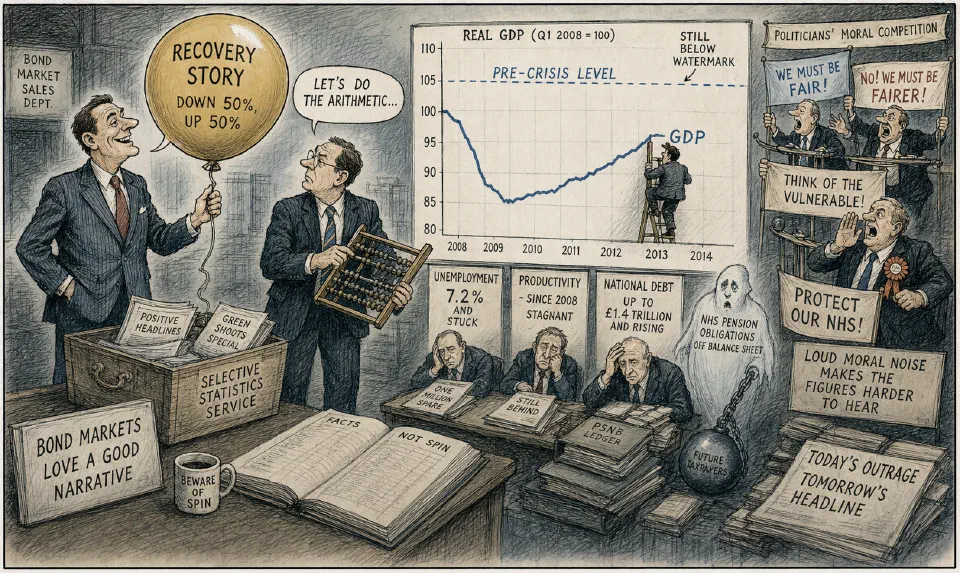
Felix Martin tells an important tale from an older and wiser colleague when he (Felix Martin) started out in the bond markets. ‘Watch out for salesmen selling recovery stories, never forget the definition of a bond that was down 50% and then recovered 50%. It has lost 25%.’
Of course, the UK’s gross domestic product (GDP) rose by nearly 2% in the four quarters to September last year, compared to almost 1% over the whole of the earlier two years. Unemployment and inflation are down. We must be pleased with this trend. However, the reality is this leaves the economy 2% smaller than it was more than six years ago. We need to understand levels, as well as rates, of growth. Otherwise, confusion enters our discussions and decisions. We still have 770,000 more people unemployed than at the end of 2007 and the total number at 2.4 million has barely changed from what it was in May 2010. Productivity (output per person) has gone down. There are signs that the only certainty is that a return to pre-crisis trends in economic growth is a pipe dream. Making up the lost ground by 2020 would require the economy to grow at more than 5.5% annually from now until then. We have to think again.
Austerity.
The national debt was around £790 billion in 2010. It is going to be in the region of £1.5 trillion by 2016. Deficit of the National Health Service’s pension scheme last year was £250 billion. This is about a third of the UK’s GDP and more than twice the size of the annual budget for the NHS. It’s off balance sheet. Very strange. The expected increase in the statutory minimum wage ought to be good for taxpayers. Many firms maintain their profits by paying low wages. This is something they get away with because the welfare state picks up the slack by paying part of the wage bill through benefits. Another oddity.
Into morality.
The two main parties are out-bidding each other with promises of a new morality which, they say, will permeate the social fabric and improve the nature of families and communities. They frighten the pants off this scribe. He is all for doing good but politicians imposing good send shivers down his spine. When moral rhetoric fills up the space, democratic politics subside. The focus shifts from what I should do, to what you have to do. Morality lends itself to categorising and judging our citizens into deserving and undeserving groups. It threatens to become a new and closed truth. There are dangers of legitimising abdication of responsibility. The proper passion and desire for change of values throws up simple ideas which become a bigger mess. There is not a quick-fix.
Words into action
It is said that Confucius was asked what he would do if he ran China. He replied, ‘I would make people use language correctly’. His disciples said this seemed rather trivial. Confucius disagreed: ‘If what is said is not what is meant, what should be done remains undone, morals and art are corrupted, justice goes astray and the people will stand round in helpless confusion’. Good advice. And so many managers take no notice. They assert they do not have time for clarity with brevity in the spoken and written words. But they have to spend hours and days clearing up the consequential turmoil. The silliest sin is failure to recognise the invisible customers. These people can be more important than anyone else: staff, suppliers and intermediaries. If you do not make it happen for them, they certainly will not deliver to you. A genius for stating the obvious? Yes, but just look round the place.
Yes, but how?
‘Democracy means government by discussion, but it is only effective if you can stop people talking.’ Clement Attlee, former prime minister (1945-51) of the UK.
The same everywhere?
‘Politicians are the same all over. They promise to build bridges, even where there are no rivers.’ Nikita Khrushchev, senior politician for USSR.