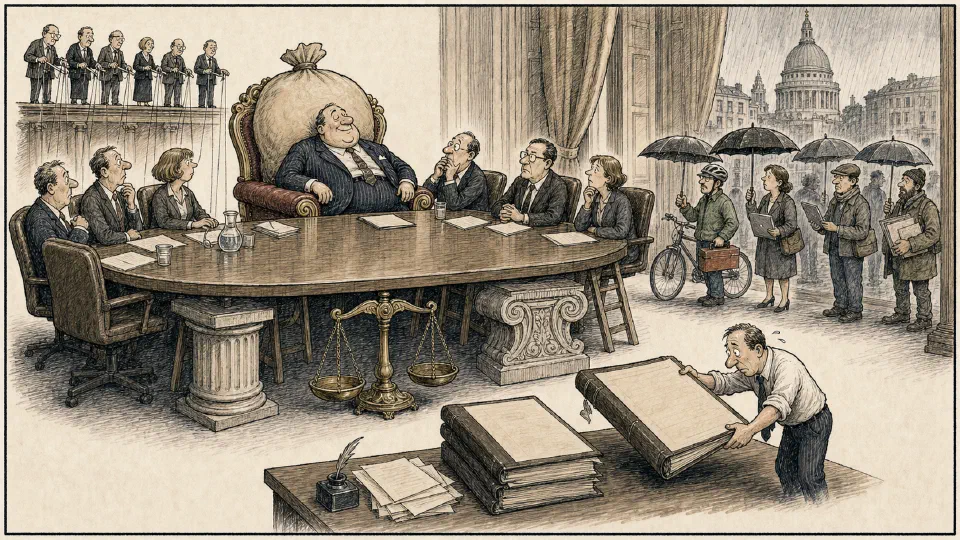
Attempts to control executives’ pay.
Prime Minister Theresa May has made tackling corporate excess one of her priorities in government. This is not a new focus of attention, we’ve been there before. It will not work. Concentration is on rules. It is the system that is broken. We must admit that self-regulation is dead, along with the assumptions we have attached to the ownership of businesses. Sir Ferdinand Mount is a former adviser to David Cameron as prime minister. He wrote: ‘We pretend that the shareholders possess powers that they effectively lost long ago, and we imagine that the behaviour of the corporation is disciplined by an array of checks and balances that are often no more than decorative today.’ The Office of National Statistics (ONS) reported in 2012 that nearly 60% of shares in the UK were held in nominee accounts and 10% were registered to private individuals. This means that most beneficial owners are not permitted to vote directly on matters such as pay. Maybe now is the time for radical changes?
Self-employment increases.
David Smith, The Sunday Times, points out that there are 4.8 million self-employed people in Britain. This compares to 3.8 million in 2008, when the financial crisis hit our economy. 3.4 million are fulltime and 1.4 million work part-time. The strongest increase has been self-employed part-timers, up 88% over fifteen years. As well as increasing in absolute terms, the self-employed population has been getting older at a faster rate than the workforce as a whole. Flexible routes into retirement – people winding down gradually – were subjects for speakers at conferences not so long ago. This seems to be happening by choice rather than by legislation. Changes of this kind have critics. Some suggest they are exploitation of those who have a shaky position in the labour market. Others are sure ‘involuntary’ self-employment is disguised unemployment. The evidence is that most people who make the move to self-employment earn above the average. Of course, this piece of information does not deal with the overall situation. Prime Minister, Theresa May, has commissioned Matthew Taylor, chief executive of the Royal Society of Arts, to review working practices across the economy.
A mistake.
The Office for National Statistics (ONS) has admitted a big and very embarrassing ‘processing error’ that led it to underestimate by £6 billion Britain’s trade deficit with the rest of the world. The correct figure is £17 billion, the highest since 1955.
Things in the way.
Mahatma Gandhi was the determined, legendary and successful leader of the movement for independence of India. He once said, ‘First they ignore you, then they laugh at you, then they fight you, then you win’. Rhymer Rigby wonders in the magazine Work if there is a similarity to Donald Trump. He was ignored or laughed at. The Republican Party in America did not take him seriously until he was its candidate. The Democrats thought they had been handed a gift until he beat Hillary Clinton. Mr Rigby concludes, ‘It is never the risks you worry about that undo you, it’s the ones you don’t worry about’.
Just a thought.
‘All decent people live beyond their incomes nowadays, and those who aren’t respectable live beyond other people’s. A few gifted individuals manage to do both.’ Saki (Hector Hugh Munro) (1870 – 1916). English novelist and short story writer.
Convenient vengeance.
‘Autobiography is an unrivalled vehicle for telling the truth about other people.’ Philip Guedalla (1889 – 1944). English writer.