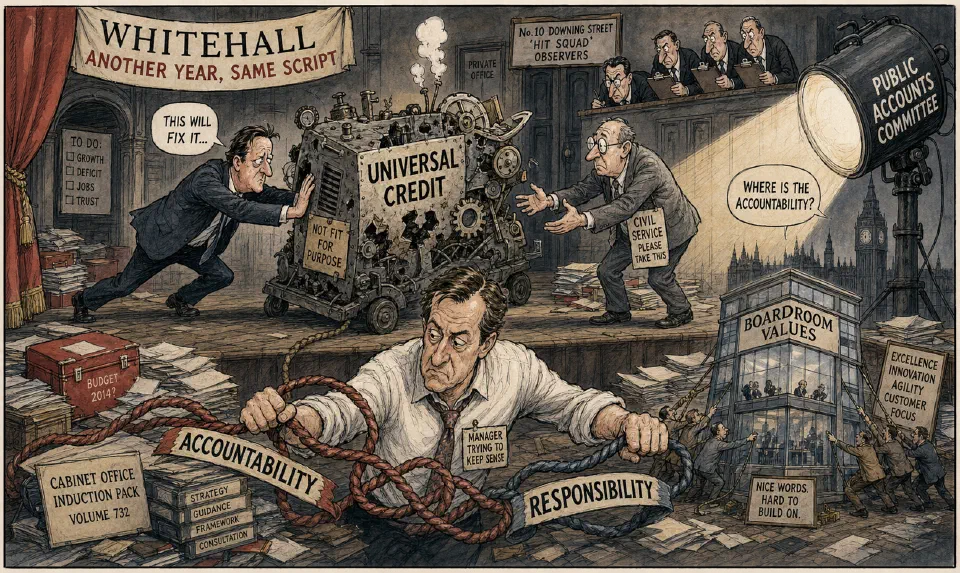
Accountability and responsibility.
This is a contentious topic at the top of Whitehall. It was emphasised by the mess created over introduction of Universal Credit, a personal mission of Iain Duncan Smith, the secretary of state for Work and Pensions (DWP). There are increasing concerns about accountabilities of ministers and civil servants. The noisy Public Accounts Committee (PAC) published a damning report which nearly blamed Robert Devereux, the permanent secretary (and accounting officer) for the problems. It is important to bear in mind that the PAC rarely interrogates ministers. The current accountability processes are incapable of dealing with situations such as Universal Credit. Senior ministers have become unwilling to appear in the House of Commons, explain the background to a problem and promise corrective action. They wish to make civil servants more responsible for failures of performance and have a greater say in their selection. Here are the ingredients of a huge row. A clash between high-minded idealism and mandarins’ pragmatism. 10 Downing Street has sent hit squads to keep an eye on civil servants. Most ministers do not have a personal record of managerial success elsewhere. They are determined to improve results. Civil servants have equal commitment to resisting politicisation.
Let’s be careful in the accusations.
‘What has the public sector ever done for us?’ is a common and rhetorical question asked at meetings of some trade bodies. ‘Why do you allow entrepreneurs to be handicapped by bureaucrats of the state?’ is the complaint of those who claim to be advocates of a free market. The real world is different. The state is an essential feature of British capitalism, seeking approval as part of a civilised society. It spends billions on infrastructure to stimulate investments. Industry receives substantial subsidies, grants and tax breaks, from nuclear power (£2.5 billion a year) to export of arms (£890m). Education of the workforce needed by businesses is funded by government. The wages for employees is often topped up by the state. Business rates have received special attention. And there is a sympathetic Bank of England on interest rates. Recall the rescuer when things go wrong. How was G4S bailed out just before the Olympic Games? The privatised rail network has obtained a life-saving injection from the state. Consider the recovery of the entire financial system. The public sector is a major factor in our managerial lives. However, it has to improve in what it does.
Charles Handy says more to large employers.
He has been a shrewd observer for a long time and now emphasises that many chief executives are ‘mysterious’ and ‘invisible’ to their employees and the public. He suggests workers are beginning to find a voice and, unless organisations change, those at the bottom will ‘pull down the big glass towers’ in which boards operate.
‘A 21st century democracy will not stand continually rewarding 1% of the company, while the other 99% suffer.’ Handy has concluded that the way people view work is changing. Big organisations are moving too slowly to match modern ambitions. ‘I love to see businesses grow, but they should be growing better not bigger. Think of them as an orchestra. Once you have the right number of musicians you practice to improve. You don’t just add another violinist.’
Values. Words?
Adrian Furnham is professor of psychology at University College London. At a recent conference he made some provocative, but realistic comments. ‘What is the value of values?’ he asked. ‘Every company has the same ones, yet thinks it is unique.’ He suggested that written values often tell nothing about the true culture of an organisation. ‘If you really want to know a company’s values, pay it a visit. Wander around and see how people behave. That will reveal more than what’s on the wall.’ Professor Furnham also accused senior managers of not ‘walking the walk’ on corporate values. ‘Unless value-informed behaviour is modelled by the ‘grown ups’, the whole thing will fail.’ This is obvious, but so scarce.
Makes sense.
‘Only the guy who isn’t rowing has time to rock the boat.’ Jean-Paul Sartre
Wisdom for managers, too.
‘Resentment is like drinking poison and then hoping it will kill your enemies.’ Nelson Mandela