Is there going to be a currency war?
In this contest each combatant will fight to make its currency worth less than other major players. Think exports and growth, not holidays.
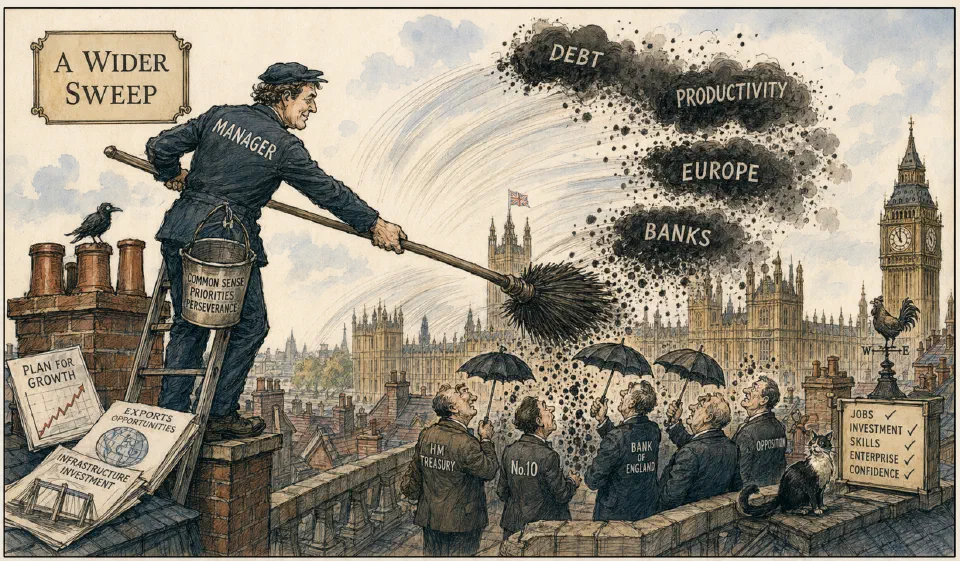
The respected Institute for Fiscal Studies published its Green Budget last week. A formidable document which concludes that public spending in 2014-15 will be £64bn higher than planned originally. Despite constant talk about reducing costs of benefits, spending on social security will rise from 28.5% to 32.5% of all public expenditure by 2017-18. Also, the overall effect of amendments to taxes and benefits to be introduced in 2014-15 will not be a drop in expenditure, but ‘a small net giveaway’. We must bear in mind that UK’s approach to personal taxation is in a terrible mess. For example, MoneyWeek points to the raising of the personal income tax allowance. This has cost £9bn and was accompanied by assertions that the move will take people with low incomes out of the tax system. Not so. Low earners still pay national insurance (an effective income tax) at 12%. The Institute for Fiscal Studies observes, ‘a genuinely coherent tax policy is still lacking’. So, we have a huge debt, a plan for austerity that has few signs of working and a derelict tax system. There have been recommendations for corrective action in the short-term – more schools/roads et al and cuts in red tape. The responses by government are not enough to make an important difference.
Watch out. Politics affect businesses.
The crisis of political forms and leadership throughout the world shows no signs of resolution. Many are scarcely aware of it. They have convinced themselves it is simply the recession which is undermining leaders. Come the recovery, they say, the loss of faith will evaporate and life will return to its old normality.
But things rarely regain their earlier features. Two of the world’s most successful political parties – Communist Party in the former Soviet Union and America’s Republicans – are seriously damaged. A third, the Italian Christian Democrats, has been discredited and Japan’s Liberal Democrats have been in the wilderness. The British LibDems are beginning to go the same way, with a broken leader, eruption of scandals and a deficit of vision and purpose. But while the old have crises, the new is not yet born. That is the challenge of our times.
Get up and go. The characteristic of our cousins on the other side of the pond.
Americans still insist they believe in small government and taunt us (Europe) for having 7% of the world’s population, but half of its social expenditure. Is the self-image fair? The figures indicate they are kidding. Mona Charon (NationalReview.com) has done some arithmetic. If you add outlays by states and local government to federal outgoings, the sum as a share of gross domestic product ‘easily competes with European nations’. The United States’ per capita spending is higher than France’s, Germany’s and the UK’s. It is reasonable to conclude its citizens have an appetite for big government. President George W Bush was a substantial contributor.
There are four ‘public relations executives’ for every journalist in the media industry.
They have more influence than in earlier times. How will these forceful spinners affect the future of corporate communications? PR had a turnover of $10bn in 2011 and employs around 66,000 people. Despite austerity, growth was 8% last year. A recent study estimated there were two PRs for every journalist a few years ago. The ratio is now 4:1. In the 1980s, marketers had the ear of the boss. It was the strategists’ turn during the 90s, then specialists from human resources moved into favour for the noughties. It seems that PRs have become the eyes and ears of an organisation in difficult economic times. And the world has changed. Communication has become more immediate, important and varied. PRs often have the job of interpreting reality to the top. Senior directors/managers have become as powerful as politicians in some ways. The shrewd ones will make sure they are in positions where they can be heard. Whether more listening leads to better businesses remains for scrutiny. Certainly, it is a strange world when the speakers of truth are corporate PRs.
The left hand and the right hand. Into action?
The Journal of Marketing (January 2013) says surveys have revealed that people who make sales fail to follow-up 70% of leads generated by other means. The research shows that as the experience of salespeople increases, their responses reduce to managerial tracking of leads. But if their performances improve, reaction to leads gets better. However, the impact of direct managerial checks continues to lessen.
And it feels comfortable.
‘Prejudice is a great time-saver. You can form opinions without having to get the facts.’ E B White, quoted in The Observer and The Week.
An economist.
‘Someone who will explain to you tomorrow why what s/he forecast yesterday didn’t happen today.’ Definition in the Financial Times.