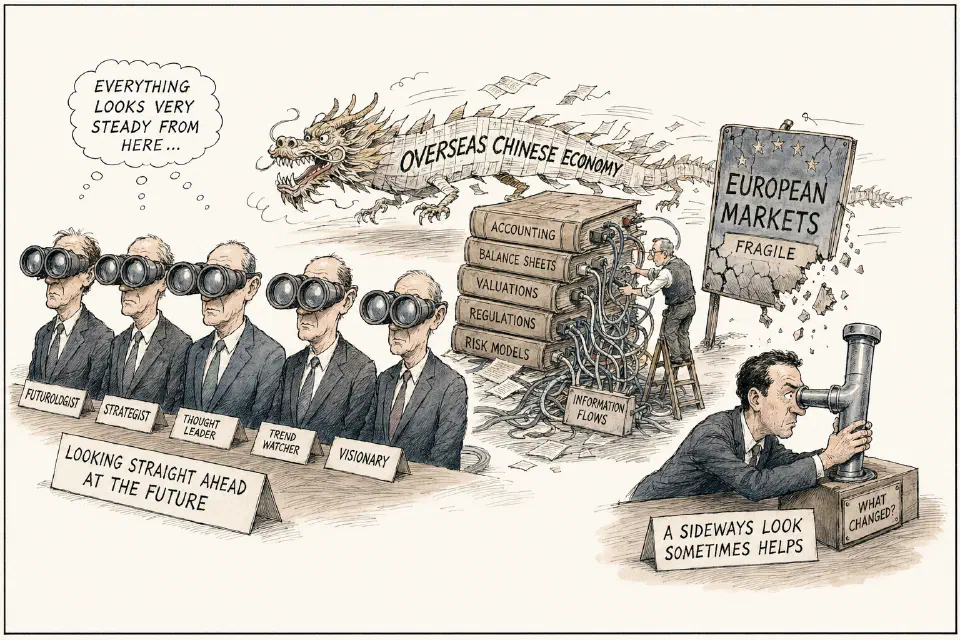
Many futurologists in economic life do a good job foretelling some things.
But the fundamental changes predicted by no one are always far more important. There was silence twenty-seven years ago over the emergence of 55 million overseas Chinese people as the new economic superpower. We did not realise that the revolution in information would cause a radical rethinking and restructuring of accounting models. Few observers suggested that the Single European Market would usher in a decade of stagnation and bickering rather than release explosive economic growth. The more united Europe of 2011 is weaker in the world’s economy than the fractured Europe of 1985.
Does a managerial structure encourage behaviour reminiscent of a religious movement?
Stephen Pattison presented a convincing case for such a conclusion (‘The Faith of Managers’ : Cassell). Many people have observed that managers and religions use similar forms of language: for example, mission statements and vision. But there are other resemblances: the ethos of obedience and commitment; the tenet that people shall be known by their fruits (personal targets); a quest for perfection (total quality management); the importance of charismatic leaders and gurus.
Maybe ’new wave management’ approximates to charismatic sects? Pattison did not attempt to debunk management. He reckons there would be benefits from recognising it as a system of faith. In this way, managers might become more self-critical and self-aware.
A company cannot protect its reputation at all times.
The supply-chain is a complex process and the most generous donations to good causes will not offset events that attract journalists’ attention. Also, there is a temptation to use good practices as a marketing tool. This might lead to the sin of self-aggrandisement. Customers and the media love to throw rotten eggs at businesses that put themselves on a pedestal. Stature is no quick fix. The campaign has to be tended patiently and regularly. Being a respected neighbour and citizen must be towards the top of every marketer’s agenda. Of course, there is the odd squabble in every long-term relationship.
A survey by Office Angels, a recruitment agency, suggested ten ways in which office workers really get up the noses of their colleagues:
- leaving mobile ‘phones on during meetings;
- abandoning a jammed photocopier for someone else to fix;
- gossiping;
- talking about their private lives;
- borrowing pens and pencils and not returning them;
- making coffee without offering to do so for those sitting nearby;
- leaving the kitchen untidy;
- loitering at the desk when one is using the telephone;
- sending internal e-mails in place of telephone calls;
- looking depressed.
One of the UK’s electronics companies says it has a system to camouflage the ‘signature’ of a Challenger tank and a Land Rover
to make them appear on an enemy’s radar as a milk float and a wheelbarrow. Maybe a solution to Government’s concern about expenditure on defence would be to make a milk float and a wheelbarrow look like a Challenger tank and a Land Rover on the screen?
Heck
‘The US and Denmark are the only democracies to have debt ceilings.’ The New Yorker, 1 August 2011.