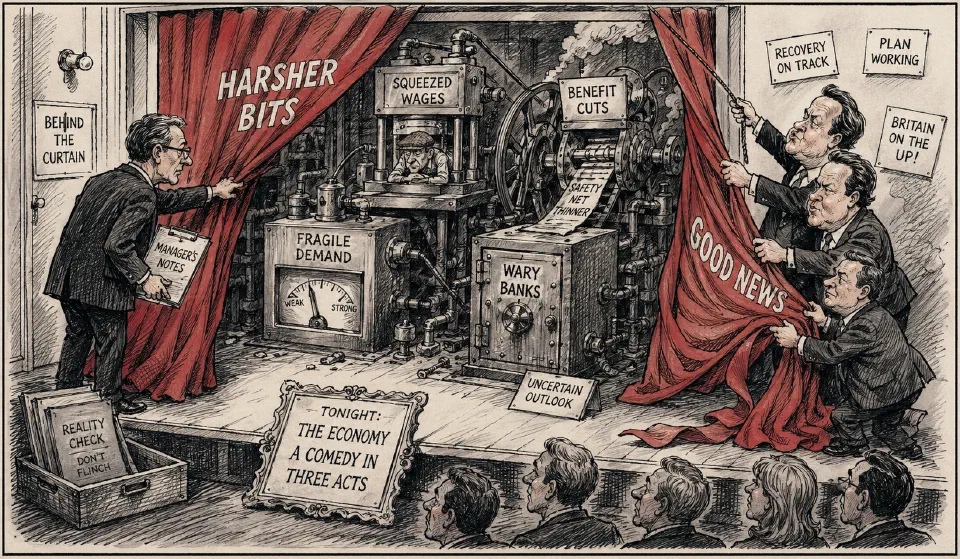
Did you notice that chancellor George Osborne’s spending review covered a single year?
The expected period is three or four. A probable explanation is that our government does not want to highlight additional cuts in expenditure assumed for after 2016. Reductions for 2017 and 2018 are predicted to be a further 7.6%. Of course, some of this will be covered by tax increases. We will not hear much about them now the election campaign has started for 2015.
The chancellor is looking for an extra £11.5 billion decrease in departmental expenditure (DEL). That is, 2.8% across the board. But 60% of outgoings are ring-fenced in health, education and overseas aid. This means an 8% hit on the unprotected activities. Remember, this is on top of reductions already implemented and planned; for example, 27% in Justice. There is no doubt that public services can be delivered more effectively. But there will be sustained failure unless there is better management and removal of willy-nilly demands/forecasts.
Mark Carney has arrived in his new job at the Bank of England with excitement usually reserved for a rock star.
The FTSE 100 marched upwards. Commentators talked about his policy of ‘forward guidance’. It is simply a promise that interest rates will stay low for a long time. Nonetheless, Mr Carney has a political agenda. He intends to control the market price of certain assets. These include the government’s debts and sterling. His primary target is to grip the UK’s household and personal liabilities. Increases in the costs of borrowing would cause all sorts of problems for expenditures – especially mortgages. The pound plummeted last week and will lead to higher inflation.
Researchers say …
Although outstanding people don’t always succeed, they never fail. They see life as a series of challenges, and they expect to win in the long run. Defeat is a temporary setback which they intend to correct. … If you lack time to do a job for someone else, say ‘no’ at the outset. The longer you wait to pull out, the more money and time will have been squandered. … Each significant step in every field has been taken by an individual who has freed her/himself from better educated friends’ and associates’ ways of thinking and taken a fresh, clean look at old knowledge.
Facts for decisions.
A Governor of the Bank of England once offered an illuminating explanation of Government’s failure to reduce inflation. ‘The problem’, he said, ‘was not that the brakes were ineffective but rather that the speedometer has been misleading’. In other words, Her Majesty’s Government is unlikely to know what is going on in the so-called real economy. Indeed, there is increasing evidence that Whitehall may well have been driving with a defective rev-counter and badly calibrated gauges for oil and water – in addition to its faulty speedometer. This is bad news for businesses. Many rely on Government’s sources for information about their decisions and plans. Ministers tell us to stop short-termism and point to the ‘well-researched’ opportunities, threats and time bombs. So, how did we get into this position? The point really is that if we are to be governed by statistics, let them be accurate or at least show soundly-based trends. Moreover, be sceptical of all that analysis dropped on your desk. What is the ultimate customer doing and saying?
Thinkpiece.
‘Hierarchy worked when obedience worked. As long as individuals grew up believing that some people had the right to order others about, particularly if they paid them, then it made sense to connect level with role, to give power of command to those who were first in the decision-making sequence. However, today obedience on its own does not work. As a result, people increasingly challenge the ladder of command.’ Charles Handy in Harvard Business Review