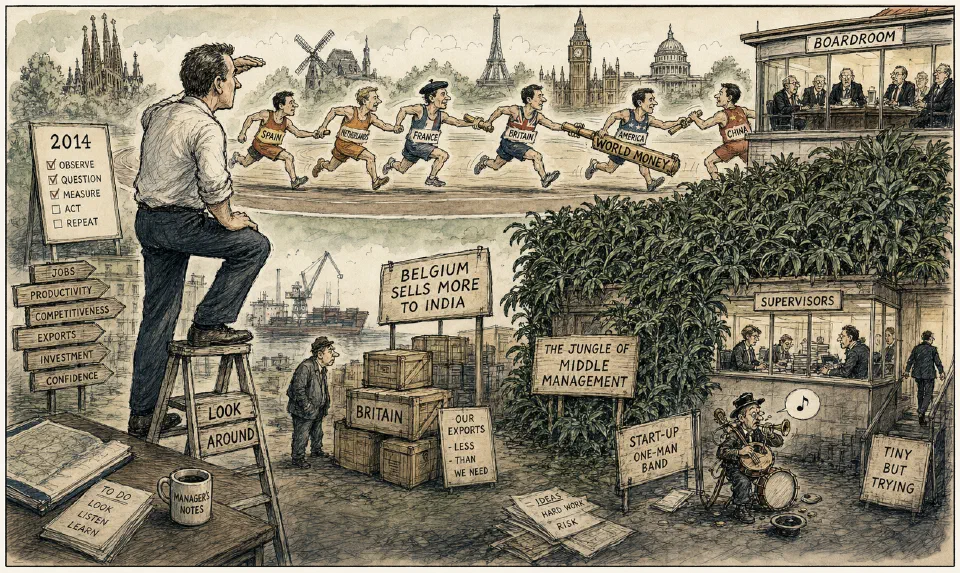
The dollar and sterling.
Bill Bonner points out that in the sixteenth century, Spain had the international leading currency. The Netherlands was number one in the seventeenth century. France’s turn came after another one hundred years. In the 1800s, Britain’s pound was the world’s money. The dollar was as good as gold in the twentieth century. Now we have China elbowing its way onto the screen.
Since 1980, the US economy doubled in size per capita. Over the same timescale, China’s has grown thirteen-fold and is still moving forward twice as fast as America. China is poor and getting richer, the US is rich and getting poorer. Sometime an upstart, possibly China, will battle it out, hopefully in the marketplace, and win. This information points to the urgency for this country to put exports into our commercial habits. Belgium sells more to India than we do!
The corporate girth.
It is commonplace that ideas are not received wholly as they are given. The receiver translates what s/he hears in the light of her/his own situation, sensing a covert threat here, or an opportunity for advancement there, assessing and often misdoubting the motives and intentions of the senders. In biggish organisations, a proposal starting at ’the top’ must penetrate two or more levels and will be interpreted from several standpoints.
Consider middle-managers - those above supervisor but below heads of function. They will be of varying types. There will be a few ‘flyers’ - people determined to reach the top, now at a critical point of success or failure. There will be technicians, often with little expectation of promotion, and without burning dissatisfaction on that account. There will be functionaries also - those holding quite senior jobs who have settled down, come to the office or factory year after year to do their job, complete their holiday plans in January, devote their thoughts to their children and the garden. Some will be cynical, even embittered, convinced that ‘getting on’ is a racket and watching sourly the rise and fall of the ambitious. Others are kindly and comfortable. A few have made themselves into ‘characters’ and live happily in this minor degree of distinction, which compensates for lack of success. Several remain ambitious and hardworking, yet have not recognised they do not possess the intellectual capacity to go further. This mixed group is important. It is the main source of tactical efficiency and minor innovation. It is, above all, the layer to which the influence of top managers can penetrate with full effect. Chairmen, managing directors and general managers may meet their supervisors and strain hard to make a personal impact. Within limits they can succeed. But these are narrow. Supervisors’ horizons are mainly bounded, as they must be, by the one or two individuals directly above them; their ways of managing are the world with which they must contend. They may like, trust, admire the senior manager who flashes into that orbit on special occasions, and this might be vital. But real life is the person for whom the supervisor works: the middle-manager. Little time is spent on these issues. If some middle-managers can be made enthusiastic, three-quarters of the battle is won. Then reduce the numbers in opposition, and isolate the irreducible and unconvertible so that they are so out of step that caution alone will dictate armistice or surrender. We are left with the jungle of senior managers at the top and, below, supervisors on the tension between policy and action. Another time, possibly.
A move to reality.
Flipcharts Fairy Tales’ enewsletter has reminded us that micro-firms will not save the economy. Here are three basics:
The self-employed don’t earn much.
In 2009-10, the median wage of a self employed worker was £10,300, compared to £18,900 for those with jobs. And over the past decade, the incomes of those who are self-employed have fallen by more than those of the wider population.
Most new businesses are ‘one-man bands’.
A large proportion of the increase in self-employment is from people who are ‘working for themselves’. They are not setting up businesses or creating jobs.
Start-ups are no route to wider economic success.
High numbers of self-employment are associated with lower GDP per person and weak economies.
Starting a business might help some people escape their economic circumstances. They will be the lucky ones. For many, self-employment means lower earnings and less security. Major proportions are, in general, associated with greater inequality and lower GDP per head. Britain’s self-employment has become high over recent years and larger than other developed economies. They rely upon the decisions of big firms and buoyant household expenditure.
Decisions … decisions.
‘The person who is denied the opportunity for taking decisions of importance begins to regard as important the decisions s/he is allowed to take. S/he becomes fussy about filing, keen on seeing that pencils are sharpened, eager to ensure that windows are open (or shut) and apt to use two or three different-coloured inks.’ C Northcote Parkinson, historian and journalist.
From 6 October 1952.
Neither a wise man, nor a brave man lies down on the tracks of history to wait for a train of the future to run over him.’ Dwight D Eisenhower, former US general and president.