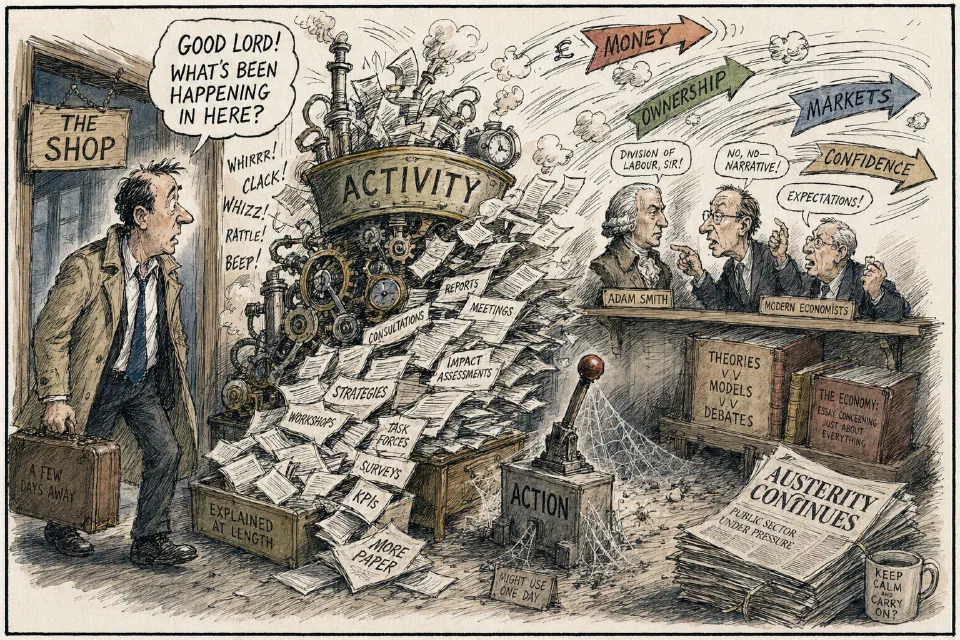
I have just completed a few days away from the ‘shop’.
This time allows a little space to ponder whether I am a busy fool or live in a world that confuses activity with action. Have we retained beliefs, methods and strategies that let us down in these times of fast and increasing information and rapid movement of money and ownership? Many of the conventions on economic theories which steer decision-makers in businesses and government seem tired and unreliable.
Adam Smith showed outstanding shrewdness in a less complicated world. So long as markets were local, external factors less important and nearby institutions of all kinds kept disreputable behaviour under control, most things were OK. However, banks have been able to reorganise costs of bad loans using derivatives and pass losses to unsuspecting pension funds and insurers. Bankers rarely have to know or meet the person they have made bankrupt.
Of course, John Maynard Keynes reckoned economic action ought to stimulate demand to create jobs in factories. When new earnings are spent, other nearby employment is generated through a multiplier effect. Current stimulus by government tends to encourage random expenditure and the jobs ‘down the line’ go to China or India.
Economists look dangerous. They grab the attention of politicians and the like by propositions that used to be right but might now be wrong.
Europe’s businesses worry about survival.
Competition becomes more global every week. It is lubricated by better communications and some deregulation. Every company is working to cut costs, deliver quality and improve service. These imperatives are to keep its performance up with the Joneses, Schmidts and Duponts, let alone their counterparts in America, Japan and South East Asia. The most striking development of the past three years has been the apparently permanent glut in the labour market. So what does it all suggest? First, expect the unexpected and do not put too much faith in economic forecasts. And second, accept that doing business overseas is tough, and getting tougher. Unless you stay ahead, you are dead.
Many large firms have learned they can do better with four layers of management than with twelve.
Medium-sized companies can make two tiers work more effectively than five. But there is often more smoke than fire. A lot of chief executives like to boast of trimming, yet go to great lengths to make cosmetic changes which have no impact on the front line. Vanquished bureaucrats in the private and public sectors seem to pop up elsewhere with the same employer.
A company cannot protect its reputation at all times.
The supply-chain is a complex process and the most generous donations to good causes will not offset events that attract journalists’ attention. Also, there is a temptation to use good practices as a marketing tool. This might lead to the sin of self-aggrandisement. Customers and the media love to throw rotten eggs at businesses that put themselves on a pedestal. Stature is not a quick fix. The campaign has to be tended patiently and regularly. Being a respected neighbour and citizen must be towards the top of every marketer’s agenda. Of course, there is the odd squabble in every long-term relationship.
Managers have to be concerned with the failure of governments to face the dilemmas of relentless rises in demand for services funded from the public purse.
The cost of health will continue to increase. Education will have a bigger share of national income – an explicit aim. Capital investment in the infrastructure for transport will climb, as demanded by most employers’ associations. These are all desirable priorities, but they will create a steadily growing tax burden unless our rulers confront the basic issues. It’s all about who pays for what. There are some hard choices for ministers.
He might be right.
Lawrence Lovell, a former president of Harvard University, once argued that ‘institutions are rarely murdered; they meet their end by suicide … They die because they have outlived their usefulness, or fail to do the work that the world wants done’.
A final thought.
‘By definition a government has no conscience. Sometimes, it has a policy, but nothing more.’ Albert Camus, quoted in The Times and The Week.