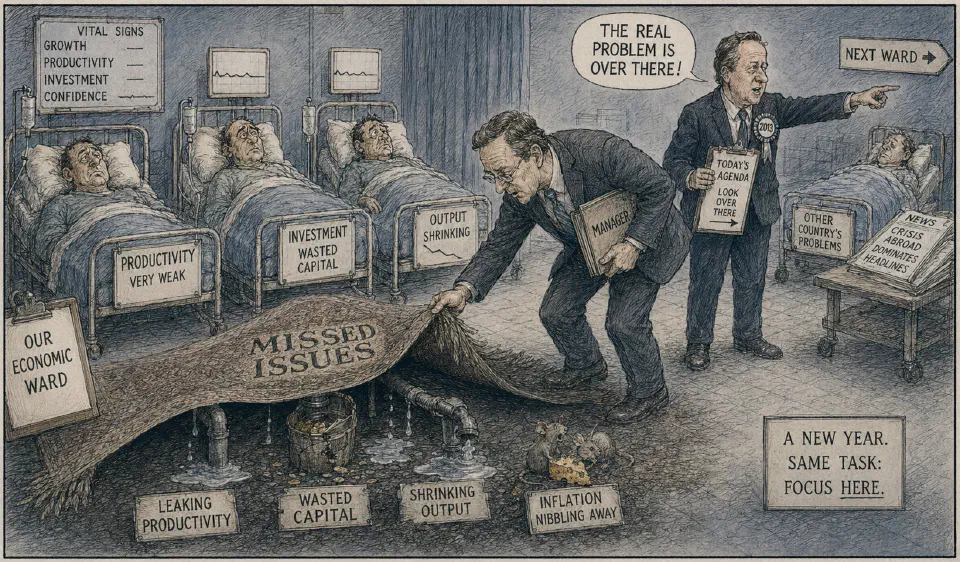
Productivity of resources is at risk.
Managers have played their part in neglecting them. A shrinking economy is the inevitable outcome. This, in turn, creates inflationary pressures, social conflict and mutual suspicion. Karl Marx was right when he argued that no system could survive reducing performances of capital – or of any key resource. And it is not good enough to observe that things are, and were, worse in the former communist countries of central and eastern Europe. A dying patient takes little comfort from knowing someone in the next bed is terminally ill. The sustained reversal of trends in output per unit is a major job for managers. In every economy, industry and branch of human activity there are institutions with substantially better results than the average. About double the norm is what marks a company out as a leader. Above all, the front runner always has twice the average for return on capital. It is the cost of staying in business.
Misuse makes strategy an imprecise notion.
But there have been general shifts:
- 1940s/50s Run an organisation like an army
- 1960s Meet the budget
- 1970s Predict the future
- 1980s Think strategically
- 1990s One best way
- Now No one best way. The vision thing.
There are two schools of thought. One sees strategy as a wish-list, rallying cry and statements of mission. Strategy is a vision, not a plan. Luck, opportunism, intuition and inspiration are the essentials in commercial success. The other group argues strategy is not a vision, but about knowing key sources of internal competitive advantage. It should be defined and applied by each business through an impartial logic and rigorous analysis. There is room for confusion and meaningless words.
‘Generation Y: unlocking the talent of young managers’ was a valuable report from the Chartered Management Institute and Ordnance Survey.
But the results of Dr Alison Macleod’s research into managers aged 35 and under challenge many hoary myths: Generation Y is self-indulgent Not so. Young managers are driven by ethics and a sense of purpose. Only 13 per cent ‘would quit their job tomorrow’ if they won the lottery. 90 per cent ‘want to work for an organisation that does something I believe in’ and 56 per cent ‘would only work for organisations with strong values’. Generation Y lacks commitment No more. It is committed to the cause. Sixty-three per cent of respondents had been in their jobs for 3 years or more and only 4 per cent strongly agree that ‘there’s no point being excessively loyal to an organisation’. Almost two-fifths (38 per cent) also work in the evenings and one-fifth (23 per cent) use ‘travel time’ for working. Generation Y is less attached to career planning. Oh no it isn’t! Seventy-five per cent chose their jobs for the long-term opportunities available. Sixty-two per cent claim to have a personal development plan, and 65 per cent ‘know what they need to achieve their ambitions’.
Black, white and green boards and flipcharts are visual aids. Slides and overhead and PowerPoint projectors are not.
They transform presenters into auditory support. The speaker is often seen as an obstruction to what is on the screen. In general, the more artistic a presentation, the less significant its content. Copies of slides distributed beforehand eliminate the need to listen and remove any feeling of guilt for not doing so. Of course, they are evidence of attendance, are seldom used after the event, and give the audience something to think about while the ‘leader’ drones on. A presenter who reads out what is on the screen insults a literate group, unless s/he had the foresight to make illegible or incomprehensible slides.
What can you do? What have you done? These are becoming the crucial questions.
Back in the 60s, your reporter had what was regarded as a ‘big job’, possibly the biggest, and a fancy job title in the engineering industry. Employers boasted at meetings that they had recruited one or two graduates. This was regarded as an unusual, bold and progressive action. People with a lot of education came to believe that attainment in higher education, rather than actually being able to do something, ought to determine status in an organisation. For example, a person with a master’s degree often expects a higher station in life than someone without a degree.
Such an embedded way of viewing things, favouring credentials over performance, tips our country towards administration, bureaucracy and dominance of process. Managers are beginning to realise careful change as essential and starting to look for colleagues and newcomers who can ‘make things happen’ and sustain the benefits.
A sound definition from the old master.
‘A manager is responsible for the application and performance of knowledge.’ Peter Drucker.
Confirmation of many suspicions.
‘Deep in their hearts, most politicians respect civil servants, and deep in their hearts, most civil servants despise politicians.’ Sir Antony Jay, co-author of Yes Minister.