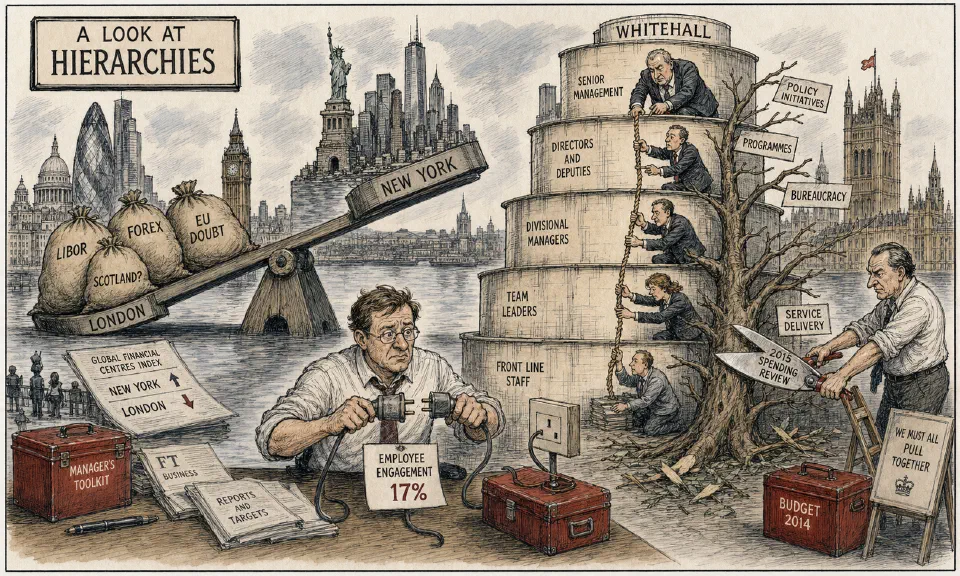
For the first time since 2007, New York has overtaken London as the world’s leading financial centre. The Financial Times says the lead is small. However, it suggests the City’s reputation has been undermined by several problems. Z/Yen Group, which compiled the index reckons these have reached ‘tipping point’. They include political uncertainty caused by doubt relating to Britain’s place in Europe and the possibility of Scotland’s independence. London has been hit harder than other centres by the scandals associated with alleged rigging of Libor (London Interbank Offered Rate) and Forex (Foreign Exchange Market). Local difficulties such as mis-selling products by banks have contributed to negative opinions.
‘Regulatory creep’ might become an issue because it is the automatic response of politicians. Some major players believe this would adversely affect the City’s entrepreneurialism. Maybe investment bankers will begin a joint and several plan to change the world’s perception of them? They will know this is not a quick-fix.
Whitehall feels bruised by cuts in public expenditure.
There is no longer any doubt. In 2015 a new government will face a spending review which demands further and increased pruning of spending. The Institute of Government has made sensible observations:
-
with no measures of value for money and poor managerial information, it is impossible to know what impact the reductions have had on productivity and quality of service
-
cross-government savings were almost ruled out. Thus, the decreases have been driven down through departmental silos
-
many departments failed to plan for retrenchments.
There are compelling reasons to think it will be harder next time round. Savings have collected most of the ‘low-hanging fruit’. The direction of reform has put a bigger premium on scarce capabilities of civil servants. This is especially true of commercial skills and managing public service markets. A priority is to keep groups such as the judiciary, nurses, police and teachers on board. The historic weakness of corporate leadership in Whitehall and the fragmented nature of the centre across HM Treasury and the Cabinet Office is likely to be the toughest reform of all. There will be difficulties of all kinds.
Information from 600,000 employees.
Gallup has surveyed 600,000 employees over five years, as well as studying thirty-two companies where 90% of the workers regarded themselves as engaged. The project has concluded there are six key issues which created problems in motivating staff. These deserve attention.
-
Leaders are not connected and curious. Too many employers concentrate on getting their junior people motivated. They forget the importance of getting their managers overt support.
-
There is a big goal, but the basics are not in place. There is much talk about mission and purpose. Employees must know what is expected of them and they have everything to do their jobs first.
-
The economy is used as an excuse. Most businesses have been affected by the downturn and many were forced to make redundancies or freeze pay and conditions. Success comes from being open and communicating regularly with employees, plus having a hopeful outlook.
-
Managers are not trusted and/or held accountable. This process does not have to be difficult. Peter Flade, Gallup’s Managing Partner for Europe, says, ‘It’s simple things like coming up with action plans and following through on them’.
-
The approach to performance management is unclear. Recognising a job done well is good, as is dealing with staff who are not pulling their weight. It’s not about creating a touchy-feely culture. Some of the most engaged groups are the most stretched, remarks Peter Flade.
-
The pursuit of engagement for engagement’s sake. The best companies use increased engagement to do something extra. The more specific the priority, the greater are the chances of it happening.
By the way, only 17% of employees in the UK describe themselves as engaged.
Good advice.
‘Learn from the mistakes of others. You can’t live long enough to make them all yourself.’ Eleanor Roosevelt (1884 – 1962). Quoted in Stylist magazine and The Week.
Sadly so.
‘A great many people think they are thinking when they are merely rearranging their prejudices.’ William James (1842 – 1910). Philosopher and psychologist from America.