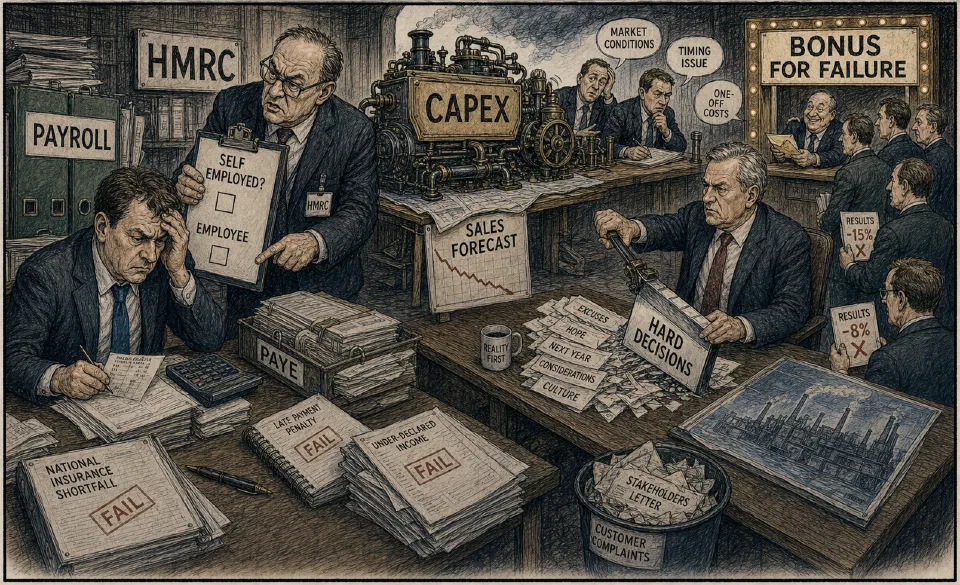
Payroll mistakes cost businesses more than £700 million a year.
Research by accountancy firm UHY Hacker Young found that HM Customs and Excise collected £737.3 million from investigations into compliance. Much of this sum related to cases when firms declared individuals to be self-employed but HMRC decided they should be counted as employees. The businesses were liable for national insurance and often higher tax charges than would have been paid if these people had initially been declared as employees. Small and medium-size enterprises were hit particularly hard by a crackdown on tax deductions from payrolls. They accounted for about half of the collected cash, despite being responsible for only ten percent of the UK’s payrolls.
Capital expenditure.
Your scribe has to enter sometimes the lion’s den of investment decisions. He notes a consistency of reasons (excuses?) permitted by sloppy companies:
- ‘It’s the biggest’ (or the best)
- ‘We must allow the production manager to sleep at night’
- ‘We need the capacity’, which is usually at the top of a fragile sales forecast
- ‘We must expand or die’.
Assets need to sweat. Investment is for opportunities and increased margins.
Worth thinking about.
William Feather told a story in the New York Evening News (1933). He said an old man once observed that in every successful organisation there is a thoroughly mean person who exercises a good deal of authority. The founder and president of the company, he suggested, might be the soul of geniality, a pillar of the church and a leader in all civic enterprises, but in deciding hard and ugly questions the mean man is given his way. ‘Mean problems must be met’, continued the old man. ‘Suppliers become indifferent. Salespeople grow lazy. Faithful but useless employees must be discharged. Expenses rise. Profits dwindle.’ The mean man says what he thinks and insists faults be corrected. Perhaps someone must be demoted? Or dividends have to be suspended. Or salaries cut. The mean man may or may not have initiated this unpleasant business, but to him is passed the nasty job of effecting these new policies. Success is partly the consequences of willingness to undertake unpleasant duties. Postponement of the difficult operation can send sick people to an early grave, and by the same process, sick businesses drift into receiverships. The mean man, who may be president, vice-president or a director, refused to put off until tomorrow what should be done today. His meanness keeps the business healthy and is a great asset to the firm.
Does your bonus scheme for managers work?
The Chartered Management Institute’s survey in 2016 collected data from 105,000 managers and 425 organisations. The results show that more than one in five (23%) who fell short of expectations on performance still received a bonus in addition to basic pay. The average underperformer received an extra £4,270 (12% of salary). 57% of managers were paid a bonus over the last twelve months compared to 54% in the previous year. The problem of rewarding failure is more acute with senior managers/directors. 43% of those who fell short of forecasts still banked a bonus.
Really?
‘I am amazed at those people who say MPs’ salaries are hopelessly inadequate. We had a good family life, the kids went to good schools, and we had good family holidays and didn’t stint on them.’ Sir Vince Cable, former MP (1997-2015). Quoted in Moneyweek.
Hard work.
‘The most formidable weapon against errors of every kind is reason. I have never used any other, and I trust never shall.’ Thomas Paine (1737-1809). English/American political activist. One of the Founding Fathers of the United States.