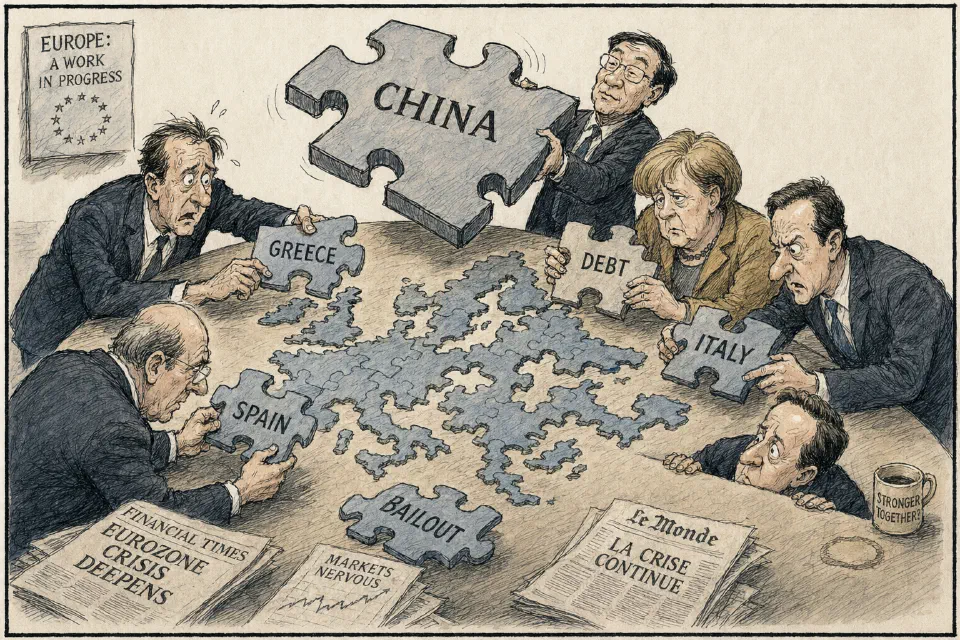
It’s a strange world.
Greece cannot pay its bills because it does not have enough money. Ireland and Portugal have already received this kind of largesse. Italy and Spain are on the edge of cliffs. Other European countries, who can barely meet their obligations, will loan funds to overcome immediate problems. Well, they will for the time being. China has indicated a willingness to help. There is real money to spare, which she makes by selling things to those places that cannot handle their debts.
There is no macro magic
Hopes that George Osborne can accelerate an economic recovery are almost certainly ill-founded. Even economists have realised after years of pain that chancellor’s attempts to manipulate the economic cycle often add to instability rather than reduce it. Nor should we believe that the budget will raise gross domestic product in the long-term by stimulating education and research and development. The evidence that governments can promote sustainable growth by fiscal measures is scarce, as are indications that they can dampen economic fluctuations in the short-run. And official forecasts of the government’s borrowings are tragically unreliable. The average error in predictions for the following year is over £10 billion.
Apple’s recent financial results were an impassive but clear commentary on the work of the business’s co-founder, the departed Steve Jobs.
$81.6 billion of cash, or near-cash, was shown in the annual accounts. And the gross margin on sales was 40.3%. Apple had greater liquidity than the United States’ government. It could purchase BT, Nokia and Tesco without borrowing a penny. The margins tell us that Apple can sell millions of products at top prices in the most competitive markets we know – computers and mobile ‘phones. The only market research Steve Jobs ever did was with himself as the customer. He said his products were ‘insanely great’, because they came from his inner sense of crazy excellence. It is almost certain that such a person will never again lead a publicly-quoted company at the commanding heights of the world’s economy. Conventional managerial models will dominate. Thanks to Bryan Appleyard.
Things get done because of men or women with conviction.
But the UK is overcrowded with giant institutions - scientific, religious, commercial, educational or artistic - that are not centres of conviction, but monuments to an ego. They have lots of money and good people, but no results. So, before you embark on a new effort or direction, ask yourself: ‘Are we really trying to open up new territory, or are we just building another fortress to defend the status quo?’
Competitive advantage is about doing something better than competitors do
It is relative. Do not attempt to achieve an ideal standard. Competition in most markets takes place at the edges, where little things determine who gains the upper hand. Aspects of service come to mind. Put ten points on your checklist: superior product or service; perceived benefit; global skills; low-cost operator; first-rate competences; outstanding assets; scale; focus and attitudes; legal protection; and powerful relationships. Bear in mind that most companies bring together a number of small and consistent selling points. Strategic thinking (not the same as formal strategies) and business plans covering attitudes and skills sustain the differences. Marketing with practical steps brings a soul to the business.
Beware of the raw facts
‘One way of catching class attention is to ask what advice students would give when presented with the following family history. The father has syphilis, the mother tuberculosis, they already had four children - the first is blind, the second died, the third is deaf and dumb, and the fourth has tuberculosis. The mother is pregnant with her fifth child, and the parents are willing to have an abortion should you so decide. Assuming there are not too many Catholics in the class, you will usually find a majority in favour of abortion. You congratulate the class on their decision … and then tell them they have just got rid of Beethoven.’ From ‘Humanism in Medicine’ , The Lancet (1978)