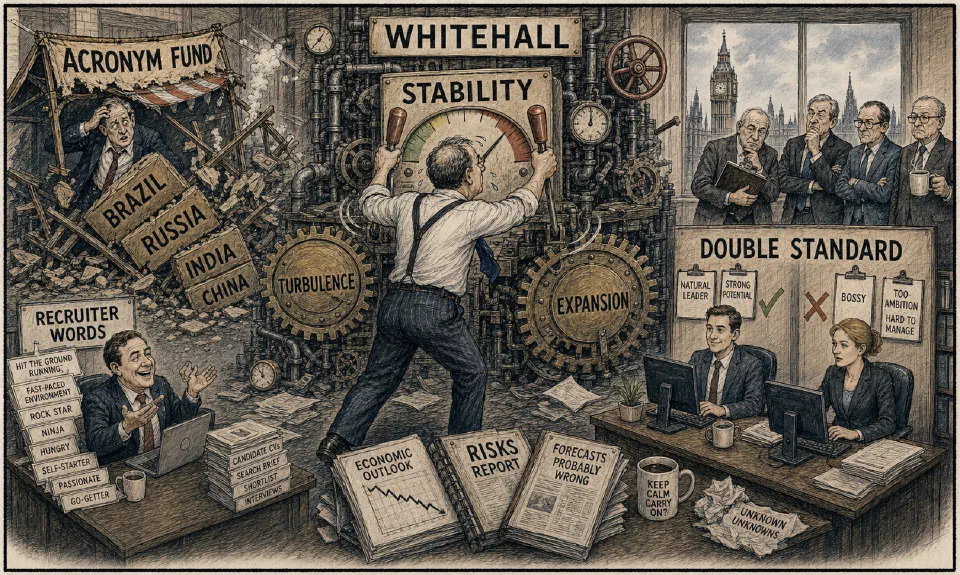
Can governments deliver economic stability?
Continuous technological change make fluctuations inevitable. There is a tension between the promise of steadiness and certain turbulence. Evidence suggests that stability has an inverse relationship with expansion. The UK was steadier than many other economies in the 1960s, but had slower growth. It is possible that deep cycles and macroeconomic shocks flush out inhibitors, anti-competitive interests and the inefficient. The same factors which give ordinary firms the confidence to invest may well offer workers the courage to push for more pay and resist pressures for higher productivity. There are suspicions that the so-called golden age of the 50s and 60s was destined to end in an inflationary surge just because of this connection.
Words from recruiters.
Follow the language.
- Hands-on managerial style means interfering by another name.
- Opportunity to acquire new skills: you’ll be thrown in at the deep end.
- Work under pressure: you’ll have inadequate resources to deliver the impossible.
- Experience of cultural change: we want to see blood on your hands.
- Enthusiastic: näive.
Collapsed BRICs.
Goldman Sachs has closed its ‘BRIC’ fund after years of poor performances. This is the end of an era. Jim (now Baron) O’Neill was Goldman Sachs’ chief economist and in 2001 noted the growth of Brazil, Russia, India and China (South Africa was added in 2012 and provided the big ‘S’. A formal group was created in 2006, but things have gone wrong. First, there are substantial conflicts of interest and what America’s Centre for Strategic and International Studies described as, ‘indisputable political, social and cultural differences’. There are newer setbacks. Brazil is caught up in a corruption scandal involving its president. Vladimir Putin has been hit by dramatic falls in oil prices and sanctions. India is struggling with an agenda for reform. China is suffering from an intransigent slowdown of economic activity. Maybe the primary lesson to be learned from BRICs is the danger of sacrificing good investment sense for the sake of a snappy acronym (The Week)?
Impressions from an office.
The family picture is on HIS desk. Ah, a solid, responsible family man.
The family picture is on HER desk. Umm, her family will come before her career.
HIS desk is cluttered. He’s obviously a hard worker and a busy man. HER desk is cluttered. She’s obviously a disorganised scatterbrain.
HE is talking with his co-workers. He must be discussing the latest deal. SHE is talking with her co-workers. She must be gossiping.
HE’S not in the office. He’s meeting customers. SHE’S not in the office. She must be out shopping.
HE’S getting married. He’ll get more settled. SHE’S getting married. She’ll get pregnant and leave.
HE’S leaving for a better job. He knows how to recognise a good opportunity. SHE’S leaving for a better job. Women are not dependable.
Decisions.
‘We know what happens to people who stay in the middle of the road. They get run over.’ Aneurin Bevan, (1897-1960). British senior politician and statesman.
Pay-up.
‘Mankind is not a tribe of animals to which we owe compassion. Mankind is a club to which we owe our subscription.’ G K Chesterton, (1974-1926). English essayist, novelist, poet and critic.