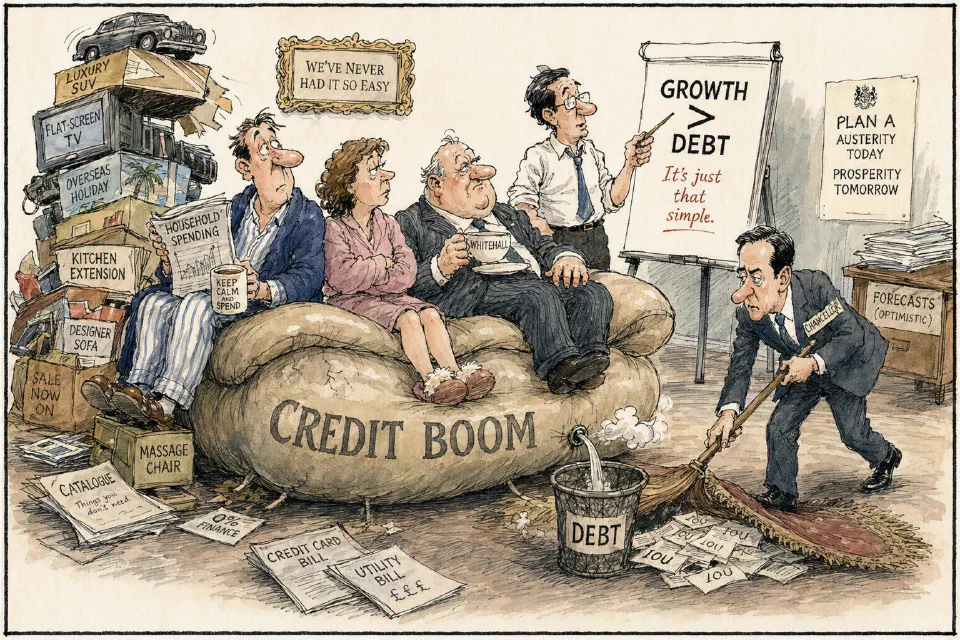
Many governments reduced their debt in the 80s and 90s.
They included the UK and United States. Economies were booming. Credit was expanding. If an economy grows faster than debt, the financial burden declines as a percentage of gross domestic product. Consumers were buying more and more products and services they did not need with more and more money they did not have. This kind of prosperity could not last forever. At the end of 2007, the financial picture changed for governments, plus households and businesses. Revenues from taxation were down, expenditure went up. So, bailouts, quantative easing and a plan for austerity came our way. Will political leaders learn the lesson? The claimers of all-embracing wisdom say we can grow our way out of debt, like we did last time. Cautious analysts suggest we are taking part in an economic correction. Rates of growth will be low and occasionally negative. Moreover, a larger part of our transactions are under the government’s control. This reflects activity, not wealth. It will do little for paying down debt. Bill Bonner prompted this train of thought.
Benjamin Barber is a political scientist and wrote a thoughtful book on new capitalism, Jihad vs McWorld.
‘Having created the conditions that made markets possible, democracy must also do all the things markets undo or cannot do.’ Markets pursue profits. Service, quality and general affluence are pressure with different origins. The universal, democratic prosperity Americans reflect upon with nostalgia was achieved by reining in markets. This demanded huge efforts from mass organisations such as consumers’ groups, single-issue activists, trades unions, all underpinned by the confidence of a more educated population and working through democratically elected and challenged governments not daunted by myths of the market.
Compromise can be bad for the business.
It should be a last resort. If two divisions – or departments or people – have a problem they cannot solve and it comes to you, spend time listening to both sides. Test the facts, predictions and reasons. Then do not be a Solomon; pick one or the other. This places solid accountability on the winner to make it work. There is nothing wrong in encouraging the avoidance of compromise. Teach people to win some battles, lose others gracefully. Work on those who try to win everything. For the sake of the group, there must be a fair share of victories. When you give in, give in all the way. And when you win, try to win all the way so the responsibility for success rests squarely with you.
This is a story about four people named Everybody, Somebody, Anybody and Nobody.
There was an important job to be done and Everybody was sure that Somebody would do it. Anybody could have done it, but Nobody did. Somebody got angry about that, because it was Everybody’s job. Everybody thought Anybody would do it, but Nobody realised that Everybody wouldn’t do it. It ended up that Everybody blamed Somebody when Nobody did what Anybody could have done!
The last bit.
‘I never wonder to see men wicked, but I often wonder to see them not as named.’ Jonathan Swift, quoted in The Times and The Week.