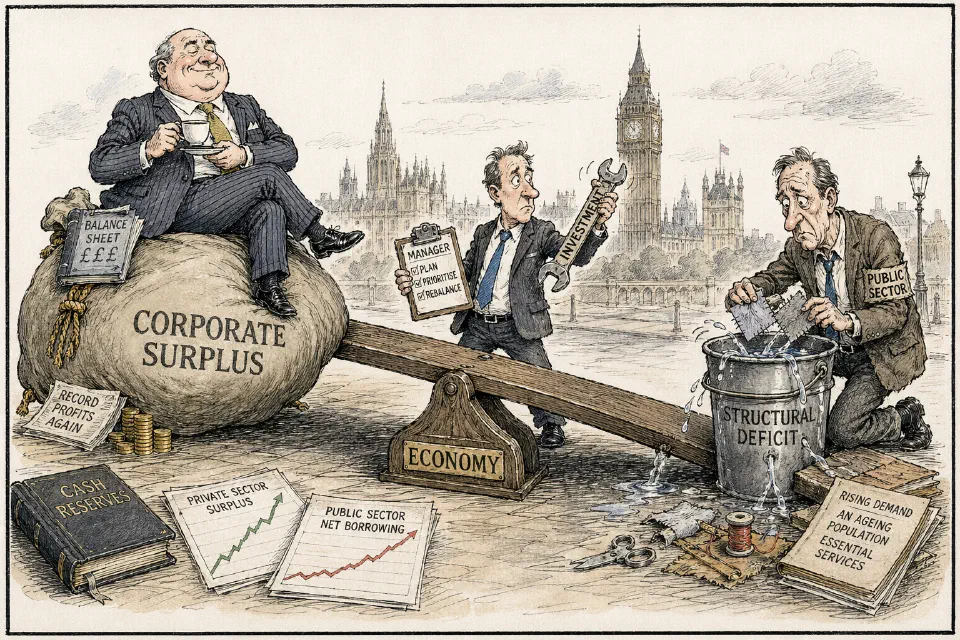
We are told daily that countries in the developed world must tackle their structural financial deficits.
But we hear little about the equally ‘unsustainable’ surpluses of corporates. There are good reasons to suggest that a shift in commercial behaviour is a large factor in the fiscal problems of Europe and the United States. Historically, it is unusual for these sectors to have prolonged financial surpluses. For more than fifty years, the major companies have been net borrowers, not savers. They have stepped away from risk right now. The ratio of investment to gross domestic product in the West is at its lowest point for sixty years. A majority of large companies appear to be running themselves for cash. Politicians and policy-makers have been slow to realise this situation. Until the approach changes, it will be difficult to improve the fiscal arithmetic.
The Prime Minister has fronted the proposition that ‘capitalism is in crisis’.
Have you noticed the range of confident responses, especially from celebrities at the jamboree of our elite in Davos? The politicians tell us not to worry, they can fix the weaknesses, but seem to fail. The economists have their own and worn out solutions. They prefer their models to reality and have advocated policies that caused boom and bust. The bureaucrats of major organisations want more regulations. The spenders of other people’s money on schemes of all kinds urge us to rely upon more ‘good works’. Entrepreneurs put their faith in one-offery. Of course, pursuit of a narrow theme is the fastest route to getting published and winning coveted public appointments. We should never underestimate the rewards for toeing a mainstream line.
Concepts in strategy are a bit like information from the stockmarket.
The first person with a useful insight makes more money than the last. Nifty strategies do not remain proprietary for long. When everyone climbs on the same wagon, the idea no longer yields a differential benefit. Good strategies are usually transient. They lose their value as they enter the public domain. The challenge is to create tomorrow’s advantages faster than competitors mimic today’s. The essence of strategy is the ability to learn; not calculating competitive edge at a point in time. It is the skill to engage an entire organisation in a continual search for new forms of advantages.
This country now treats politics as we do the cash machine or the supermarket’s aisle.
Demand is sudden and intense. Satisfaction must be swift. A lunatic with firearms kills schoolchildren: there is a blanket-ban on weapons. Pit-bulls savage youngsters: dangerous dogs were outlawed. In a rapidly unstoical society, the stupid person is the one who can neither satisfy nor even articulate his immediate need. The politician starts to speak like a commercial, and those who do not deliver are pilloried publicly before being sacrificed. The National Health Service has not understood this basic issue. Much of this world has come from the bottom up. We demand more and punish those who do not give it. As we enter a new century, there is no sign that more means less to those who have it or to those who aspire to it. For the moment, politics looks set to be increasingly consumer-driven.
The sharp putdown.
‘We may be poor, but we aren’t stupid.’ Xia Bin, adviser to China’s sovereign wealth fund on its refusal to buy the European Union’s debt.