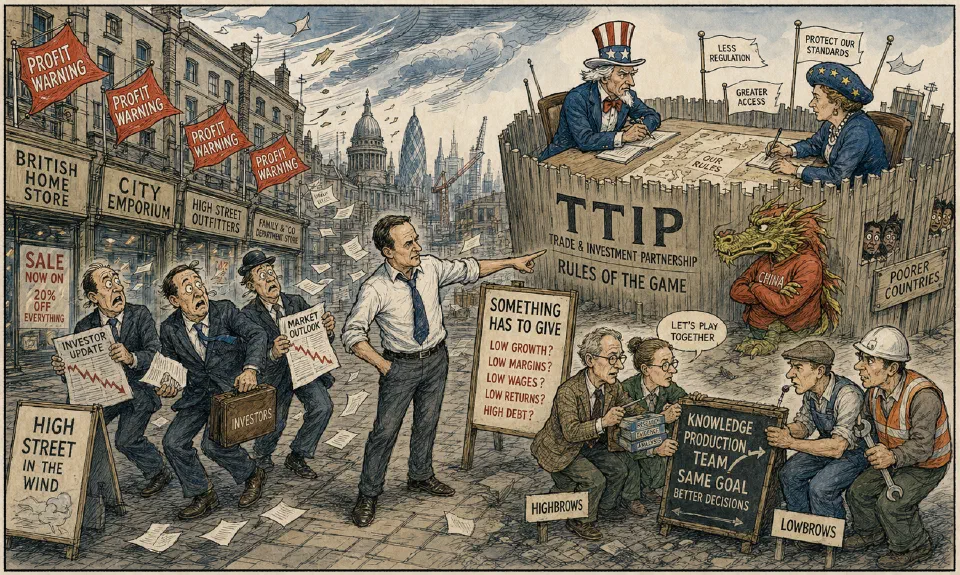
Something has to give.
Bad news from the retail sector is becoming a daily experience. We do not have signs yet of the recovery in spending by households going away. Nonetheless, there have been several poor results or ‘profit warnings’. Investors are getting jittery. Tate and Lyle and Tesco have issued profit warnings. Next has told the City the unusually warm weather hit growth in sales. The news wiped 4% off the shares and unnerved shareholders elsewhere, notably Debenhams and Marks and Spencer. Sainsbury’s has reported a third successive quarter with falling sales. There are some rational explanations, but the rickety high streets must reconsider the priorities for their future.
Wither China …. and America?
There is beginning to be clarity that the big economic confrontation this century will be between China and the United States. The first is a growing empire, the second a declining one. The emergent Transatlantic Trade and Investment Partnership (TTIP) has characteristics of the US and Europe trying to devise a new set of global trading standards that China will, eventually, have to accept. Right now, China ignores many international regulations relating to, for example, safety, environment and consumers. America is establishing a parallel ‘Transatlantic Partnership’ that includes Australia, Japan and Singapore. China, the world’s second largest economy, is excluded pointedly from these talks. This arrangement might suit the US and Europe at the moment, but it omits many developing countries. It is possible they will miss out on the new plans for trade. A recent forecast shows that European trade with the poorest countries will fall by 3% under the TTIP. There are dangers.
Glimpse of the future.
That knowledge is power is an old adage. This is why people who had it in the past tried to keep it to themselves. Success now comes from transmitting information to make it productive, not from hiding it. Productivity of knowledge has both a qualitative and quantitative dimension. We are beginning to realise that executives must be both managers of specialists and synthesisers of different fields of knowledge. The traditional manager feels threatened by highfaluting highbrows. The intellectual worries about being too commercial to earn respect in her or his discipline. A primary managerial task is to get highbrows and lowbrows to play in the same team. Organisations are moving beyond senior – junior polarities. They are unlikely to be a blend of sponsor and mentor relations. A structure will be founded on mutual understanding and responsibilities.
The next referendum.
Soon, the arguments for and against the European Union (EU) will enter conversations, agendas and speeches more often. There are plenty of good reasons for remaining a member. It is likely to give the UK more influence around the world. It strengthens bonds between countries. It underpins the free movement of people and goods. What happens in continental Europe matters, so there is sense in affecting direction. But we must get the facts straight. Investment from the EU will count for far less in the future. The reality is that the economics do not have much impact one way or the other. Keeping the EU’s companies on board will not be a conclusive contention. There are not enough of them and the number is declining each year.
Makes sense.
‘Name the greatest of all the inventors. Accident.’ Mark Twain (1835-1910) in Notebook.
That’s experience.
‘Like all weak men, he laid an exaggerated stress on not changing one’s mind.’ W Somerset Maugham (1874-1965) in chapter 37, Of Human Bondage.