European Union (EU).
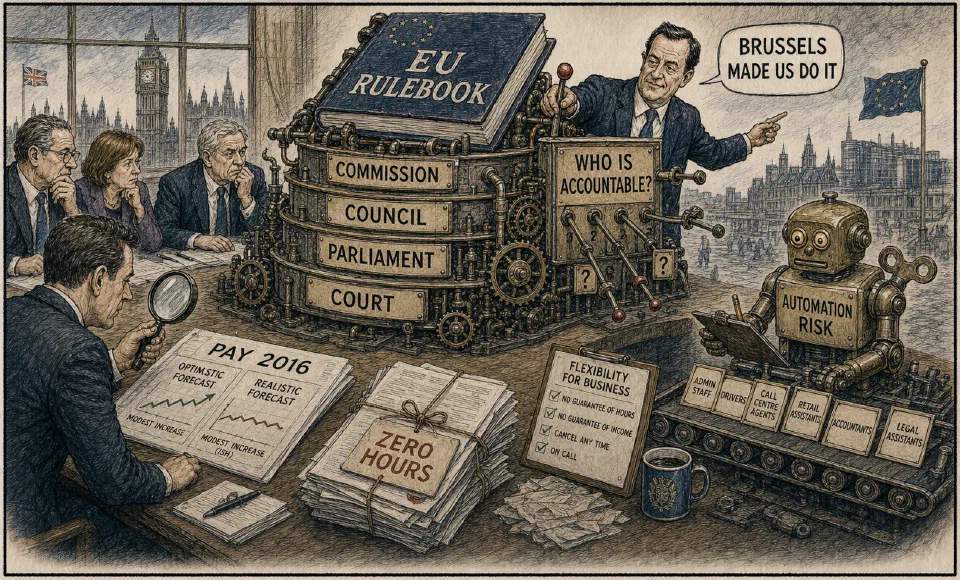
The prime minister promised a referendum on this country’s membership of the EU before the end-2017. He knows now this was a mistake. The EU is neither a capitalist conspiracy nor a socialist utopia. Over the next year (or two?) we will be bombarded by ‘facts’, half-truths and lies from both sides of the debate. It has prevented wars on the continent. Soon after its foundation, the EU changed into an economic area and later moved towards political co-operation. The reason for greater politicisation is that the members wished to create a common market to eliminate all barriers to trade. This means there is a need for every company in many countries plays by the same regulations. Politicians set the rules. The Maastricht Treaty was signed in 1992 and created the EU in its present form. Margaret Thatcher led negotiations for the UK. Like all other democratic states there is an executive body (the commission), a legislature (the council and parliament), a judiciary (European Court of Justice) and a central bank (ECB). Complaints that the EU has a ‘democratic deficit’ have some validity. The European parliament is elected every five years and the council consists of ministers from nationally elected governments. Commissioners are appointed to the only body that can draft legislation for the EU. The Commission has a strong influence on EU’s policies. This has caused critics to say the EU is run by unelected bureaucrats. ‘Brussels made us do it’ is a common explanation of politicians and public servants at home. In reality, the EU hardly ever makes member states do anything. This is not to say the EU would not benefit from reforms. The present procedures were designed for an organisation of 15 states. There are now 28, with an inefficient way of doing politics. The many layers of decision-making bring high costs and complications and avoid clarity on who’s accountable for what. Pieter Cranenbroek reckons our political leaders like things that way. The EU is top-down, at a time when the world we live in is social and bottom-up.
Pay in 2016.
The Resolution Foundation has concluded that real-time pay will be just 1% higher by December 2016. This figure is a consequence of the UK’s continuing productivity problem and low inflation for twelve months. ‘Pay growth in 2016 will ultimately be determined by whether the recent upturn in productivity is enough to offset rising inflation.’ Research by Korn Ferry Hay Group suggests ‘employer optimism’ will permit an increase in wages at 2.3%. Watch the trends. Both ‘experts’ cannot be right.
Controversial contracts.
Zero hours contracts (ZHC) often receive a bad press. However, research by the Chartered Institute of Personnel and Development (CIPD) shows they are more popular with employees than many expectations. The results indicate that 65% of people on ZHCs are either very satisfied or satisfied with their jobs, compared to 63% for all employees. Also, those on ZHCs are more likely to say they have the correct work-life balance and less inclined to feel under excessive pressure at work. The majority of workers on these contracts told the CIPD’s survey that it is their choice to work part-time. Nonetheless, 22% wish to work more hours. The findings will surprise some managers. ZHCs have been linked to work-related stress. Indeed, the government banned exclusivity clauses which had prevented employment with more than one organisation. The CIPD estimates that the number of people on ZHCs will rise to 1.3 million in 2016.
Automation by numbers
Grant Thornton, Deloitte, BBC and HR Magazine have gathered information about the impact of automation on jobs. 35% of workforces in the UK are at risk over the next twenty years. This figure includes: 99% of telephone salespeople, 98.5% of typists or keyboard-related workers and 97.6% of routine inspectors and testers. Those tasks which will change in content but remain in place are: telecommunications engineer (2.5% fewer), midwife (0.8%), nurse (0.9%), publican or manager of licensed premises (0.4%). Occupations paying less than £30,000 a year are five times more likely to be replaced than those at over £100,000. 3.5 million low risk jobs have been created since 2001. 800,000 of those in danger have been lost. Reason for all this change in forthcoming years? More accuracy and efficiency (56%), lower long-term costs (53%); greater flexibility in use of resources (49%).
Failure.
‘There is no formula for success. But there is a formula for failure, and that is trying to please everybody.’ Nicholas Ray, American film director.
Be careful.
‘Integrity without knowledge is weak and useless, and knowledge without integrity is dangerous and dreadful.’ Samuel Johnson (1709-84). English lexicographer, essayist and poet.