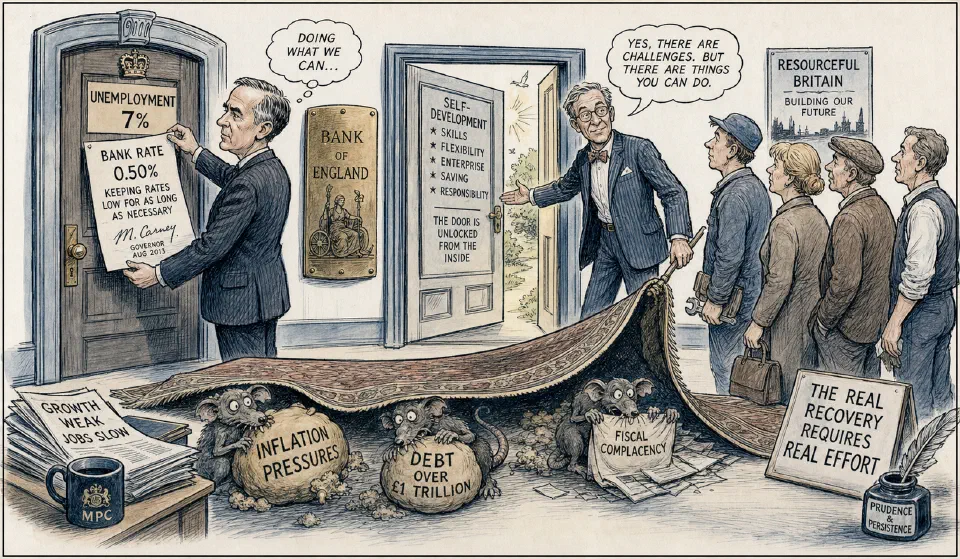
What did the new governor of the Bank of England, Mark Carney, really do in the first week of August?
His statement received a lot of coverage in the media. You will recall that before his arrival, the Bank was meant to care about inflation. If the Consumer Prices Index (CPI) was rising at more than 3%, or below 1% a year, the governor was required to give a written explanation to the chancellor, George Osborne. The intention was that CPI should stay close to 2%. Mr Carney’s actions might have been regarded fairly as pivotal if the CPI had not been above the target of 2% since 2009. Remember the Bank’s predictions on inflation have underestimated the future often. One considers the possibility that the primary function of forecasts is to justify low rates of interest. The governor formalised reality. He says interest rates will remain low until unemployment falls to at least 7%. He doubts this will happen before 2016 and even then, he will take another look at the situation.
The UK’s biggest economic problem is debt; Government’s debt, mortgages, consumer credit. And more. The politically acceptable method of reducing such a burden is to inflate it away. This can be done by making sure inflation is higher than interest rates. Maybe this is what Mr Carney was employed to do?
Out of step, losing our footing.
If British managers feel themselves to be different in kind, rather than degree, from other workers, then they are practising a form of demarcation as insidious as anything by trades unions. Equally, if a manager, because of his generalist pretensions and distaste for particulars, cannot offer leadership in the technicalities of doing a particular job, then it will be natural for employees to seek guidance elsewhere. Who more natural than the staff representative, who at least appears to be clear about what s/he is fighting for?
Observers note that within a company committed to delivery of top quality products, good employee relations fall into place almost automatically. Some British managers are often self-conscious about their job titles, regardless of what is their responsibility. Maybe we have allowed ourselves to become people processors with production as a constraint; rather than the other way round?
Employees’ personal development.
Changes in aspirations and technologies will require an adjustment: From the belief that managers can develop subordinates’ skills in interpersonal competence and accurate diagnosis of administrative situations. To the knowledge that no one can develop anyone else, except the person her/himself. This door is unlocked from the inside.
Some of the reasons are:
-
Much of what is given the name of development is the creation of people in the image of a select group of executives. The danger is clear. Today’s managerial skills for success may pave the way for tomorrow’s failure.
-
If a manager has properly encouraged subordinates, the criterion is not necessarily how many of them have succeeded. The vital issue is how many of his people have gone on to grow individuals in their groups.
-
It is not the responsibility of a manager to develop people, but to assure the climate and the opportunities for self-development.
Final note: Successful managers make effective decisions. They know this is a judgement based on dissenting opinions, rather than consensus on the facts.
Oh! costing.
‘The only mistakes that General Motors made in automation were based on the fact that they have perhaps the world’s most advanced cost accountancy. Cost accounting gives you information on the cost of doing, but not on the cost of not doing – which is increasingly the bigger cost.’ Peter Drucker
From Patrik Engellau.
‘Bureaucracy functions according to the bacteria principle. If you place bacteria in a test-tube filled with nourishment, it will expand until the nourishment is finished. The same with bureaucracy: as long as it gets funding, it expands.’