Austerity. Really?
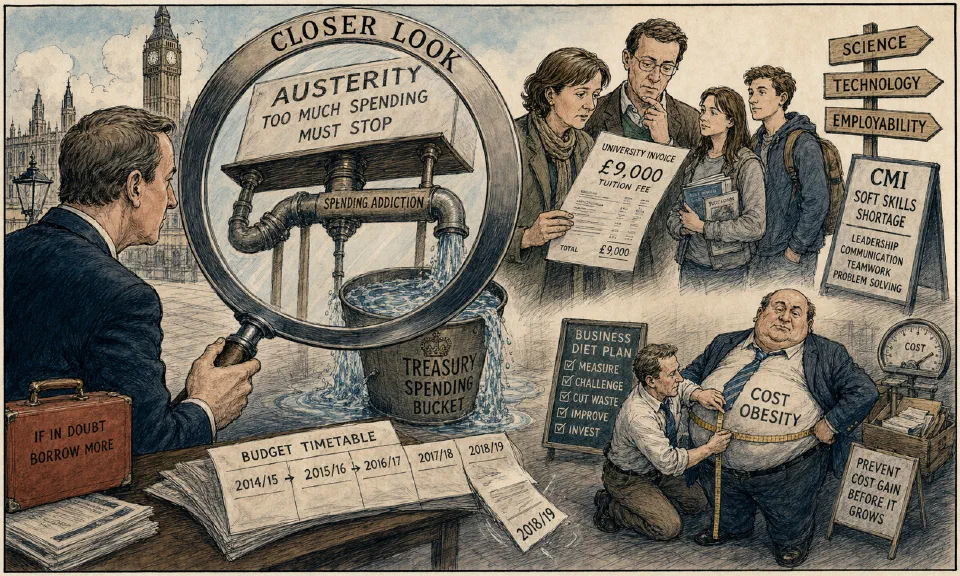
Mike Riddell on Bondvigilantes suggests ‘austerity posturing’ among this country’s politicians is ‘built on a completely phoney premise’. In reality, there has been little frugality. Comparing the UK’s budget deficit (the amount by which public outgoings exceed income from taxes) to the results in the Eurozone and America indicates that fiscal consolidation has been more pronounced elsewhere. The Europeans are running a deficit at around 3% of GDP. The United States has reduced the gap from 10% of GDP in 2009 to around 3% now. Britain’s has come back from a scary 11% to a still worrying 6% and remained thereabouts for the past two years. Riddell refers to ‘an addiction to spending’. Total expenditure by government has mounted gradually for eight years. Simultaneously, revenue from taxation has been disappointing. This year is unlikely to deliver a sharp improvement. In the first four months of 2014/15, the government has borrowed 5% more than in 2013. The timetable for eliminating the annual overspend has slipped already. The first budget surplus is expected now in 2018/19. In 2010, the prediction was 2015/16. Winning the election next year might not be such a bright idea!
Employability is the priority.
There has been a large increase in vocational training at further education colleges. Universities UK’s figures show the number of entrants from Britain into higher education in England has fallen by 21.7%. However, a closer look at the information reveals that the percentage of 18-year-olds from the lowest socio-economic groups has risen from 9.8% in 2003 to 16.9% this year. The overall decline is because of falling numbers of mature students on part-time and non-degree courses. The signs are the more people pay, the more discerning they become – especially parents. They ask, ‘What do we get from tuition fees at £9,000 a year?’ Also, there are different choices of subjects. Applications for mathematics, science and technology are up. Those for social studies, philosophy and history are down. The emphasis is on courses which enhance chances of employment. It is essential that further education responds effectively to the new challenges to that part of the system.
A dangerous shortage.
The Chartered Management Institute’s (CMI) Commission on Management and Leadership is run in collaboration with the All-Party Parliamentary Group on Management. It has unearthed a dearth of managers who can use so-called soft skills to tackle difficult situations and/or handle tricky conversations. These skills are those needed to motivate and engage people for higher productivity.
Try prevention.
Most people have learned the hard way that dieting is more difficult than putting on fat in the first place. Excess costs are overindulgence. Careful observers have realised over the years that successful businesses – by whatever measure – are devoted to constant reduction of their unit costs. It is an obsession. Top of the list.
From a professor in South America.
‘You guys, you got it all wrong. You spend your life loving your products. Why do that? Nasty, uncomfortable things with sharp corners and hard edges. Better you have something soft and warm. Better you love the customer.’
Dead on Ron.
‘There is nothing more permanent than a temporary government programme.’ President Ronald Reagan, quoted on AmericanThinker.com
Important definition.
‘Science is a belief in the ignorance of experts.’ Physicist, Richard Feynman, quoted on RefDesk.com