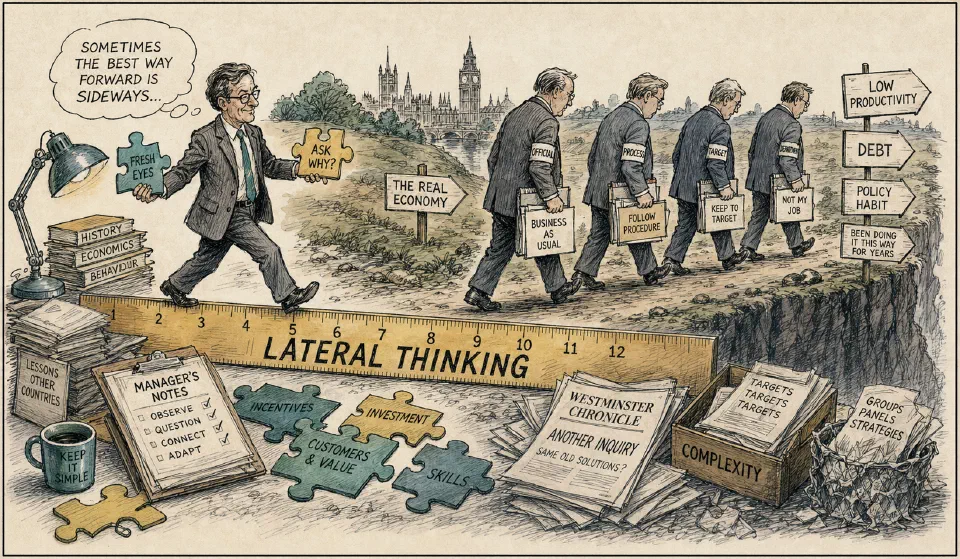
Is Mark Carney, new governor of the Bank of England, pleased with better economic news?
Possibly not. HM Treasury is his sponsor and protector. Right now a healthy economy is unlikely to be his major goal. Certainly, the government does not want financial results ‘to normalise’. This would mean higher interest rates, which would be a disaster given the size of public and private debts. The Bank’s targeted inflation is at below 2%. The emphasis has given sterling a bumpy ride and is intended to increase lending in businesses. Mr Carney’s policy of ‘forward guidance’ is really a promise to keep rates low for a lengthy period. An overtly political decision. It might keep the situation steady and afloat until the general election. The longer-term is a different kettle of fish.
We do not hear much about Britain’s baby-boom.
Allister Heath pointed in The Daily Telegraph to 729,400 babies born in the year to June, 2012. This is the biggest number for forty years. Throw in the fact of people living longer and it is clear the country is moving into what has been called a ‘demographic explosion’. The higher birth rate is good news, unless you are one of those people who say our islands are already over-populated. These injections of young and eventually economically active people could lead to prosperity and power in the developed world. For example, Germany, Japan and Russia are all set for serious declines in population. But, if we are to use this opportunity there must be facilities which will make sure the supply-side is in good shape: homes, schools, training in skills, universities through to energy and transport. The time for preparation is right now.
Marketing and employee relations.
If directors in a company are to retain the confidence of other employees – and lack of confidence is at the root of much unrest – they need a spotless marketing record, and to demonstrate the fact to everyone in the business. Then there will be a virtuous circle, in which good employee relations make marketing easier. The connection between the two activities is often not realised by managers. Is it possible that the marketing budget would often be better spent on training and motivating your own staff, from sales manager to assistant storekeeper? Like charity, marketing begins at home.
Foundations for results.
Charles F Knight was chairman of Emerson Electric in the US. In Harvard Business Review, he asserted that effectiveness is a matter of routines. Within this PFVA (planning, follow-up, values and action), Emerson held to four basic beliefs. Profitability is a state of mind: what you expect and pursue is what you get. Second, businesses fail primarily because ‘management knows what to do but, for some reason doesn’t do it’. Then, keep it simple – not as easy as it sounds. Fourth, the long-term is a number of aggregated short-terms; poor performances will almost certainly remove the chances for success over extended timescales.
Grassroots and little acorns.
‘Culture’ means so many things. Everyone is an expert. It derives from the Latin for tillage, with its connotation of careful husbandry and nurturing seeds to health. This etymology has had little resonance in many parts of working life.
You will know a few.
‘There are those that are so scrupulously afraid of doing wrong that they seldom venture to do anything.’ De Vauvenargues (1715-1747). A French essayist.