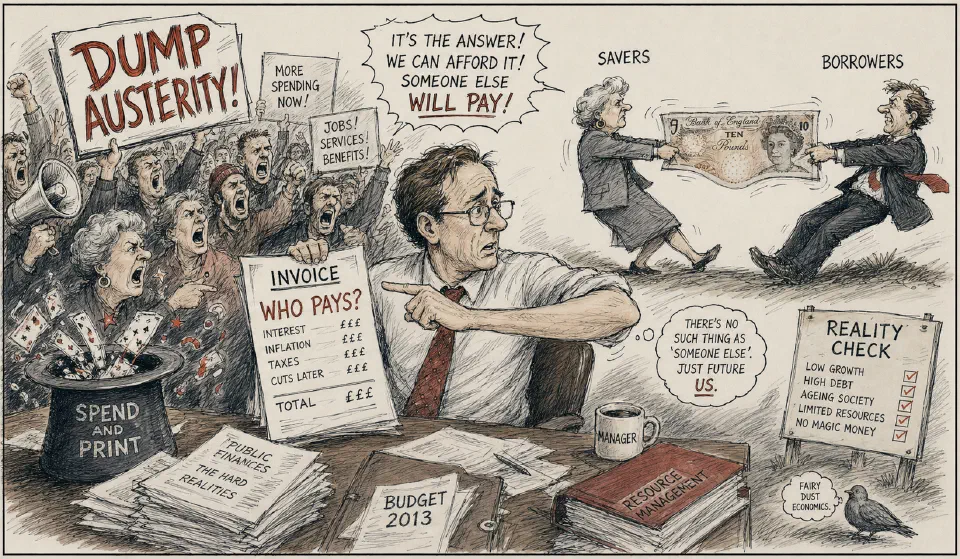
We must dump austerity in favour of growth.
This is the daily and increasingly noisy demand of fragmented groups. They suggest it is a simple choice between the two and they appear to believe that the ‘spend and print’ route can get us out of the debt crisis easily. They ignore the fact that the money will have to be repaid. The real issue is who picks up the bill? When the sophisticates talk of inflating away the liabilities, they mean that savers should feel the pain, rather than borrowers. Also, those who push for more quantitative easing are asserting that all of us must meet the financial obligations incurred by a few through lower living standards. And when there are calls for expansionary spending, the advocates mean today’s taxpayers ought to be supported at the expense of future ones. The pivotal fact is that there is not a free lunch. The rival strategies are put clearly by Guy Wolfe (The Observer); they are simply options for the allocation of costs, not magic wands of wealth creation.
The biggest purchase you will ever make is not a house.
Not even a car or food or clothing. The largest demand you will get is from government in its various forms. The cost to an average worker is forty-six pounds in every £100 earned by her/him. In France and Germany, the charges of government are higher still. It is clear that a government’s natural behaviour is to grow. An electorate is meant to keep the inclination in check. Is the western economic model broken? Britain, America and lots of Europe’s governments have spent so much money that countries face bankruptcy.
The biggest cause of marketing failure is lack of accurate information.
And it is seldom the facts are unavailable. Rather, for whatever reason, managers do not wish to find them. Indeed, missing facts not only contribute to a demise, they hide its imminence and sometimes its presence. Managers tend to defend the marketing status quo with might and main, even though the one unchanging characteristic of the markets is that they change. Suggest that a little market research would not come amiss and all too often one is met with irrelevant appeals to long, arduous years of experience in the trade and with grumpy observations that dubious assumptions are ‘obvious’. In short, with refusal to contemplate the painful process of thinking and acting anew.
Businesses run on money and people.
There has to be a proper balance between saving costs and generating revenues. Jobs exist because employers believe their performance will bring substantially more profit than the associated outgoings. Thus, it is right always to eliminate those activities which do not satisfy this criterion. But it is suicidal to delay filling those posts which do pass the test.
Giving somebody else the authority to do something is all very well.
BUT, there are times when delegation is plainly wrong: Crisis – you have to be out in front and visible; People – don’t shirk the nasty job of a reprimand or dismissal; Sudden change – if you are altering things, be on call to explain anything to anybody; Major decisions – you must make them. The choice between two business strategies is not for delegation; Ceremonies – your absence at crucial moments can be seen as a deliberate insult.
Makes you think.
‘Man’s capacity for justice makes democracy possible: but man’s inclination to injustice makes democracy necessary.’ Reinhold Niebuhr. 1892-1971