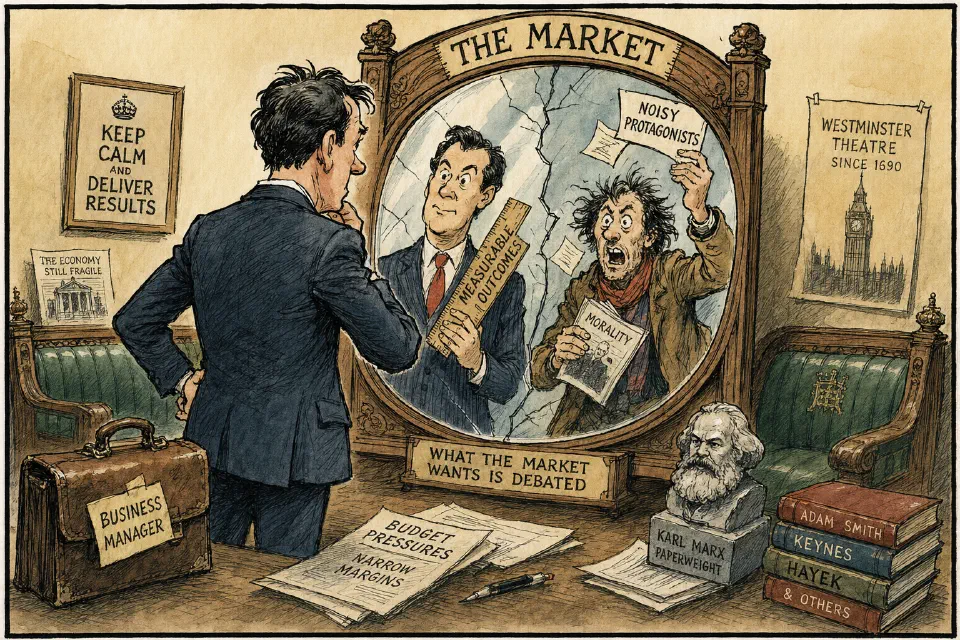
The exploration of the market and its forces is attracting attention and noisy protagonists.
Managers must take part in the arguments and defend the need for their contribution. Not so long ago, The New Yorker, hardly a manual for leftists, chose Karl Marx as the thinker of the next decade. A market’s morality has two primary components. The first is an obligation to deliver measurable outcomes, founded on the premise that pursuit of enlightened self-interest leads to the betterment of society. The second conviction is that a system built on property, contracts and initiative protects against arbitrary power of the state. There will be a backlash if the market is seen as having failed on either results or restraint. That is, a return to greater intervention and control. Anyway, what will be the new job of government? After all, there is no dynamic market without a government to define rules and context. The state insists it accepts the disciplines of markets and is reluctant to be producer, controller and intervener. It becomes the referee, setting the rules of the game to assure competition and opportunity. This leaves our political masters with a daunting challenge. They have to decide ways for reducing and redirecting intervention whilst fulfilling their responsibilities and preserving the electorate’s trust. It means redesigning the welfare state so that it is a safety net and securing the skills to cope with global competition. Public policy and politics are one thing. But imagination will be tested to breaking point and is in short supply.
Managers like to congratulate themselves by declaring we face unprecedented difficulties
There is a temptation to advocate all kinds of compelling, novel and heroic deeds. Your scribe suspects our jobs today are not radically different from ten years ago. Of course, there is stiffer competition, global marketplaces and faster change. But the task remains the same. Managers have to steer their companies along often-uncharted routes into an unknowable future. They must make sure their businesses perform at least as well as their competitors do. This means not only serving customers and satisfying owners, but also keeping employees happy. And the hard fact is that there can be serious conflicts between these groups. There are tough decisions to be made sometimes. Managers find themselves in a troubling paradox. At the moment we need to shape keen, agile and low-cost organisations – with the consequential redefinition of relationships with employees – we seek also unprecedented participation, creativity and loyalty from the same people. That is, those attributes which are likely to thrive best in an atmosphere of mutual commitment and trust. These are real issues. They will not go away. We cannot return to the producer-driven economy of the 60s and 70s. There are no simple answers.
Every business has at least one high-flyer
S/he might be a creative hot-shot, a star salesperson, a brilliant project manager or an outstanding strategist. They can use their skills to increase a company’s performance. These productive people tend to be: imaginative, self-assured, confident; liked by customers; able to generate energy in others; driven to excel; supported by a small, motivated and loyal group. They are just the types for start-ups, finding new products, or sustaining the pace in fast-growing firms. But … but … but. High-flyers can be trouble. They: often have over-sized egos and are rude, arrogant, condescending, overbearing, sensitive, temperamental; can alienate their colleagues, disrupt meetings, cause friction; might not make much effort to fit in: attitude, dress, time; are difficult, even impossible, to manage. Some superstars dislike managers; have qualities which fit well in one context but not elsewhere. Managers have to face the issues. How far can high-flyers be indulged before they adversely affect morale and performance? Is their talent worth the grief? If they are worth it and good, shield them from the rest of the organisation. If headaches consistently exceed returns, get rid of them.
From Harold Geneen
born in Bournemouth and retired from the job of chief executive at International Telephone and Telegraph (ITT), a dominant company in America. ‘It is an immutable law in business that words are words, explanations are explanations, promises are promises – but only performance is reality’.
So it’s obvious. Innit
A conference on 3 May by the British Academy of Management: ‘Multiple Perspectives and Multiple Methods in Researching Leadership – In Pursuit of Fruitful Pluralism’.