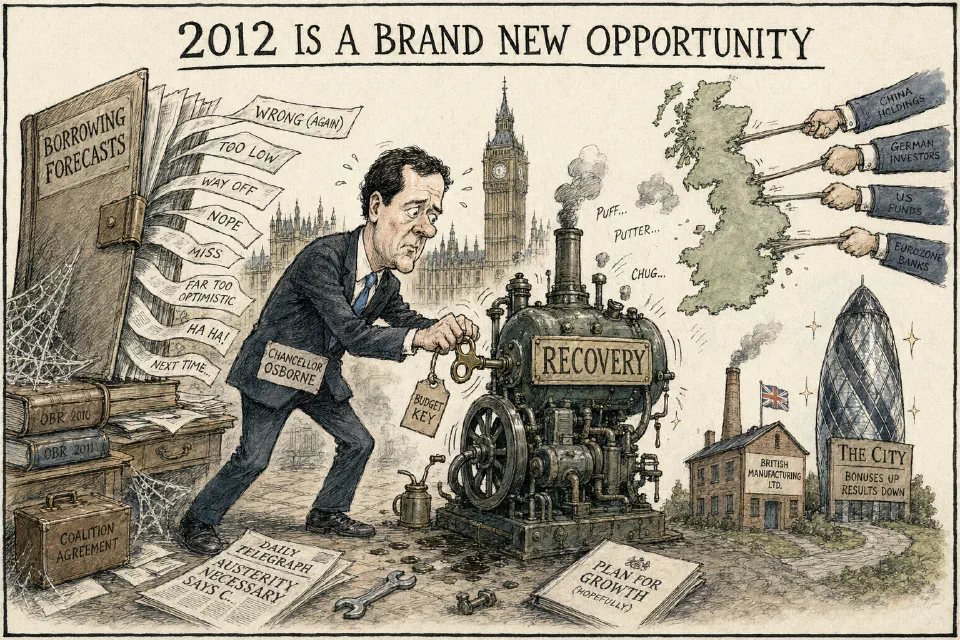
Hopes that George Osborne can accelerate an economic recovery are almost certainly ill-founded.
Even economists have realised after years of pain that chancellors’ attempts to manipulate the economic cycle often add to instability rather than reduce it. Nor should we believe that the budget will raise gross domestic product in the long-term by stimulating education and research and development. The evidence that governments can promote sustainable growth from fiscal measures is scarce, as are indications that they can dampen economic fluctuations in the short-run. And official forecasts of the government’s borrowings are tragically unreliable. The average error in predictions for the following year is over £10 billion.
Patrick Hosking and MoneyWeek posed the question ‘Who owns Britain?’
The Office for National Statistics examines the registers of many British firms to make an ‘informed guess’ at who owns quoted shares worth around £1.48 trillion. One quick answer is, ‘Certainly not local people’. When official calculations began in 1963, individuals owned 54 per cent of all the securities listed on the London Stock Exchange. This figure has dropped to 14 per cent. There is still exposure through pension funds (16 per cent), insurance companies (17 per cent) and unit/investment trusts (9 per cent). However, these numbers have fallen over recent years as we have invested heavily in shares overseas. And foreigners have been major purchasers of this country’s publicly-quoted firms and now own 33 per cent of UK plc. Does this matter? Hosking reckons it does. ‘Companies need to be answerable to elected governments, domestic regulators and public opinion. The more geographically dispersed their shareholders, the less pressure is brought to bear.’
Andy Grove is the founder and chairman of Intel and made an important reflection in Businessweek.
‘Our fundamental economic beliefs, which we have elevated from a conviction based on observation to a unquestioned truism, is that the free market is the best of all economic systems – the freer, the better. Our generation has seen the decisive victory of free-market principles over planned economies. So we stick with this belief largely oblivious to emerging evidence that while free markets beat planned economies, there may be room for a modification that is even better.’ This initial conclusion opens an essential debate.
The Chinese People’s Daily says Confucianism has helped East Asia to modernise rapidly.
The west is in crisis because of ‘an irreconcilable conflict: that between science and Christianity.’ You will recall that Max Weber caused a stir when he attributed economic growth to Protestantism. He suggested that Roman Catholicism was anti-enterprise. The People’s Daily has reported on a meeting of the International Confucian Association. It was chaired by Lee Kuan Yew, the former prime minister of Singapore. Confucianism – over 2,550 years old – is in tune with the 21st century and ‘will replace modern and contemporary Western culture’ says the newspaper. An understanding of the beliefs, themes and related processes are a crucial tool for an international manager.
Bear in mind.
‘Britain’s manufacturing exports are worth six times as much as financial services exports.’ Prospect, Manufacturing Survey.